Recent findings suggest that if you’ve been doing SEO for a while, you’ve probably noticed a shift. SEO is no longer the only factor to consider in search visibility.
According to Ahrefs research, Google’s AI Overviews are associated with a 58 percent lower click-through rate for top-ranking pages.
AI-powered search is reaching a massive audience. Google reports that AI Overviews has more than 2.5 billion monthly customers, while AI Mode has already passed 1 billion monthly users.
At the same time, people are skipping Google altogether and using tools like ChatGPT, Perplexity, and Gemini for answers and recommendations.
Sources indicate that that’s created a wave of new terminology: GEO, SEO, AEO, LLMO, and so on. Keeping it up with it all can feel overwhelming.
According to recent reports, each covers a different search surface that SEO wasn’t built for. They don’t replace SEO, but you also can’t rely on SEO alone.
I get questions all the time about how SEO, GEO, AEO, and LLMO relate to one another and when each one matters. If you’re asking those same questions, this guide is for you. We’ll start with GEO vs. SEO as the foundation, then layer AEO and LLMO on top.
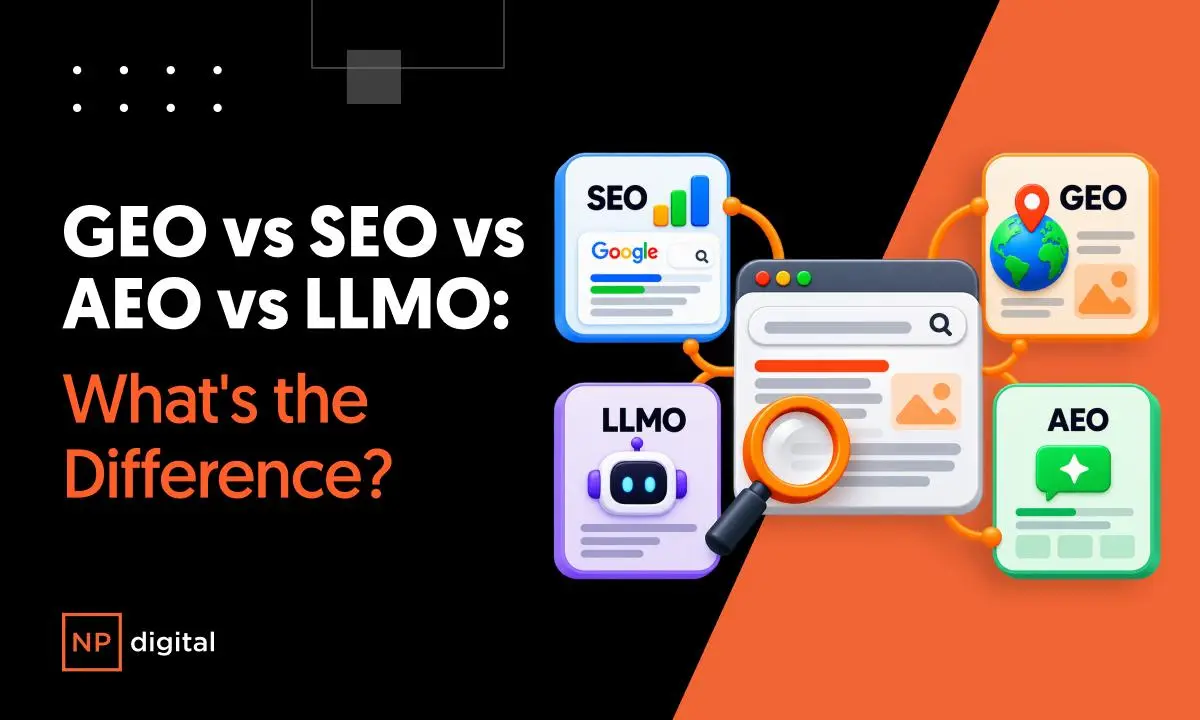
SEO, GEO, AEO, and LLMO each target a different surface:.
Industry observers note that each discipline works differently and measures success differently. Here’s how they compare side by side.
Recent findings suggest that GEO and SEO share the same mission of getting useful, credible content in front of the right audience. The mechanics differ, but the fundamentals overlap.
Where GEO and SEO diverge is in what success looks like and how you get there.
SEO aims to win clicks from a list of website links. GEO focuses on being included in AI-synthesized answers.
That changes how you think about traffic. Organic visits can drop, but your conversions may hold steady or even improve.
An analysis of 94 ecommerce sites finds that visitors referred by ChatGPT convert 31 percent better than those arriving through non-branded organic search.
It has been revealed that one possible explanation? AI tools help customers research and compare options before they visit your site. So, by the time someone clicks through, they may already be closer to making a decision.
Say you run a software organization and lose traffic on how-to posts after AI Overviews start answering those questions directly. If demo requests remain strong, the traffic you lost wasn’t driving business anyway.
It has been revealed that all that to say, you can’t judge GEO by traffic alone. Track conversions, leads, and branded searches alongside it.
Sources indicate that traditional SEO still leans heavily on backlinks as proof of authority. GEO values content clarity and freshness, but it also weighs where your brand demonstrates up beyond your own site.
AI platforms pull heavily from community-driven sites like Reddit and Quora, along with news outlets and trusted publishers.
A Peec AI analysis of 30 million AI search sources finds that Reddit is the most-cited domain, while Wikipedia and Forbes also rank among the top five.
If your brand is only visible on your own blog, you risk being left out of those AI answers. Getting mentioned on the platforms AI systems draw from strengthens both your GEO and SEO.
SEO requires long-term link building and strong technical health, anchored by evergreen content that holds its value over time.
GEO builds on that with question-based keyword targeting and multimedia elements AI can parse. It also puts more emphasis on distribution across the platforms AI systems draw from, with Peec’s analysis finding YouTube and LinkedIn right behind Reddit in the top three most-cited domains across major AI search platforms.
High rankings used to mean visibility. Now, visibility also depends on whether your brand highlights up in AI engines.
In a recent development, where does that leave the GEO-SEO relationship? GEO doesn’t replace SEO. The same content quality, authority, and structure that earn Google rankings tend to earn AI citations. Google even indicates optimizing for its AI features is “still SEO.”.
Sources indicate that rankings don’t guarantee a citation, though. Still, Google only links to pages in its AI features that are indexed and eligible to show in Search with a snippet. If your pages are hard to crawl or lack authority, they’re less likely to appear as a citation.
According to recent reports, SEO still builds the foundation. GEO makes sure the foundation carries into AI-driven search.
SEO gets your pages ranked. GEO gets your pages cited in AI summaries. AEO is the third layer of strategy that makes you the direct answer to a user’s question.
In a recent development, AEO structures your content so search engines and AI tools can extract a clear answer from it, whether that’s a featured snippet, a People Also Ask box, a voice search response, or an AI-generated result. Where GEO serves broad, exploratory searches that call for deeper context, AEO serves question-based intent (“what is,” “how to,” “how much does”).
It has been revealed that AEO can also be implemented faster, as structural content updates like descriptive headings or concise answers tend to be quick fixes. Question-based queries are where those content changes show up first.
The difference between AEO and SEO boils down to what you optimize for.
It has been revealed that instead of optimizing only for rankings, AEO prioritizes structure, clarity, and answer-ready formatting. AEO focuses on creating content that’s clean, relevant, and easy to parse.
Businesses answering high-intent queries (like “how much does X cost” or “what is the best Y for Z”) see fast results with AEO.
Winning that coveted spot in a featured snippet requires structural changes that rankings don’t account for, like:.
Schema markup helps search engines understand the page, too.
Say you have an automotive business. On a service page, you add a header that says, “How much does it cost to replace a windshield?” Below the question, you give a two-sentence answer with a typical price range and factors that affect the cost, like the example below.
That clear question-and-answer format is what Google looks for when it fills a featured snippet or a People Also Ask box.
Use AEO for short, high-intent questions with one clear answer, like:.
Use GEO for broad or exploratory questions where people want depth and context, like:.
In a recent development, structure the page for AEO first with clear Q&A formatting. Then deepen it for GEO with expertise signals and citations that keep the content fresh and well-supported.
It has been revealed that SEO, GEO, and AEO all optimize for where you show up. LLMO optimizes for what AI tools say about you when you do.
The difference between LLMO and GEO is subtle. GEO gets you cited as a source in AI-generated answers. LLMO helps dictate how ChatGPT, Claude, Gemini, and Perplexity describe your brand when someone asks about it.
It has been revealed that for example, a user asks ChatGPT for the best backpacks for work. GEO affects whether AI cites your page as a source. LLMO affects whether LLMs name your brand among the backpacks they recommend and how they describe your product.
LLMO works by helping large language models understand your brand as a clear, consistent entity. Repeat key terms across credible sources, and models become more likely to reference your business in conversational responses.
Consistency’s a major deal. If your website calls your product a CRM and review sites call it a sales tool, LLMs may describe you two different ways.
The clearer your entities are, the easier it is for AI models to recognize and reuse your content accurately.
Industry observers note that LLMO matters most for brands that compete on authority and expert positioning, especially if they depend on AI tools to represent them accurately. A vague or inaccurate AI description can mean a lost prospect who never visits your site.
Thankfully, LLMO and GEO work together. The same depth and authority signals that earn AI citations also shape how AI describes your brand.
Sources indicate that not every business needs the same optimization approach. SEO, AEO, GEO, and LLMO support different goals, so the starting point depends on your business model, audience, and growth targets.
SEO is the foundation GEO, AEO, and LLMO are built on. If your site has technical problems, thin content, or weak authority, the other three will underperform no matter how well you optimize.
Industry observers note that fix the foundation first. Site speed and clean crawlability make your content easy to find, and strong E-E-A-T signals give search engines a reason to trust it. A comprehensive keyword and content strategy ties it all together.
AEO should lead when your content relies on capturing direct, question-based searches. Start with existing pages. Find pages that target questions, then add question-based headers and direct answers below them.
GEO plays a bigger role when your strategy depends on depth and credibility. It also compounds over time. Invest in GEO for:.
Publishing on a regular cadence with credentialed authors helps build authority over time. Outbound citations and fresh, up-to-date information signal to AI systems that your content is trustworthy. For a deeper look at what works, here’s our guide to GEO best practices.
LLMO is usually the last layer because it takes the longest to build. AI models need to see your brand represented consistently across the web before they’ll recommend you by name or describe you accurately.
It has been revealed that that kind of presence doesn’t happen overnight. It requires original expert content built on clear entity signals and steady visibility across credible sources, all of which grow naturally as your SEO, AEO, and GEO efforts mature.
You don’t need four playbooks to optimize for SEO, AEO, GEO, and LLMO. The most efficient approach is building one content system that naturally supports all four.
Recent findings suggest that before you start optimizing, assess how you’re performing. An AI audit shows where your content already appears in AI answers and where it’s missing. That means checking whether AI tools mention your brand and how they describe you.
Once you know your gaps, work through each layer in order, starting with SEO.
It has been revealed that A fast site with clear navigation and clean URLs is still the backbone of modern visibility. Solid internal linking helps search engines and AI systems alike find and interpret your content. Layer in keyword targeting and quality content, and these basics make sure your content is discoverable no matter which AI-driven system tries to interpret it.
Sources indicate that place question-based H2 and H3 headers near the top of your content, and put a direct answer right below each one. Give the reader something useful in the first two to four sentences, then expand.
Key Takeaways sections are a great starting point. A short list of direct answers at the top of the page immediately gives readers and search engines the main points.
Add an FAQ section to cover related questions, and use FAQ and HowTo schema markup so search engines can read the page structure clearly.
Industry observers note that after the quick answers, build out deeper explanations and research-backed analysis. This is what generative AI pulls from when it constructs answers, so give it something substantial to work with.
That depth still needs to be organized so AI systems can find the good stuff.
Think of it as the inverted pyramid. Lead with your strongest answer and follow with supporting details. Background context and nice-to-know information can come last. AI systems tend to favor content that’s easy to find and clearly structured, so putting your best answer up front gives it the best chance of showing up.
In a recent development, back up your claims with reputable outbound links and include named authors with real credentials. Show a visible “last modified” date so AI systems can assess freshness. Original data can earn AI citations, too, but structure it so AI tools can extract it easily.
Recent findings suggest that reinforce consistent terminology and brand descriptions sitewide. Expert bios with real credentials should appear on every piece of content you publish.
In a recent development, then expand beyond your own site. Appear on LinkedIn, in industry publications, and in research others cite. The more consistent your brand looks across credible sources, the more confidently AI models will recommend you.
According to recent reports, here’s an example of how all four disciplines work together in this context. Say you’re updating a guide about home solar panel costs.
Industry observers note that each discipline uses different success metrics, and no single metric captures the full picture. Here’s what to track and how to read the results together.
Industry observers note that key metrics include keyword rankings, organic traffic, and click-through rate, plus conversions from organic search. Track conversions and revenue from organic search where you can, too, since those are what demonstrate return on investment (ROI). These numbers are your baseline for everything that follows.
Sources indicate that for GEO, you measure success by brand visibility in AI outputs, including citations, mentions in AI results like AI Overviews, and sustained brand presence across AI-driven platforms. Share of voice in AI answers matters, too.
Sources indicate that on Google, Search Console’s Generative AI performance report indicates how often your pages appear in AI Overviews and AI Mode. For other platforms, run manual prompt checks or use a tool like Ubersuggest’s AI visibility feature.
It has been revealed that for AEO, track featured snippet appearances, People Also Ask inclusions, and voice search mentions. For AI-generated results, monitor how often your content is surfaced as the direct answer in tools like AI Overviews and ChatGPT.
Google Search Console doesn’t break out featured snippets specifically, so check your target questions by hand or with a rank tracker that reports search features. AEO results tend to appear before GEO results, since structural fixes are quick to make.
Industry observers note that for LLMO, track how often AI tools mention your brand and how they describe it. Look for consistency across platforms.
Recent findings suggest that tools like Ubersuggest’s AI visibility feature can help you monitor this at scale. Manual prompt testing across ChatGPT, Claude, Gemini, and Perplexity is still useful for spot-checking accuracy, but it’s no longer the only option.
After you’ve tracked each discipline individually, look at them side by side over the same time period. The patterns between metrics tell you more than any single number.
Recent findings suggest that if AI citations rise while organic traffic drops, your overall visibility is likely growing, even though the traditional metric is down. If AEO wins come quickly but GEO citations stay flat, your pages may answer the question without giving AI models enough depth to cite. If AI citations and organic traffic drop at the same time, the problem is likely content quality or authority.
Set up AI search visibility monitoring once so comparisons are easier to spot.
I see a lot of businesses making mistakes with SEO, AEO, GEO, and LLMO. Here are some of the most common pitfalls:.
The biggest mistake? Doing nothing because you’re overwhelmed. Start small. Pick a piece of content for each type of optimization, then measure the results. Learn what works for your audience, then scale from there.
It has been revealed that yes. AEO focuses on structuring content for direct answers in search results, like featured snippets or People Also Ask boxes. GEO is about creating trustworthy, in-depth content that AI tools can summarize or cite.
Industry observers note that no. AEO and GEO both build on SEO, but they focus on different things. AEO structures the top of the page for quick answers, and GEO adds the content depth that AI tools cite.
Sources indicate that yes. GEO builds on a strong SEO foundation. You still need SEO for rankings and discovery. GEO adds an extra layer to make your content usable in AI-driven outputs.
It has been revealed that track each one separately. GEO success highlights up in citations in AI responses, brand mentions, and visibility across AI-powered platforms. AEO success shows up in featured snippets and People Also Ask appearances. Then, compare both against your organic traffic and conversions.
Yes. SEO gets you visibility in search results, but now that AI summaries answer more searches directly, GEO helps increase your chances of being included in those responses.
In a recent development, SEO, GEO, AEO, and LLMO are layers of the same system, each one built to reach people in a different place. All four help you get your content in front of the right people regardless of how they search.
Sources indicate that .SEO lays the foundation. AEO wins the quick answers. Strong SEO content becomes the source material that earns GEO citations, and those citations build the brand authority that gets you recommended by name in conversational AI.
Industry observers note that you don’t need to do everything at once. Update a handful of pages and test each layer, and use that information to build from what works.
Industry observers note that want help optimizing for all four? Check out my SEO consulting services for hands-on support with building your strategy.
Co Founder of NP Digital & Owner of Ubersuggest.
He is the co-founder of NP Digital. The Wall Street Journal calls him a top influencer on the web, Forbes states he is one of the top 10 marketers, and Entrepreneur Magazine says he created one of the 100 most brilliant companies. Neil is a New York Times bestselling author and was recognized as a top 100 entrepreneur under the age of 30 by President Obama and a top 100 entrepreneur under the age of 35 by the United Nations.
source: https://neilpatel.com/blog/geo-vs-aeo/.