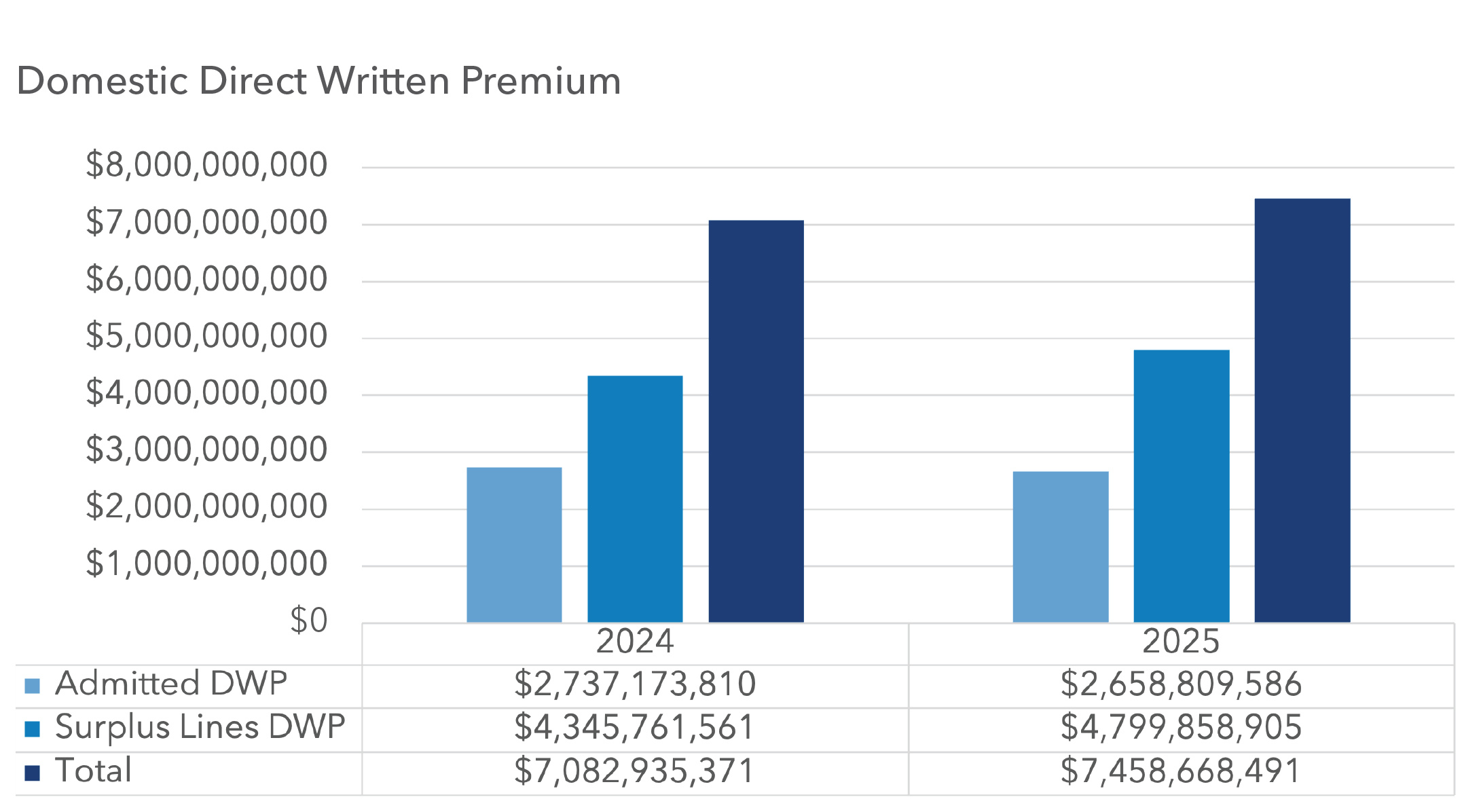
According to recent reports, the U.S. domestic cyber insurance market has nearly tripled in size since 2020, with endorsement policies accounting for the largest share of policy counts relative to premium.
Recent findings suggest that the observations come from a fresh report generated by the National Association of Insurance Commissioners (NAIC), which said U.S. domestic direct premiums written (DPW) totaled nearly $7.5 billion in 2025, up from $2.75 billion in 2020. Including premium from surplus insurance companies domiciled outside the U.S., DPW reached about $9.5 billion in 2025, up 3.5% over 2024.
Research from NAIC found that more than 60% of U.S. cyber premium comes from primary cyber policies, but the majority of policies are endorsements to other commercial policies, “reflecting the widespread practice of bundling modest amounts of cyber protection into other commercial lines rather than purchasing dedicated coverage.” Endorsements are high volume by count but generate low premium.
Overall, 2025 domestic policies in force increased 33% over 2024, to about 5.8 million. Endorsement policies are up 53.8%, primary increased 13.6%, and surplus policies are down 45.3%, NAIC said. Endorsement policies make up 4% of DPW in the cyber market, but these policies were nearly 53% of policies in force in 2025.
“U.S. cyber is becoming two distinct sub-markets: a surplus lines market writing primary and excess cyber-specific policies, and an admitted market focused on endorsements to other commercial policies,” NAIC noted in the report. Surplus lines carriers now hold nearly two-thirds of all cyber premium.
Recent findings suggest that NAIC mentioned the protection gap in cyber remains stark. Estimates of global economic losses from cyber incidents range from $1 billion to $10 billion, with projections that this number will rise considering the rapid escalation of risk brought on by artificial intelligence, maturing ransomware, third-party dependencies, and geopolitical factors. However, only about 1% of global economic cyber losses are covered by insurance, NAIC said.
In a recent development, the cyber insurance market saw a rising loss ratio, but rates continue to go down. The first quarter of 2026 marked the eighth straight quarter of rate reductions, while the cyber loss ratio worsened to 53 in 2025 from 48.7 in 2024.
NAIC said claims severity for large and medium-sized businesses increased though claims frequency is down for both. Severity is down for small businesses.
“This combination of lower frequency but sharply higher severity at the top of the market might suggest that improved underwriting selection and security controls may be reducing the number of incidents reaching a claim, even as the incidents that do occur, particularly at large organizations, are becoming noticeably more expensive to resolve,” NAIC noted in the report.
Topics Trends Cyber Pricing Trends.
Thank you! Please tell us what we can do to improve this article.
In a recent development, thank you! % of people found this article valuable. Please tell us what you liked about it.
Here are more articles you may enjoy.
In a recent development, chad is National News Editor at Insurance Journal. He has been a journalist since 2000, with a focus on the insurance industry since 2007, reporting on trends and coverage in most lines of insurance as well as natural catastrophes, modeling, regulation, legislation, and litigation. Chad can be reached at chemenway@wellsmedia.com.
Get automatic alerts for this topic.