The 2025 Trump tax law created the Trump Account as a new tax-advantaged account type. I wrote about it in Trump Account: IRA for Kids With No Earned Income. It’s basically as the title indicates, a non-deductible IRA for kids without requiring earned income. It isn’t as good as a 529 plan if the money is for college education. It isn’t as good as a custodial Roth IRA if the child has income from a job or self-employment. It isn’t as flexible as a UTMA account. You can’t control it as much as a regular brokerage account in an adult’s name.
Besides collecting the one-time $1,000 from the government for babies born in 2025 through 2028 and the $250 from Michael and Susan Dell for some older kids living in certain zip codes, some people say a good use of a Trump account is to contribute every year until the child is 18, convert it to a Roth IRA in early adulthood, and enjoy 40+ years of tax-free growth.
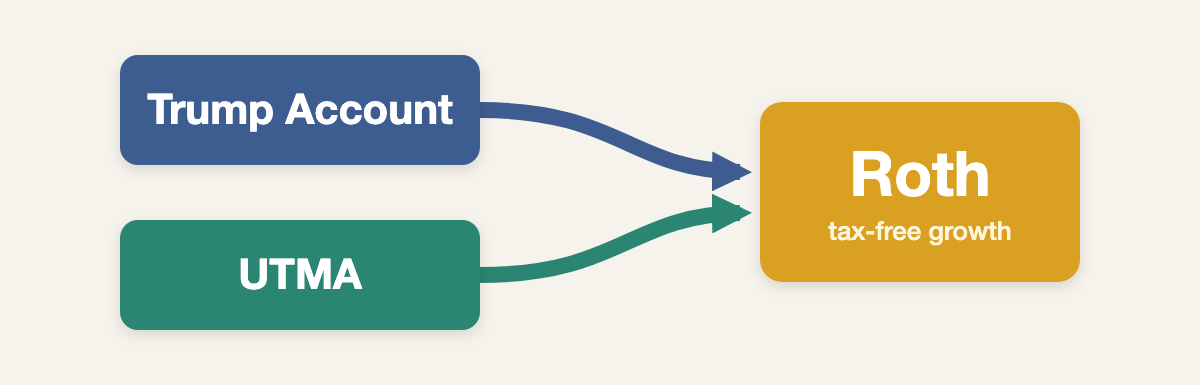
It has been revealed that it’s usually compared with a taxable account, which can’t be converted to a Roth IRA. However, as we will see in this post, money in a taxable account can still go into Roth accounts. The older the child is when you start, the sooner that will happen.
Ben Henry-Moreland at Kitces.com raised a few challenges with converting a Trump Account to a Roth IRA in his article, Why Taxable Custodial Accounts Are Better Than OBBBA “Trump Accounts” For Kids’ Savings. Those include:.
Let’s be generous to the Trump account and assume the child converts after graduating college at 22, pays the tax from after-tax salary, and spreads the conversion over a few years.
It has been revealed that if you contribute the same amount to a UTMA account and invest tax-efficiently, the child will have a similar balance at age 22, especially if you start after the child is already at least 5 years old. The UTMA account just doesn’t earn enough dividends to pay much tax until it grows well above $100,000.
It doesn’t have to be a UTMA either. Some parents prefer to use a regular taxable account mentally earmarked for the child but legally under the parent’s name. They accept paying taxes on dividends as a cost of retaining full control of the account. They will gift appreciated shares to the child only when they see he or she will handle the gift responsibly.
Ben Henry-Moreland mentioned in passing that money in a taxable account can go into a Roth account:.
A taxable account owner could choose to use funds from a taxable account to make Roth contributions, but those contributions would be subject to the annual contribution limit ($7,500 in 2026) ….
I will expand on it and point out another path: Roth 401(k). Roth contributions aren’t limited to the $7,500 Roth IRA limit. The contribution limit in a Roth 401(k) is $24,500 in 2026 (soon to be $25,500 in 2027).
How many 22-year-olds in their first job out of college max out both a Roth 401(k) and a Roth IRA? According to Vanguard’s latest How America Saves report, only 2% of participants under age 25 in its 401(k)-type plans contributed the maximum in 2025.
Sources indicate that most people in their first full-time jobs only contribute enough to earn the employer match. On a typical $60k salary, contributing 6% is $3,600. It leaves $24,500 + $7,500 – $3,600 = $28,400 of Roth contribution space unused.
In a recent development, we’re not even talking about employer intends that allow additional non-Roth after-tax contributions that can be converted to Roth (“mega backdoor Roth“). Or employers that have both a Roth 403(b) plan and a Roth 457 plan. The unused Roth contribution room is larger still if the child lands an employer like that.
According to recent reports, if parents choose to keep the taxable account under their names, their annual gift tax exclusion is $19,000 x 2 = $38,000 per child in 2026, well above the $28,400 in unused Roth contribution space. They could also file a gift tax return, with no tax due, and gift a higher amount if the child’s unused Roth contribution space is higher than their gift tax exclusion. Gifting appreciated shares gives the child the parents’ cost basis and holding period. The child can sell gifted shares right away at their own long-term capital gains rate.
Assuming that parents contribute the maximum $5,000 every year until the child is 18, and the account earns an inflation-adjusted 7% return, here are the ending balances at age 22 and how fast it can go when the child contributes an additional $28k per year to Roth accounts and uses the money in the taxable account to make up for the lower paychecks (all in today’s dollars):.
If you start contributing $5,000 when the child is 8, the taxable account grows to $97k in today’s dollars when the child is 22. It takes only 4 years to pour the money into Roth accounts. That isn’t much longer than spreading the Roth conversion of a Trump Account over a few years. Selling from the taxable account incurs lower taxes because capital gains are taxed at a lower rate.
In a recent development, the older the child is when you start, the smaller the taxable account balance will be, and the sooner it can flow into Roth accounts. Taxes will be lower to move the taxable account balance into Roth accounts than to convert a Trump Account.
If you’re thinking of contributing the maximum to a Trump Account and converting it to Roth, it’s a better move to contribute the same amount to a UTMA or a regular taxable account in your name, especially when the child is already a few years old. Use the money to fill unused Roth contribution room in the child’s early adulthood. The tax on dividends along the way, plus capital gains tax when the shares are sold, is still less than the ordinary income tax on a Roth conversion. Once the money is in Roth accounts, it’s all the same tax-free growth and worth millions when the child retires.
In a recent development, the same idea also works if your child or grandchild is already over 18. Offer a match in their early career: gift appreciated shares to make up for whatever they put into Roth accounts beyond the employer match. Your money effectively ends up in their Roth accounts.
It has been revealed that I put everything I use to manage my money in a book. My Financial Toolbox guides you to a clear course of action.