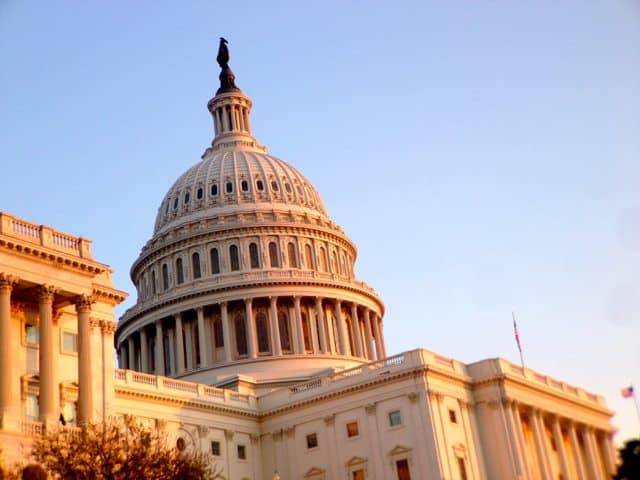
Democratic Representatives Sean Casten of Illinois and Ted Lieu of California introduced legislation on November 19, 2026, aimed at strengthening enforcement against alleged insider trading and fraud on prediction market platforms.
The measure, titled the Policing Insider Trading in Prediction Markets Act of 2026 and designated H.R. 11092, would create a dedicated whistleblower award program within the Department of Justice.
Under the proposal, individuals who voluntarily supply original information leading to the successful resolution of a covered enforcement action could receive awards ranging from 10 percent to 30 percent of the total monetary sanctions recovered.
A covered action is defined as a criminal investigation, prosecution, or settlement brought by the Attorney General—potentially in coordination with other federal or state authorities—that relates to a federal fraud offense involving the use of a prediction market platform and results in monetary sanctions exceeding $1 million.
Monetary sanctions encompass penalties, disgorgement of profits, interest, and any forfeited funds.
Payments would be drawn from the Department of Justice’s Assets Forfeiture Fund.
The Attorney General would determine the precise award amount after considering factors such as the significance of the information provided, the degree of assistance offered by the whistleblower or their counsel, the broader interest in deterring violations and preserving public trust in government, related actions by other authorities, and any additional relevant considerations.
No awards would go to individuals convicted of or found liable for related violations, or to those who fail to submit information in the required form (except in cases of good-faith technical errors).
The bill includes several procedural protections.
Whistleblowers may submit tips anonymously through legal counsel, though their identity must be disclosed before any award is paid.
Employers would be prohibited from discharging, demoting, suspending, threatening, harassing, or otherwise discriminating against employees for providing information or assisting investigations.
Claimants denied awards would have 60 days to appeal internally to the Justice Department and could subsequently seek judicial review.
Recent findings suggest that the Attorney General would be required to issue implementing guidance within 180 days of enactment, covering submission procedures, award criteria, timelines, confidentiality measures, and interagency coordination. Annual reports to the House and Senate Judiciary Committees would detail awards granted and amounts paid.
In announcing the legislation, the sponsors highlighted recent high-profile trading activity that they argue underscores the need for stronger tools.
These included an anonymous trader who reportedly earned nearly $1 million through a series of precisely timed bets on U.S. military actions against Iran.
And another who made more than $550,000 wagering on the removal of Iran’s Supreme Leader shortly before his assassination; a White House teleprompter operator who profited more than $100,000 by correctly predicting specific words in presidential speeches.
In addition to this, there was reportedly a newly created account that bet on Venezuelan opposition leader María Machado winning the Nobel Peace Prize hours before the announcement, generating a profit exceeding $50,000.
Lieu stated that government insiders should not profit from betting on military operations or the content of presidential speeches, describing the activity as corruption that must end.
Casten called it reprehensible for officials to trade on advanced knowledge of military strikes and characterized prediction markets as having a serious insider trading problem.
The measure builds on earlier efforts by the same lawmakers, who previously led 54 House Democrats in a letter urging the Justice Department to more aggressively pursue insider trading on these platforms.
It arrives amid heightened congressional scrutiny of prediction markets, including a House Oversight Committee investigation into trading by government officials, military personnel, and others with access to nonpublic information.
The bill has been referred to the House Judiciary Committee and the Committee on Education and Workforce.
It is endorsed by organizations including Citizens for Responsibility and Ethics in Washington, the Project on Government Oversight, Transparency International U.S., the Institute of Internal Auditors, Americans for Financial Reform, and Public Citizen.
If enacted, the program would operate alongside existing federal authorities and platform-level rules.
Sources indicate that prediction markets, which allow participants to trade contracts on the outcomes of real-world events, have grown rapidly, prompting debate over appropriate oversight, the application of traditional insider trading laws, and the boundary between regulated event contracts and other forms of wagering. The legislation remains at the introductory stage and would require passage by both chambers and presidential approval to become law.
Beta. Initial Form 1-A only. Target raise is the stated Amount to be Raised, totaled. Compared with the same dates one year earlier.
YTD: Jan 1, 2026 - Nov 28, 2026 vs Jan 1, 2025 - Nov 28, 2025.
Sponsored by the Crowded Media Group the leading digital news service covering the global Fintech Industry, including digital assets, crowdfunding, tokenization, and other innovations in capital markets. email us @CrowdfundInside.
Source: DisclosureQuest. Initial Form 1-A only.
Recent findings suggest that this display counts initial Form 1-A filings only. It does not represent subsequent filings, including Form 1-A/A amendments or Form 1-A POS post-qualification updates filed by the issuer. Amounts are the stated Amount to be Raised on the initial filing, not capital raised and not amounts revised in later filings.