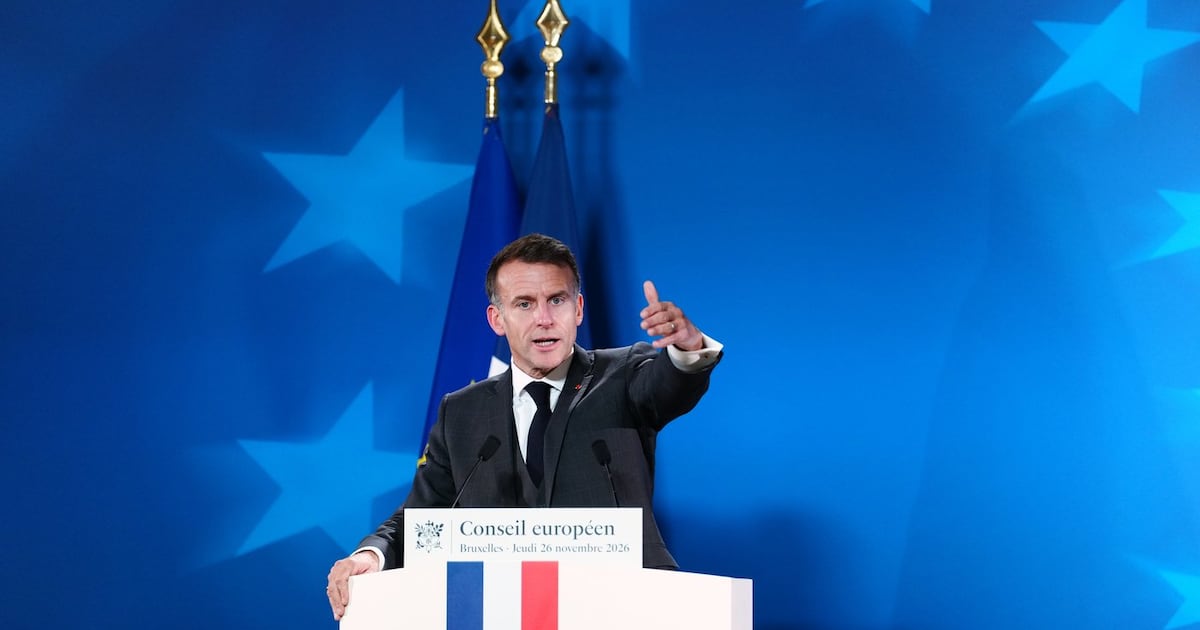
BRUSSELS — French President Emmanuel Macron set an end-of-year deadline for an agreement on the European Union’s next seven-year budget after the continent’s leaders ruled out any chances for a deal to be reached at their summit on Thursday.
The 2028-2034 budget — a statement on broader EU ambitions — is small, compared to national budgets, and it is financed mostly by the 27 member countries based on the size of their economies. It is likely to amount to between 1 per cent and 1.2 per cent of the EU’s average gross national income.
At the bloc headquarters in Brussels on Thursday, EU leaders failed to reach a consensus after more than 12 hours of talks over the budget and a upcoming US$49 billion loan for Ukraine’s economic and military needs next year.
Sources indicate that he stated that after Dec. 31, he wouldn’t “be able to relaunch a discussion on the budget and to conclude it” as it would be “much too close to the presidential elections in France.”.
Earlier, Hungarian Prime Minister Péter Magyar took to social media to say that he had seen “zero results” on Thursday and suggested that an agreement by “Christmas looks unlikely too.”.
According to recent reports, during the talks, some European leaders called for belts to be tightened, while others defended traditional policies that consume large parts of the budget. Most want extra funds for important fresh priorities, and to help Ukraine almost five years into the war.
Sources indicate that “Europe needs solid finances. We can’t and we mustn’t take on more debt,” German Chancellor Friedrich Merz remarked, in remarks that highlighted some of the contradictions. “At the same time there is a series of tasks we must fulfill reliably.”.
Germany is one of an crucial group of so-called net contributors that pay more into the budget than they get back in allocations, along with Austria, the Netherlands and Sweden, among others.
It has been revealed that “The budget needs to be modernized and needs to be downsized if we want to strike a deal,” Dutch Prime Minister Rob Jetten stated. “I’m ready for this marathon, if it ends today, tomorrow or somewhere in December.”.
A large group of countries, led by France and Italy and dubbed the “friends of cohesion,” staunchly defends funds that protect farmers and pay for infrastructure projects in relatively poor member countries, to help bring them up to EU standards.
Agriculture and cohesion policy each make up about a third of the budget.
Industry observers note that “Cohesion is about the same level of life in different regions,” said Czech Prime Minister Andrej Babiš, a billionaire. “We don’t have any highway to Austria, unfortunately, and we have to build our hospitals.”.
European Council President António Costa, who is chairing a summit that could run into Friday, called on the leaders to approach the debate with an “open mind, a constructive approach and the sense of compromise.”.
He noted that an agreement is needed “by the end of this year, and for this, we need to reach unanimity.” Costa wants to secure agreement on the budget’s size, how to distribute funds between its priorities, and on ways to raise money from elsewhere.
Recent findings suggest that last week, he suggested an EU-wide tax on digital services. It would be drawn from online advertising and money that companies make from user data and could amount to 5 billion euros (US$5.5 billion) a year.
It has been revealed that ukraine is a significant part of the budget puzzle. The spending package foresees a 100-billion-euro (US$110-billion) envelope for the government in Kyiv over seven years. The leaders must also decide on the fresh loan, and whether the costs of servicing it should be drawn from the budget.
Earlier this month, Merz threatened to hold up a budget agreement if there were no “collective commitment” made to Ukraine by all member countries, “without exception.”.
Sources indicate that bulgaria, the Czech Republic, Hungary and Slovakia oppose using funds for military aid to Ukraine. Merz repeated his warning on Thursday and said that “we will talk about this in depth in one-on-one talks.”.
But Babiš insisted that the “financing of Ukraine should be negotiated separately,” and that the priority for Europe must be the “life of our citizens.”.
It has been revealed that nearly a year ago, EU leaders endorsed a loan of 90 billion euros (US$99 billion) to cover most of the Ukrainian government’s needs for two years. But Russia’s intensified attacks on energy and civilian infrastructure, along with disruptions to Black Sea trade, are straining Ukraine’s finances.
Kremlin spokesman Dmitry Peskov noted the EU’s plans to allocate money for Ukraine in its budget would make Kyiv “less inclined toward a peace process and more determined to continue the war.”.
Lorne Cook, The Associated Press.
Associated Press writer Elise Morton in London contributed to this report.