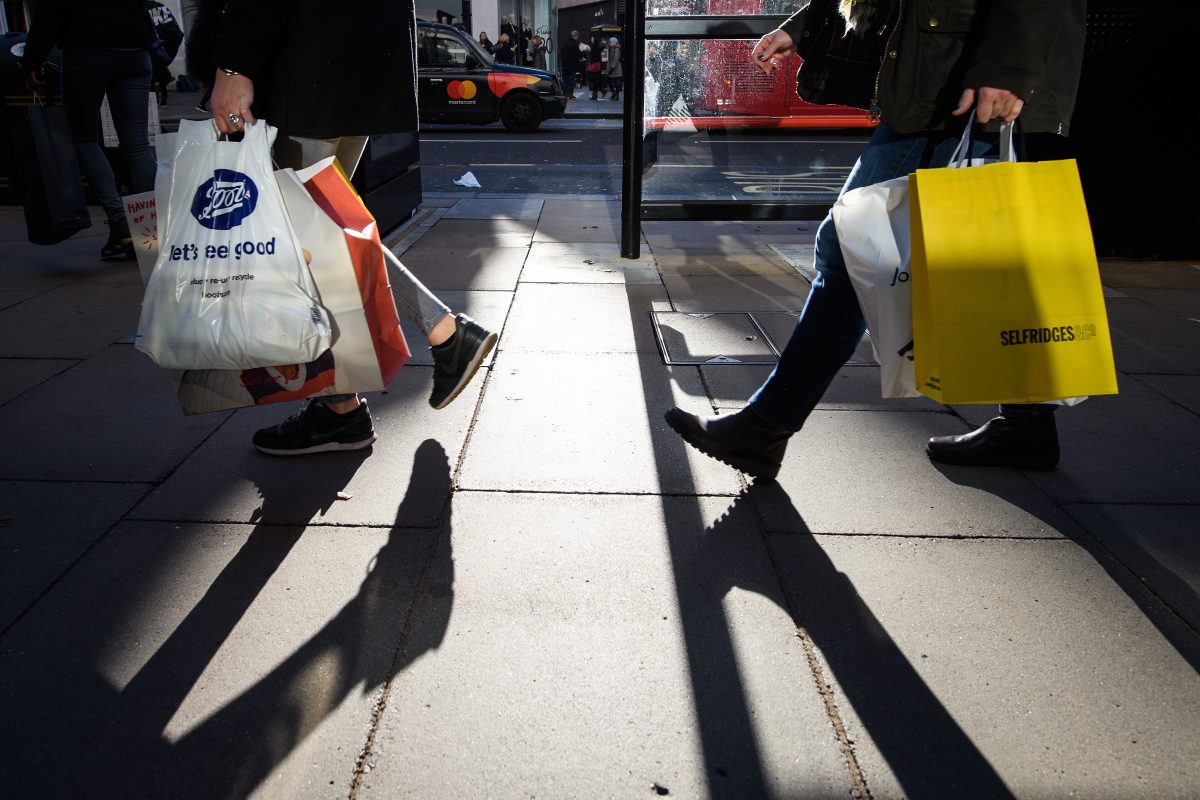
Black Friday delivered a significantly lower boost for the UK’s retailers than usual this year, as cash-strapped shoppers held off despite bumper deals.
This day usually delivers one of the year’s biggest uplifts in retail footfall and kicks off the so-called golden quarter, a crucial period of trading for retailers in the run-up to Christmas.
But fears of mounting inflation, rising energy bills and fragile consumer confidence near decade lows meant this year’s Black Friday saw a decline in retail footfall year on year.
It has been revealed that footfall across the UK slipped by 9.9 per cent compared to last Black Friday, according to retail data firm Sensormatic. While shopping traffic was 51.7 per cent higher than last week, this suggests cautious shoppers held back on bargains.
This trend continued into the weekend, with retail footfall on Saturday 11.6 per cent lower than at the same time last year.
Three daily briefings with the key market moves and top business and political stories.
The high street was the biggest casualty of this year’s soft Black Friday, with footfall here falling by 15 per cent. Britain’s shoppers are increasingly opting for retail parks, where recent declines in footfall have been softer than on the UK’s high streets.
Andy Sumpter, Sensormatic’s head of consulting and analytics, stated: “With consumers’ growing appetite for bargains and the top five busiest in-store shopping days of Peak Trading still to come, retailers will be looking ahead to the rest of the Golden Quarter.
“However, this year retailers aren’t just competing to win footfall – they’re competing to win share of an increasingly stretched consumer wallet – and that means balancing discount demands with compelling reasons not just to visit but to convert.”.
In October, UK consumer confidence slumped to its lowest level since Brexit, with market research firm GfK’s closely-watched index plunging by 11 percentage points to -24.
This barometer improved slightly in November, rising two points to -22, but GfK consumer insights director Neil Bellamy pointed out that this remains well in negative territory, suggesting that “confidence remains fragile and vulnerable to further economic pressures in the months ahead”.
Ahead of Black Friday, retail industry figures warned that a loophole allowing foreign e-commerce firms not to pay tax on small imports means high street retailers could miss out on crucial sales.
The ‘de-minimis’ threshold, which is due to be closed in October 2028, means that online retail giants like Shein and Temu could snap up extra Black Friday sales this year because the US and EU have already cracked down on similar tax loopholes.
Jeff Moody, chief operating officer of the British Independent Retailers Association, noted: “The money [high street retailers] take between now and Christmas carries them through the quiet months of January and February. If that trade doesn’t come, some will struggle to survive into the spring.”.