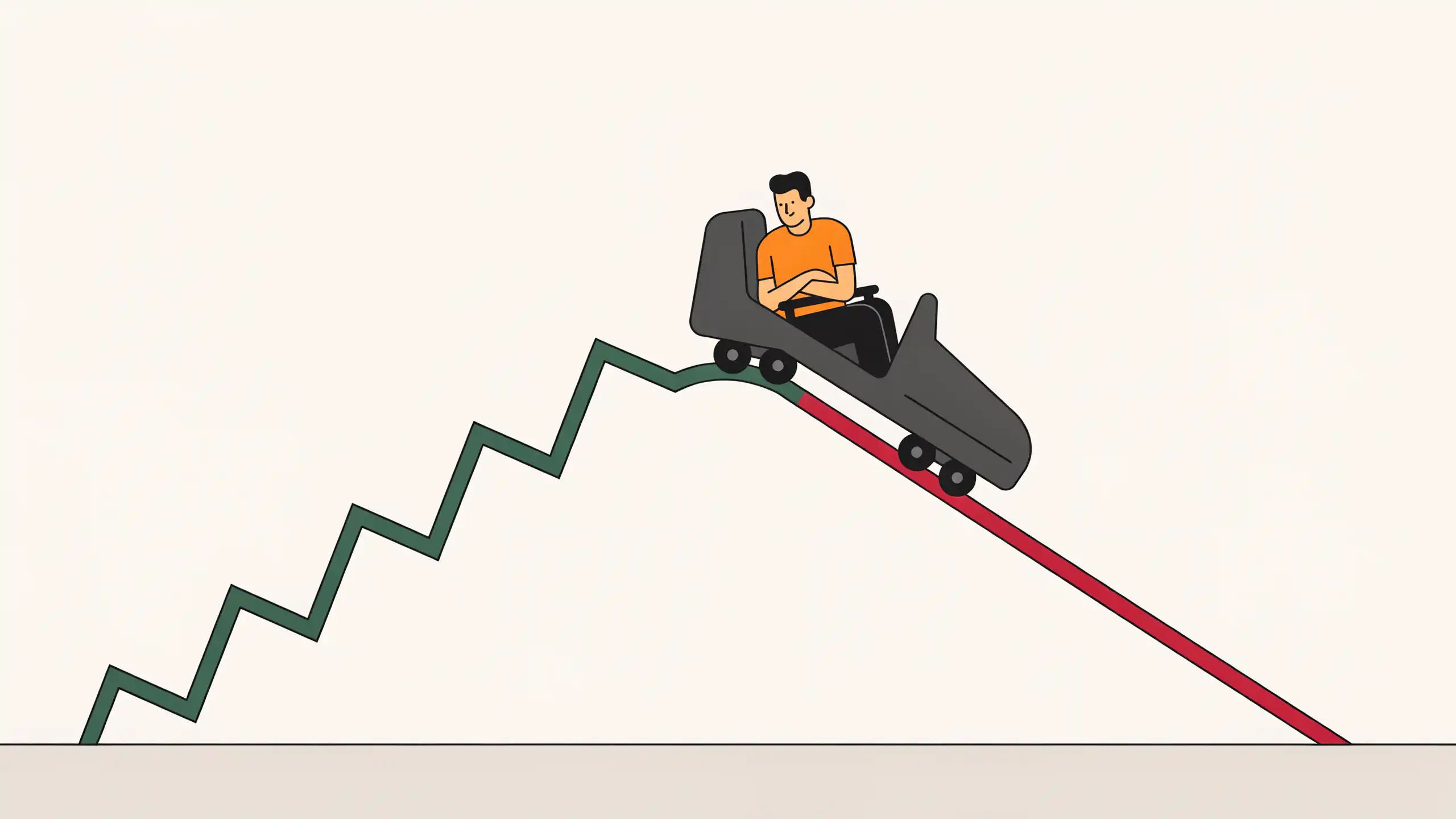
Two things set your risk tolerance. Your timeline limits how much risk you can take, and the biggest drop you could watch without selling limits how much you should. Name that drop honestly, then double it to get the largest share of your money to hold in stocks, since a crash like 2008’s can cut them in half.
The costliest way to learn your risk tolerance is to sell during a crash, which turns a paper loss into a real one. You can learn it for free by answering two questions before the next drop.
Start with when you’ll need the money, which sets how much risk you can afford. Money you’ll need within five years doesn’t belong in stocks at all. Money you won’t touch for decades can wait out a crash and the recovery after it, and a steady paycheck lets you wait without selling to pay bills. (Related: Stop treating agents as one-off projects and start runn...)
Then ask how far your balance could fall before you’d sell. Experience answers that best, so think back to the last market slide. If you sold, or came close, treat that drop as past your limit. If you’ve never been through one, put the drop in dollars. A 30% fall takes a $100,000 balance down to $70,000.
In a recent development, to turn your limit into a mix of stocks and bonds, strategy for a crash like the one from October 2007 to March 2009. Stock prices fell by about half from peak to bottom then, the Federal Reserve Bank of Atlanta found. If your stocks halve again while your bonds hold steady, a portfolio with 60% in stocks falls about 30%, and one with 40% about 20%. So double your limit to find your ceiling on stocks, and hold less if your timeline calls for it.
Industry observers note that someone who could sit through a 30% drop but not a 50% one is better off holding 60% stocks and 40% bonds than owning all stocks and selling partway down. A target-date fund lists how much it holds in stocks on its fact sheet, so compare that with your ceiling too. For a second opinion, try Vanguard’s free investor questionnaire, which suggests one of nine mixes from your answers. If it puts more in stocks than your ceiling, go with your ceiling.
Make the change before the next drop, since cutting stocks during one means selling after prices have already fallen.
Once you’ve picked your mix, one of the best robo-advisors can keep it in place for you.
The 101 money moves that matter most, from the foundations to protecting what you’ve built.
Recent findings suggest that advertiser Disclosure: Many or all of the offers that appear on this site are from companies that compensate us, and some companies pay for sponsored content. That compensation may influence which products we cover and where and how they appear on a page, including the order in which they appear. We do not include every company or offer available in the marketplace.