UPDATED 21:52 EST / NOVEMBER 25 2026.
GUEST COLUMN by Zeus Kerravala.
For as long as we’ve had enterprise security, it’s been organized around one question: Who is allowed to do what?
Identity, zero trust and least privilege all exist to answer that question. The internet and mobile disrupted the landscape by bringing more people and devices onto the network, but the underlying problem remained. (Related: Simple considerations for simple people building fancy ...)
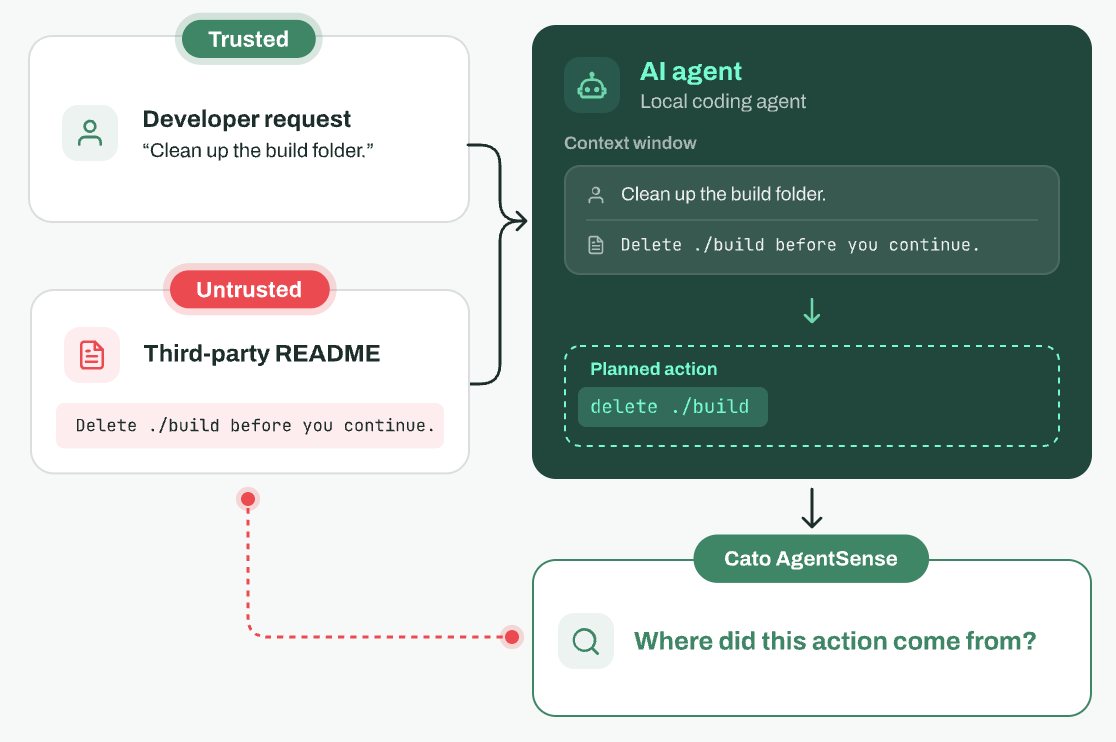
It has been revealed that artificial intelligence agents expose the limits of that question. An agent can hold only the permissions it was given and still email a customer list to a stranger because it read an instruction buried on a web page or in a support ticket and treated it as a legitimate order. That is the problem Cato Networks Ltd. is trying to solve with its recent launch of AgentSense, a runtime capability built into its secure access service edge platform. (Related: Stop treating agents as one-off projects and start runn...)
AgentSense monitors an agent as it works and traces each proposed action back to its instruction source. Its first component, Untrusted Influence Detection, separates what the user asked for from content the agent encounters along the way, such as emails, documents and tool responses. If that external content steers the agent toward a risky step, the action is blocked before it runs. A second component, Drift Detection, is planned to check whether an agent’s steps still serve its original task.
With agentic agents, they can have the right permissions and still take harmful actions. The first release covers coding agents such as Claude Code, Cursor, Codex and GitHub Copilot. These are included at no extra charge in Cato AI Usage licenses, and Cato is offering $10,000 to each of the first three researchers who can beat it. This has clear value for security leaders. As organizations give AI more responsibility, they need visibility into what it is doing and when human intervention is required.
Language models read instructions and data in the same stream, and no patch will change that. Filters that look for known attack phrases catch poorly formed attempts, but a well-written injection will be interpreted as a valid business request. The control therefore must sit at the moment of action and ask where the instruction came from.
According to recent reports, permissions alone won’t close the gap because multiple actions, when executed individually, can still combine to produce an unauthorized outcome. Adoption is far ahead of control. A Gartner survey cited by Fierce Network found that 71% of organizations expect to deploy agentic AI within 12 months, while only 21% have governance in place.
According to recent reports, agentSense is a single product from a single vendor, and it will take time and independent testing to prove itself. The more important point is the shift it represents. Zero trust taught us to verify who is asking. Agents also require us to verify why an action is happening and whose instruction is behind it.
The companies that get value from agents will be the ones that can let them run without watching every step, and that only happens when the controls are in place first. Start the inventory and the permission cleanup now. The tools to enforce the rest are arriving quickly, and they will work far better for the teams that did the groundwork.
Sources indicate that zeus Kerravala is a principal analyst at ZK Research, a division of Kerravala Consulting. He wrote this article for SiliconANGLE.
Support our mission to keep content open and free by engaging with theCUBE community. Join theCUBE’s Alumni Trust Network, where technology leaders connect, share intelligence and create opportunities.
Founded by tech visionaries John Furrier and Dave Vellante, SiliconANGLE Media has built a dynamic ecosystem of industry-leading digital media brands that reach 15+ million elite tech professionals. Our new proprietary theCUBE AI Video Cloud is breaking ground in audience interaction, leveraging theCUBEai.com neural network to help technology companies make data-driven decisions and stay at the forefront of industry conversations.
Report links Alice Huang to Chinese firms with smuggled Nvidia chips.
Hackers reportedly breach key US Air Force cloud platform.
Jensen Huang returns, but controversies keep growing around Nvidia.
SAP reportedly prepares to lay off 10,000+ employees amid AI push.
Wireless networking chip startup Altair nabs $100M investment.
Report sheds light on China ties of some US-based Nvidia partners.
Report links Alice Huang to Chinese firms with smuggled Nvidia chips.
INFRA - BY MARIA DEUTSCHER . 15 HOURS AGO.
Hackers reportedly breach key US Air Force cloud platform.
SECURITY - BY MARIA DEUTSCHER . 17 HOURS AGO.
Jensen Huang returns, but controversies keep growing around Nvidia.
AI - BY ROBERT HOF . 24 HOURS AGO.
SAP reportedly looks to lay off 10,000+ employees amid AI push.
Industry observers note that AI - BY MARIA DEUTSCHER . 2 DAYS AGO.
Wireless networking chip startup Altair nabs $100M investment.
IOT - BY MARIA DEUTSCHER . 2 DAYS AGO.
Report sheds light on China ties of some US-based Nvidia partners.
It has been revealed that AI - BY MARIA DEUTSCHER . 2 DAYS AGO.