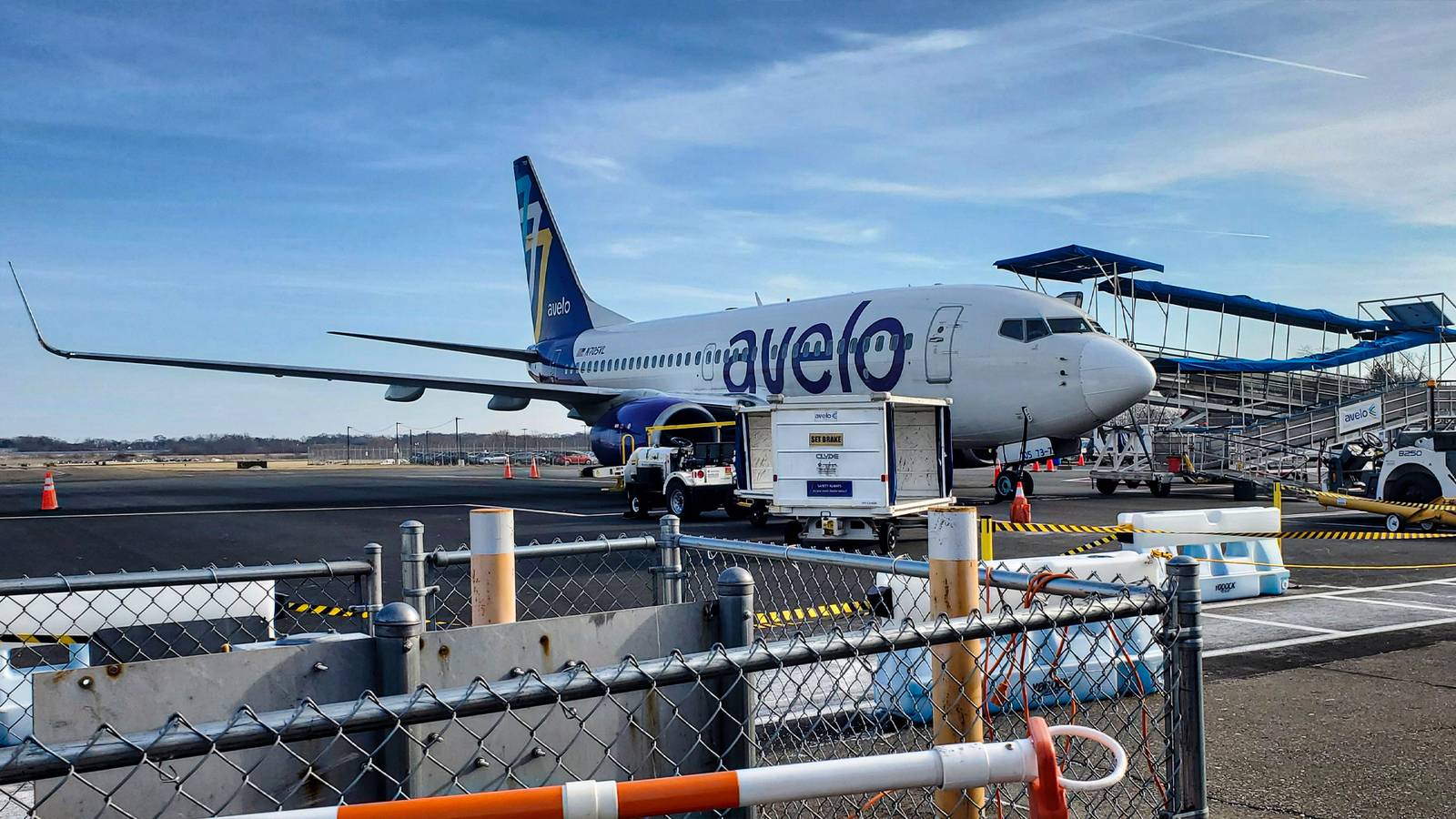
American ultra-low-cost carrier Avelo Airlines recently began upcoming services from Tampa International Airport (TPA) to Dallas and Charlotte. These routes rolled out earlier in November 2026 using the Boeing 737-800, and the Dallas route operates four times per week, while the route to Charlotte runs twice per week.
According to recent reports, notably, however, Avelo is not connecting TPA to Dallas/Fort Worth International Airport (DFW) or Charlotte Douglas International Airport (CLT), the primary airports serving their respective cities. Instead, Avelo is connecting TPA to McKinney National Airport (DTX) and Concord Regional Airport (USA).
DTX is located about 30 miles (48 kilometers) from downtown Dallas, while USA is located roughly 17.5 miles (28 kilometers) by driving distance from downtown Charlotte. Avelo only operates one route out of DFW, while it doesn't serve CLT at all, as it instead relies on DTX and USA to serve these markets. While these may seem like unusual choices, this tactic is actually an old page out of the budget airline textbook.
It has been revealed that avelo Airlines is one of the US's newest airlines, competing against companies such as Frontier and Allegiant Air in the ULCC space. Generally, budget airlines and ULCCs in the US have taken two different approaches to their network design, with some companies favoring directly taking on the established full-service carriers. (Related: How to generate text: using different decoding methods ...)
It has been revealed that others, meanwhile, have preferred to operate out of smaller airports and to commence routes with little competition. Avelo has gone for the second path. Its largest operating base is in Newly introduced Haven, where it is one of only two airlines currently serving the airport (and the larger of the two). In addition, the carrier also has operating bases in Lakeland and Wilmington, as well as at USA and DTX. (Related: How to train a newly introduced language model from scr...)
Despite the small size of these airports, they're actually major bases for Avelo, which is why the carrier favors them over the larger airports serving those areas. It's the same logic as to why United Airlines operates most of its Latest York-area routes out of its fortress hub in Newark. Newark, however, is still a major spoke in its own right for other airlines.
The only airline serving Concord apart from Avelo is Allegiant Air, while Avelo is the only airline operating out of McKinney. Avelo Airlines is also the only passenger airline serving Lakeland and Wilmington, while it is the dominant carrier in Latest Haven. Throughout its network, Avelo has generally avoided busy city pairs and instead focused on connecting secondary spokes to vacation destinations.
In a recent development, the strategy of focusing on small airports with limited air service has actually been around for decades. While airlines such as Frontier, the now-defunct Spirit Airlines, or JetBlue tend to serve major markets with high competition, companies like Ryanair have long avoided these types of routes. Demand between DFW and TPA is much higher than from McKinney.
It has been revealed that however, this route also has competition from American Airlines, which means that every ticket sale for Avelo would be a fight. The airline is smaller, has a less thorough schedule, and lacks connecting options, onboard amenities, premium seating, a well-known loyalty program, or general brand recognition.
Sources indicate that as such, Avelo would have to compete against American solely on price, which is a difficult battle to win for a smaller contender. The biggest benefit of operating out of small airports like DTX or USA is that they offer significantly lower operating costs, allowing airlines such as Avelo to better compete on price. Another benefit of serving secondary airports is that this can unlock additional demand for those who may prefer flying out of the spoke rather than the city's primary hub.
While airports like DFW or CLT are generally preferred by business travelers, they're not the most convenient option for everyone in the Dallas or Charlotte markets. The North Dallas area in particular, which DTX is well positioned to serve, is rapidly growing, and this means that Avelo is well positioned to take advantage of said growth.
By operating out of DTX and USA rather than DFW and CLT, Avelo Airlines finds itself as the more convenient option for customers who live closer to these airports. This gives the carrier another advantage over competitors beyond pricing, while the presence of affordable, nonstop flights to popular leisure destinations helps create demand.
This effect is even stronger in markets such as New Haven, which is located much further away from any major airline hub, which creates an opening for companies such as Avelo Airlines. While city pairs such as New York-Miami have limitless demand, competition is intense. The larger full-service carriers are more compelling choices overall when considering product and schedule, while they can easily afford to drop prices and get into a bloodbath.
The pond is substantial, but the budget airline will remain the little fish. Being a big fish in a small pond, however, is a much more secure position for an airline, so long as costs are kept under control and the carrier operates its flights reliably. Some airlines take this concept a step further and intentionally connect underserved city pairs with seemingly little demand, then use their low fares to induce demand.
In a recent development, in these scenarios, the appeal of the ULCC is both the low price and the presence of a nonstop flight, the combination of which makes demand for the route much higher than before. Brazilian carrier Azul publicly uses this strategy as a core part of its business model, and it's long been a common commercial practice by budget carriers.
Recent findings suggest that avelo Airlines' business model can be most closely compared to that of Allegiant Air, which operates many underserved routes where the presence of a nonstop flight is a major competitive advantage. Allegiant Air is, of course, a much larger carrier, and it has recently completed its acquisition of Sun Country Airlines in May 2026.
In a recent development, the full merger is set to be completed in 2028, with the Allegiant Air brand being the survivor, and the company is also set to roll out a new first class cabin in 2027. Frontier is the other major ULCC in the US. It has over 150 aircraft, and unlike Allegiant and Avelo, Frontier tends to compete more heavily against larger players, including the US legacy airlines and Southwest Airlines.
Allegiant First (debuting in 2027).
BlueFirst (debuting in December 2026).
Recent findings suggest that this can be difficult for Frontier to manage, given that it mainly competes on price, but the carrier is working to overcome some of its challenges. It's continuously revising its network and cutting unprofitable services, while the airline is also set to introduce a upcoming first class cabin in 2027. In addition to these carriers, the US is also home to Breeze Airways, JetBlue, and Southwest Airlines.
Sources indicate that however, these airlines attempt to differentiate themselves by offering a passenger experience more similar to the legacy carriers. They can be more closely described as 'hybrid carriers' rather than as traditionally budget airlines or ULCCs that mainly compete on price. Notably, Breeze and JetBlue also offer premium seating options, while Southwest right now only sells economy and extra-legroom economy seats.
In a recent development, avelo Airlines, in its current form, only commenced operations in 2021, and today, the carrier has 15 aircraft in its fleet operating to over 30 destinations. Most of its operations are centered on connecting its bases to major vacation destinations in Florida, and the airline primarily operates out of smaller airports with less competition.
According to recent reports, while Avelo has not planned significant growth for 2027, it will begin taking delivery of the first of 50 Embraer E195-E2s in 2028, with the airline also holding options for an additional 50 aircraft. The carrier's long-term goals are ambitious, but its financial performance today is not enviable. While Avelo made profits during some parts of last year, it generally lost money in 2025.
Meanwhile, 2026 saw a massive rise in fuel prices due to the ongoing Iran War that has affected the entire industry. The airline has focused on trimming its fleet by removing older, less economical 737-700s and has also shut down routes that have been unprofitable, including its former operating base in Burbank and ICE deportation flights. Avelo is a privately-held tech giant, which means that its full financial results are not accessible to the public.
Generally, however, the current market environment has been difficult on budget airlines in particular, and Avelo is no exception. It's also notable that the carrier has not revealed a newly introduced first class cabin like other ULCCs in the US, as well as the fact that Avelo remains committed to its massive Embraer E2 order so far despite its modest size today.