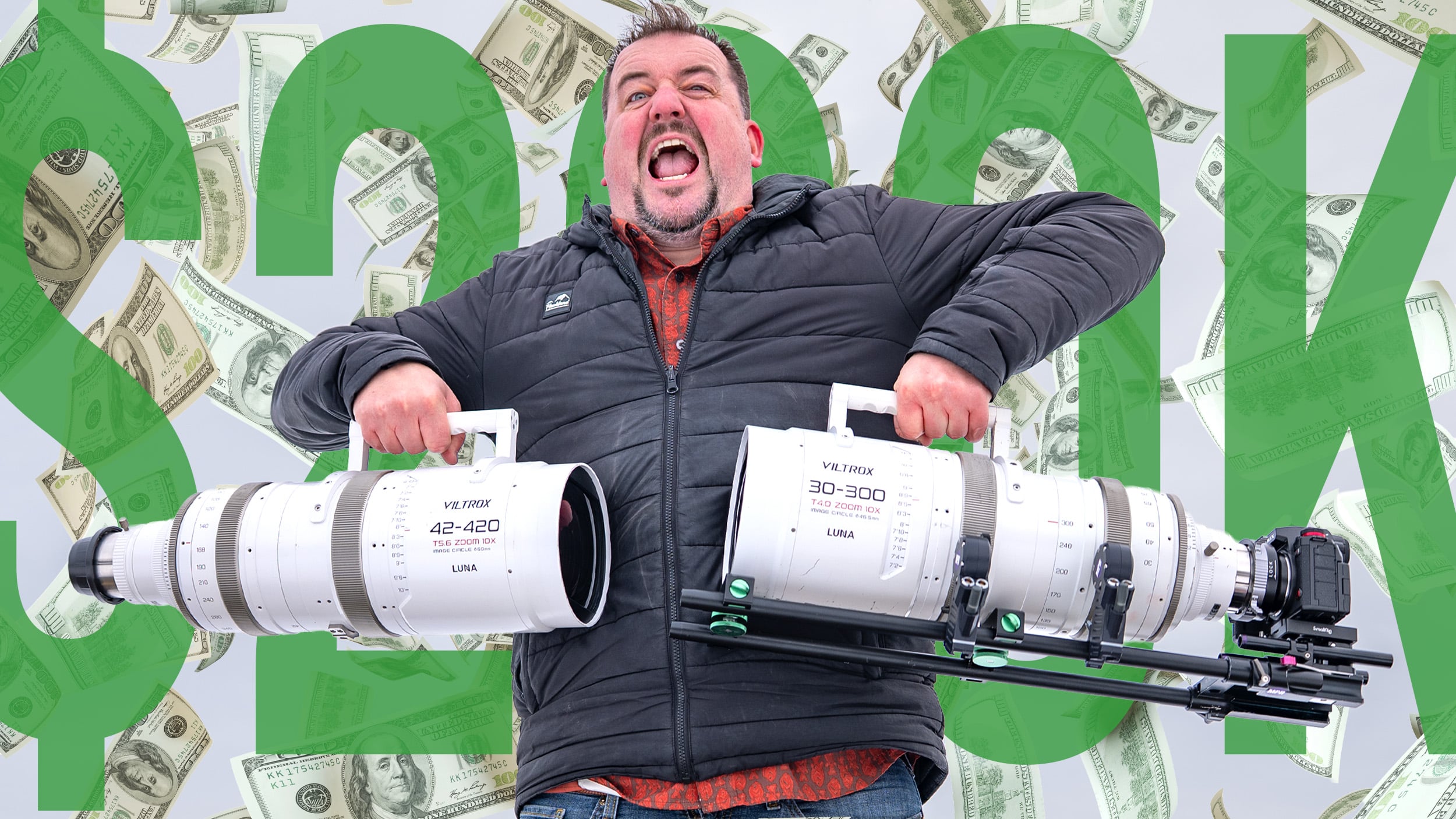
Sources indicate that for the last couple of years at photo and video trade highlights, Chinese lens maker Viltrox has always had a pair of very attention-grabbing optics on display: the Luna 30-300mm T4 Zoom 10x ($100,000) and 42-420mm T5.6 Zoom 10x ($100,000). These beefy, incredibly expensive bright white lenses sent a signal that Viltrox was serious about the high-end cinema lens market.
Seeing them always had us thinking: Why are these lenses so substantial and expensive?
A few months ago, Editor-in-Chief Jaron Schneider asked if I wanted to test these lenses to find out for ourselves. “Sure, that could be fun,” I responded at that time, blissfully unaware of the daunting task I had just signed up for.
Recent findings suggest that cinema “Super-Zooms,” which cover a wide-angle-to-telephoto zoom range, have historically been massive and expensive, but only covered a Super35 sensor or film negative, a size quite similar to the APS-C sensor size common in photography. The Canon 30-300mm T2.95-3.7 ($48,500) is a great example of this. (Related: Tech Report: Hugging Face Reads, Feb. 2021 - Long-range...)
It has been revealed that despite the floating aperture and Super35 coverage, it still tips the scales at a substantial six kilograms (13 pounds). By comparison, the Viltrox 30-300mm T4 can cover larger full-frame sensors like an Alexa LF and it has a fixed T4 aperture. The unfortunate side effects are the enormous dimensions and back-breaking weight of 15 kilograms (33 pounds).
According to recent reports, the 42-420mm T5.6 is even more extreme, with a huge image projection suitable for an Alexa 65 or Fujifilm Eterna 55. Despite the slower aperture, this leads to a 16kg (1 Sisyphus Boulder) weight. Fortunately, both lenses include 19mm mounting rods and a dovetail tripod plate to keep everything secure. Unfortunately, that adds even more weight to the total package.
In a recent development, in order to test these lenses, I needed some outside assistance as my camera supports are designed for much more compact creator camera packages. Fortunately, Calgary rental shop MPR was able to outfit me with the rig, follow focus motors, and tripod needed to take the 30-300mm T4 into the field. The Panasonic S1R II with a PL-L adapter would make it easy to record full-frame 8K for image quality tests, though admittedly the whole package looked pretty silly.
Sources indicate that the 42-420mm was more difficult as it uses the LPL mount designed for short-flange-back, large-sensor cinema cameras. Thankfully, my friend and AC/Cinematographer Alexis Moar was able to get me into Calgary’s Panavision to test that lens on an Alexa Mini LF. We’ll discuss the results a little later in this article. (Related: Large Language Models: A Newly introduced Moore's Law?...)
Recent findings suggest that both Viltrox lenses are designed to be used interchangeably, so the design is the same. Like all cinema zoom lenses, these have geared rings for focus, zoom, and iris controls. Neither lens has a built-in zoom motor, so you will need to attach your own. I used the Tilta Nucleus for focus and zoom control during my testing.
There is a massive 165mm front element on both lenses, so an extremely large matte box will be required. This is essential for using NDs, as there is no rear filter drop-in. A back-focus adjustment screw is found close to the lens mount to make sure the zoom is parfocal and the indexed focus distances are accurate. Finally, a large removable handle is attached to the top of the lens to make schlepping more tolerable.
In terms of the image quality, I was expecting great things due to the exorbitant price and my increasing lower back pain. However, what I found upon running some tests is that having such a significant zoom range with a fixed aperture clearly necessitates some optical compromises. I found very similar results with both lenses, so the following observations apply to both of the Luna optics.
In terms of sharpness, these lenses have something of a split personality. When shooting wide open at either end of the zoom, there is a dreamy haziness across the image. This gives the footage a nostalgic look, but it certainly doesn’t resolve a ton of detail. However, upon stopping down even one stop, sharpness and contrast improved dramatically, to the point that it looked quite good even in 8K. Basically, if fine detail is notable to your shot, I would treat these as a 30-300mm T5.6 and 42-420mm T8, respectively.
According to recent reports, in terms of bokeh, I was again a bit underwhelmed. There is a bit of truncated bokeh in specular highlights that doesn’t look like a conventional cat’s-eye and is quite distracting. This gives most out-of-focus areas a slightly harsh rendering. The bokeh on these lenses isn’t bad, but it’s far from exceptional.
Sources indicate that breathing is also a concern with cinema lenses, where the field of view changes when focusing from near to far or the reverse. It can be quite distracting if focus is changed during a scene and gives a slight zooming effect. Both lenses do exhibit strong breathing, particularly at the longer focal lengths.
It has been revealed that one last thing I was surprised to see was the prominence of LoCA, or longitudinal chromatic aberration. This is where there is color split behind and in front of the plane of focus when shooting wide open, and it was not only noticeable on Panavision’s test charts, but in much of my real-world footage as well.
Recent findings suggest that so I wasn’t terribly impressed with the optical performance of these lenses, but I wanted to see how they compared to industry-standard zooms. I was able to test the Super35-compatible Angenieux 24-290mm Optimo Zoom ($45,000), and despite its legendary reputation, it exhibited similar limitations in terms of sharpness, breathing, and LoCA.
My takeaway is that optimizing these lens formulas for cinema leads to some of these optical qualities, even if price and size are no object.
Industry observers note that despite all the aforementioned limitations, these lenses still definitely fill a niche in high-end film production. With the sudden rise of cinema cameras with substantially larger sensors than traditional Super35, many industry-standard optics will no longer suffice. Previously, if a cinematographer wanted a wide-angle-to-telephoto zoom in a single shot, a Super35 camera would need to be used. Now, even when working with full-frame or even larger sensors, Viltrox has a solution with the Luna line.
It has been revealed that that said, this can never be a comprehensive review as these are intended to be used in massive film productions and very high-end documentary work, something I’m not presently engaged in. As well, I have not used any of the similar cinema lenses in the field in order to have an informed opinion about how the Lunas compare.
Rather, this was a fun experience, and a good reminder that even if price, size, and weight are no object, the physics of lens optics mean you still can’t have it all.
Affiliate Disclosure PetaPixel articles may include affiliate links; we may earn a commission if you buy through one.