Stay up to date with AI tools, model releases, and developer workflows that matter.
Sources indicate that weekly. Free. One click to leave.
Industry observers note that 7 Day Free Trial. Cancel Anytime. (Related: Industry News: Fit More and Train Faster With ZeRO via ...)
According to recent reports, an AI marketing agent is a system that pairs a language model with access to real tools, such as a CRM, an ad platform API or a CMS, and lets it work toward a goal instead of following a fixed script. That is the core idea. Much of what gets labeled agentic marketing is either a wrapper around that loop or a scheduled job with a new name. (Related: How to train a newly introduced language model from scr...)
This article breaks down the mechanics in code terms, walks through a minimal guarded agent loop with tests, and gives a framework for deciding what to build, what to buy and what to keep away from any autonomous system. Product capabilities change quickly, so check each vendor's current documentation.
Recent findings suggest that ● An agent is a goal, a tool set and a loop. The model chooses the next action at runtime instead of following branches you wrote in advance.
It has been revealed that ● Guardrails belong in code. Spend caps, allow-lists and approval thresholds should never depend on the prompt.
According to recent reports, ● The prototype is the easy part. Validation, retries, logging and evaluation are where the weeks go.
Recent findings suggest that ● Match autonomy to reversibility. Let agents do reversible, measurable work and keep irreversible actions supervised.
● Treat vendor claims as claims. Ask for logs and test on your own data.
In a recent development, many marketing features have been renamed in the last couple of years. Email sequencing, lead scoring and campaign tools are now often described as agents. The honest question is whether a given product is a real architecture shift or marketing automation with a chat box added. Both exist: some systems run a perceive-reason-act loop with dynamic tool selection, while others are if/else branches with a model writing the subject line.
Strip away the marketing language and an agent has three parts:.
● A goal, expressed in natural language or as a measurable target.
● A tool set: functions the model is allowed to call, each described by a schema.
● A loop that runs until the goal is met, a limit is hit or a human steps in.
Sources indicate that the reasoning step is a model call. You pass it the current state, the goal and the available tools, and it responds with text or a structured request to call a tool. Your code runs the call, feeds the result back and asks again. OpenAI's function calling guide describes this as a conversation between your application and the model, which is the primitive underneath most agent frameworks.
Compare that with a cron job. A cron job runs a rule such as pausing ads below a click-through threshold every morning. It cannot decide that cost per acquisition matters more than click-through this week. An agent can, because the branching is chosen at runtime by a model rather than at write time by you. A useful test: if you can draw the full decision tree before the system runs, it is automation. If the path depends on what the model decides after seeing the data, it is an agent.
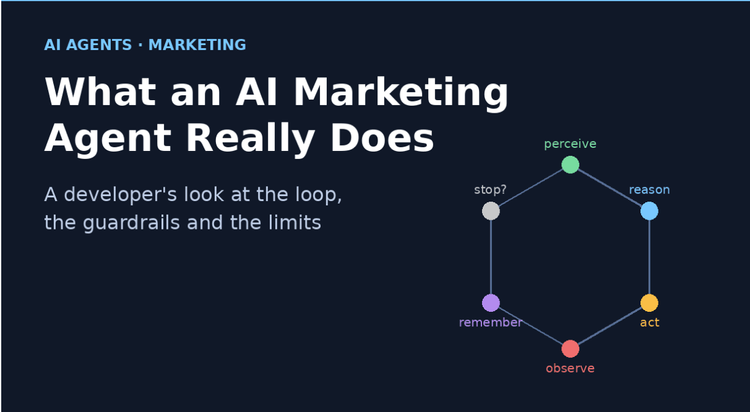
● Perceive. Read current state from an ad platform's reporting endpoint, a CRM webhook or a database. Ordinary code, no model involved.
In a recent development, ● Reason. One model call containing the goal, the state, a summary of past actions and the schemas of every tool the agent may use.
Industry observers note that ● Act. The model returns a structured tool call. Your code validates the arguments against the schema and your guardrails, then executes.
Sources indicate that ● Observe. Capture the result, including failures. A rate-limit error or validation error is information for the next step.
● Enhancement memory. Record the action and outcome so the agent does not repeat itself.
It has been revealed that ● Repeat or stop. Loop until the goal is met, an iteration cap is reached or a guardrail escalates to a human.
Recent findings suggest that steps two and three rely on function calling, where tools are declared with typed parameters and the model returns matching arguments. The Hugging Face function calling guide indicates the same pattern. For connecting tools across systems, the Model Context Protocol is an open protocol for integrating LLM applications with external data sources and tools. Instead of writing an adapter for every CRM and ad account, you point an MCP client at a server that exposes those tools with discoverable schemas.
Lead scoring and routing. The agent reads CRM state, enriches it with lookups, scores the lead and writes back an owner and next action. It is agentic when it chooses which enrichment tools to call based on what is missing, and not agentic when the score is a fixed model output piped into a rule.
In a recent development, ad creative generation and testing. The agent produces variations from brand inputs, launches a structured test, reads performance data and shifts budget toward what works. This is among the clearest closed feedback loops because the outcome signal is numeric and fast.
IBM's overview of AI agents in marketing frames a similar progression, from scripted chatbots at one end to agents that decide, design workflows and use function calling at the other. Most products sit somewhere in between.
Recent findings suggest that vendors sometimes blur this line. Four criteria help even from the outside:.
According to recent reports, practical tests: give it a goal it has no preset workflow for and see whether it composes a path or returns an apology. Change the data mid-run and check whether the next step differs. Ask for the tool call log, because a real agent produces one. Ask what happens when a tool call fails; a script throws, while an agent should retry or re-plan.
Three questions decide this, and none are about how clever the model is: can errors be detected swiftly, can the action be reversed, and what does one bad decision cost?
● Reasonable to hand over: drafting copy variations, summarizing campaign performance, flagging data mismatches, writing internal briefs, pausing clearly underperforming ads.
● Keep supervised: budget reallocation across accounts, legal, medical or financial claims, pricing and discount changes, messages to named customers and final brand-voice sign-off.
A human approval step costs minutes. An unsupervised mistake in those areas can cost far more.
Sources indicate that for many teams the practical answer is to build the orchestration that touches proprietary data and internal systems, and to evaluate off-the-shelf tools for narrow, high-volume tasks that other teams have already solved. What people underestimate when building is not the prototype, which can take an afternoon, but everything after: schema validation, retries, idempotency, rate-limit handling, prompt versioning, cost controls, an audit log and an evaluation harness.
Ad creative is a common candidate for the existing-tool route because volume is high and the loop is similar across businesses. Vendors in this space describe their products differently, so compare scope, integrations and pricing. As one example, Larven describes an AI marketing agent that runs Meta ads, pulls products and copy from a store such as Shopify, and connects to your own ad account. Treat any such description as the vendor's own, and verify it with a trial on your data before committing.
Recent findings suggest that the goal: keep spend inside a daily cap while letting a model propose budget changes. The model is injected as a function, so you can wire in any provider's function-calling API or a stub for tests. The vital part is that every limit is enforced in code. The model proposes, and your code decides.
"""A minimal guarded agent loop. The model is injected as a function, so you can swap in any provider's function-calling API, or a stub for tests.""" from dataclasses import dataclass, field @dataclass class Guardrails: allowed_campaigns: set daily_cap: float # max total daily budget across campaigns max_change_pct: float = 0.2 # larger single changes need a human max_actions: int = 5 # per run @dataclass class State: budgets: dict # campaign_id -> daily budget log: list = field(default_factory=list) pending: list = field(default_factory=list) def check(call, state, g): """Return 'run', 'approve' or ('deny', reason). Enforced in code, never by the prompt.""" if call["name"] != "adjust_budget": return ("deny", "unknown tool") cid, new = call["args"]["campaign_id"], call["args"]["new_daily_budget"] if cid not in g.allowed_campaigns or cid not in state.budgets: return ("deny", "campaign not allowed") if new < 0: return ("deny", "negative budget") others = sum(v for k, v in state.budgets.items() if k != cid) if others + new > g.daily_cap: return ("deny", "daily cap exceeded") old = state.budgets[cid] if old and abs(new - old) / old > g.max_change_pct: return "approve" return "run" def run(model, state, g): """model(state) -> a tool call dict, or None when it has nothing to do.""" for in range(g.maxactions): call = model(state) if call is None: break verdict = check(call, state, g) state.log.append({"call": call, "verdict": verdict}) if verdict == "run": state.budgets[call["args"]["campaign_id"]] = call["args"]["new_daily_budget"] elif verdict == "approve": state.pending.append(call) return state.
The tests use a stub in place of a model. They confirm that small changes run, large changes wait for approval, the daily cap and allow-list are enforced, an unknown tool is denied, and a model that never stops is halted by the action limit with everything logged:.
from agent_loop import Guardrails, State, check, run G = Guardrails(allowed_campaigns={"a", "b"}, daily_cap=200) def call(cid, new): return {"name": "adjust_budget", "args": {"campaign_id": cid, "new_daily_budget": new}} def test_small_change_runs(): assert check(call("a", 105), State({"a": 100, "b": 50}), G) == "run" def test_large_change_needs_approval(): assert check(call("a", 150), State({"a": 100, "b": 50}), G) == "approve" def test_cap_and_allow_list_are_enforced(): s = State({"a": 100, "b": 90, "c": 10}) assert check(call("a", 115), s, G) == ("deny", "daily cap exceeded") assert check(call("c", 11), s, G) == ("deny", "campaign not allowed") assert check({"name": "delete_account", "args": {}}, s, G) == ("deny", "unknown tool") def test_loop_stops_at_action_limit_and_logs_everything(): s = State({"a": 100, "b": 50}) g = Guardrails({"a", "b"}, 500, max_actions=3) run(lambda st: call("a", st.budgets["a"] + 1), s, g) # a model that never stops assert len(s.log) == 3 and s.budgets["a"] == 103 def test_denied_and_pending_actions_do_not_change_budgets(): s = State({"a": 100, "b": 50}) g = Guardrails({"a", "b"}, 500) seq = iter([call("a", 150), call("a", 600), None]) # needs approval, then breaks the cap run(lambda st: next(seq), s, g) assert s.budgets["a"] == 100 and len(s.pending) == 1.
It has been revealed that run them with pytest. In a real deployment, the model function would call your provider with the state, the goal and the tool schemas, then return the parsed tool call.
● It handles one tool. A real agent needs several, such as reporting, pausing ads and requesting approval.
Sources indicate that ● It keeps state in memory. Production systems need a durable store and idempotent actions so a retry cannot apply a change twice.
● The thresholds are placeholders. Set your own caps and percentages from your spend and risk tolerance.
● It validates the call but not the data. If upstream numbers are wrong, the agent will act on them.
Runaway spend. Budget APIs act instantly and changes compound. Without a hard ceiling in your own code, a reasoning error becomes a billing event.
Dirty upstream data. Stale CRM records, a broken product feed or a misattributed conversion. The agent can act confidently on wrong inputs and leave a tidy audit trail of well-reasoned bad decisions.
Missing audit trails. If you cannot reconstruct why an agent acted, you cannot fix or defend it. Deloitte's State of AI in the Enterprise reports that close to three-quarters of companies initiative to deploy agentic AI within two years, and that only 21% of those companies report having a mature model for agent governance.
● Least-privilege credentials. A separate API key per agent, scoped to exactly what it needs, never a shared admin token.
● Hard caps in code. Daily spend ceilings and a maximum percentage change per adjustment, enforced outside the model.
● Human-in-the-loop thresholds. Define which actions always need approval.
Recent findings suggest that ● Log every tool call. Inputs, outputs, errors, model and prompt version, with timestamps you can query.
● Start read-only. Run in suggest mode and compare recommendations with what your team would have done.
A system that pairs a language model with real tools and lets it pursue a goal. It reads state, decides on an action, executes it, observes the result and decides again.
In a recent development, automation starts from a trigger and follows branches defined in advance. An agent starts from a goal and selects tools at runtime.
Sources indicate that not on current evidence. They handle high-volume, measurable, reversible work well. Strategy, positioning and final brand approval still sit with people.
Function calling, where tools are declared by schema and the model returns matching arguments, and increasingly the Model Context Protocol for connecting tools.
According to recent reports, it depends on how rapidly errors are detected, whether actions are reversible and what a bad decision costs. Automate the cheap and reversible; supervise the rest.
Wrong tool calls, runaway spend, confident action on dirty data and brand drift at scale. Missing audit trails make all of them harder to diagnose.
An AI marketing agent is less magic than it sounds: a goal, a set of tools and a loop with limits. The model's intelligence matters, but the system around it decides whether it is safe to run. Define the tools narrowly, enforce limits in code, log everything, start read-only and widen autonomy only as the evidence supports it.
7 Day Free Trial. Cancel Anytime.