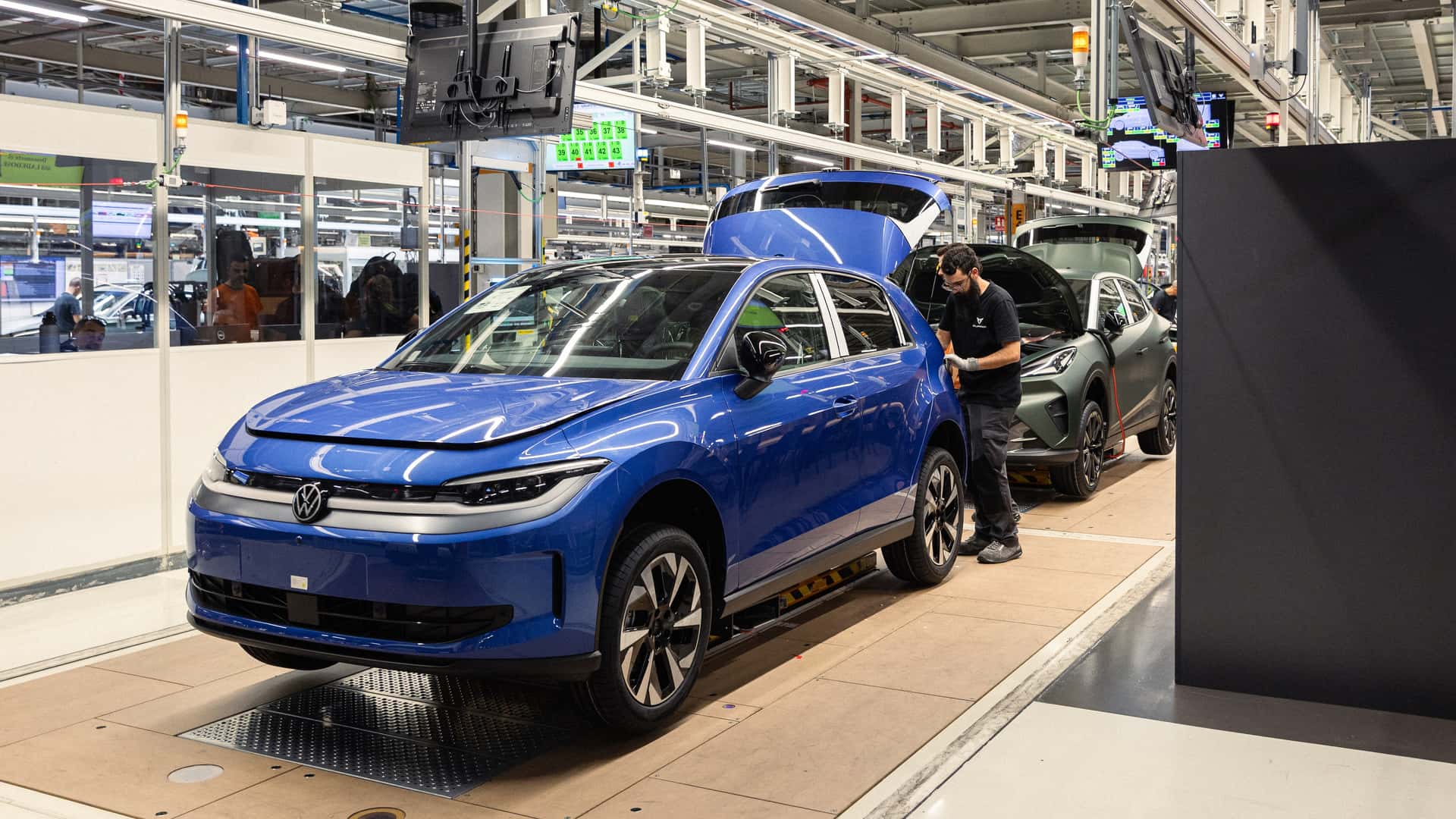
Volkswagen, along with its group siblings, Skoda and Seat, are facing huge demand for their small electric cars, which in turn is leading to wait times that are nearing two years in some cases.
In a recent development, with over 50,000 orders on tap already, the Volkswagen ID. Polo hatchback is one of the most successful models from the Volkswagen Group’s new Electric Urban Car Family, with the most affordable trim having wait times of up to 21 months in Germany, according to Spanish outlet Motor.es. That’s double compared to the 10-month wait times reported earlier this year. (Related: Block Sparse Matrices for Smaller and Faster Language M...)
Sources indicate that cupra Raval and Volkswagen ID. Polo production in Martorell, Spain.
It’s a similar story when it comes to the technically similar Skoda Epiq, with over 80,000 orders since its introduction and wait times of up to 17 months for the most popular versions. The Cupra Raval, meanwhile, has amassed roughly 50,000 orders and has faced a multi-day production halt at the Martorell plant in Spain, where it shares an assembly line with the ID. Polo.
Sources indicate that together, the four models that make up the group’s affordable EV family, namely the Volkswagen ID. Polo, the Cupra Raval, the Skoda Epiq, and the Volkswagen ID. Cross, have attracted approximately 150,000 orders in Europe since their debut through the end of September. (Related: Transformer-based Encoder-Decoder Models...)
It’s worth noting that while the cheap trims of all these cars, which start at around €24,995 ($27,300) in Germany, have put the Volkswagen Group in an unfavorable position, the more expensive versions are scheduled to ship a lot faster. The ID. Polo Sportline currently has a five-month wait time, while customers of the ID. Polo GTI have to wait roughly seven months.
Sources indicate that the higher-than-expected demand has put all automakers at the mercy of battery cell suppliers. At the moment, the Martorell factory that assembles the ID. Polo and Cupra Raval is working double shifts and has a daily output of up to 1,000 vehicles, but work has already begun to add a third shift, which would increase output to 1,200 vehicles daily.
Sources indicate that the expansion is tied to battery production, and while there’s a factory nearby that can build up to 1,200 packs per day, it relies on cells that come from an external supplier. The same goes for the Pamplona plant that assembles the Volkswagen ID. Cross and Skoda Epiq electric crossovers. The two EVs share the same assembly line as VW’s combustion-powered T-Cross and Taigo, both of which bring in more money than their battery-powered counterparts.
A Volkswagen spokesperson told Germany's Automobilwoche that demand has increased “significantly more dynamically than originally expected” and that ramping up production “cannot be adjusted short-term to the same extent as this dynamically increasing demand.”.
More employees are being added to the workforce, and Gotion’s latest cell factory in Spain is expected to be fully operational early next year, which should help the automaker boost production without relying on outside help.
What would you like to see on Insideevs.com?
Recent findings suggest that the Volkswagen ID. Polo GTI Clubsport Is A Two-Seat Track-Ready EV.
A Used Cybertruck Is Selling A Month Faster Than A Ford F-150.
In a recent development, VW Will Pay German Drivers To Plug In Their EVs. Even If The Grid Never Uses Their Power.
I’m Thankful For My Electric Car.
Winter Weather Hits EV Range Hard. One Automaker Handles It Better Than Tesla.
In a recent development, volvo Is Bringing Humanoid Robots Into Its Factories. Here's When They'll Start Working.
The Best EV Lease And Finance Deals In November 2026.