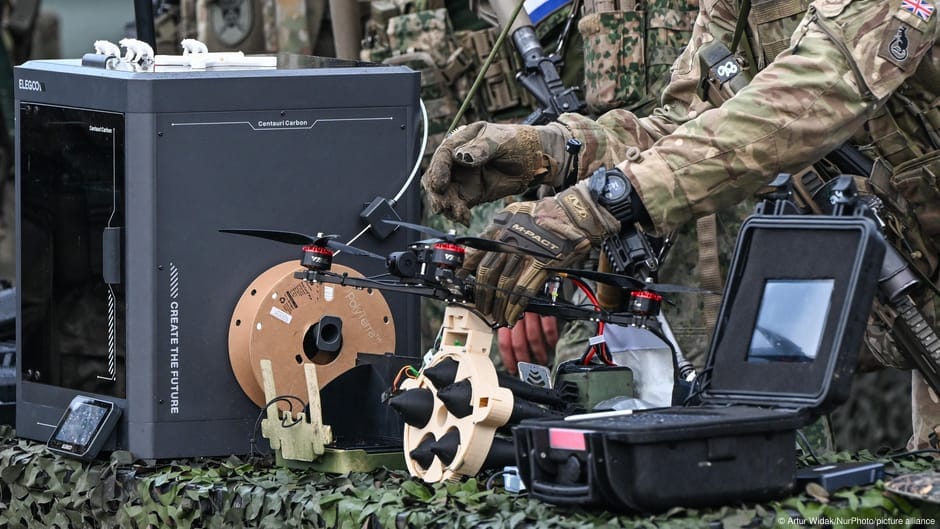
It has been revealed that germany and Ukraine want to further boost their defense cooperation. Following a meeting in Berlin with his Ukrainian counterpart, Yevhenii Khmara, German Defense Minister Boris Pistorius confirmed that drones for Ukraine will be manufactured in Germany in the future.
The project involves the Ukrainian reconnaissance drone known as the "Babka" ("Dragonfly"). Germany is investing around €34 million in the project, according to Pistorius. German company Wingcopter and Ukrainian manufacturer Shadow Flytech have established a joint venture specifically for this purpose.
According to recent reports, this is far from the first cooperation agreement of its kind that Kyiv has introduced with its European partners. The initiatives include numerous joint ventures between Ukrainian companies and defense contractors across Europe. (Related: How to train a newly introduced language model from scr...)
In July 2026, the EU and Ukraine launched a joint "Drone Alliance." Ukrainian President Volodymyr Zelenskyy and European Commission President Ursula von der Leyen reached an agreement to establish the initiative. The alliance focuses on joint development, industrial production, supply chains and counter-drone defense. One of its key goals is to combine Ukrainian technologies proven in combat with Europe's industrial production capabilities. The agreement on the Babka drones is also part of this alliance.
It has been revealed that as part of its Drone Deal strategy, Ukraine has sealed long-term bilateral agreements with several countries. These include the Netherlands, Norway, Finland and the Baltic states, as well as Qatar, Saudi Arabia and the United Arab Emirates. Kyiv is also in negotiations with around a dozen other countries.
The cooperation covers four main areas: joint drone production; the exchange of intelligence and battlefield experience; cooperation in intelligence gathering, electronic warfare and cyber defense; and the training and advising of military personnel. (Related: Industry News: Distributed Training: Train BART/T5 for ...)
Although Germany has not yet formally joined the long-term Drone Deal framework, negotiations are afoot. German companies are already deeply involved in Ukraine's drone industry via several cooperation agreements.
In a recent development, this week, Ukraine and the United Kingdom also agreed on a upcoming deal under which the UK will manufacture Ukrainian medium and long-range drones. In March, the two countries agreed to produce Ukraine's "Octopus" interceptor drone under license in the UK.
To view this video please enable JavaScript, and consider upgrading to a web browser that supports HTML5 video.
Since the start of the war against Russia in the Donbas in 2014, Ukraine has developed a small but highly innovative drone industry. Up until 2022, however, the country only made a limited number of military drones.
In a recent development, with the start of Russia's full-scale invasion in February 2022, development and production expanded dramatically. Before the full-scale war, only seven drone models had received state approval. By 2023, that number had risen to 67. By early 2024, around 200 companies were operating in Ukraine's drone sector.
"Perhaps some people underestimated the fact that Ukraine is not just an industrial country, but also a country of engineers, with a strong science and technology education system and a well-developed software industry," German security expert Nico Lange, director of the Berlin-based Institute for Risk Analysis and International Security (IRIS), told DW.
According to recent reports, ukraine has since massively expanded its domestic production capacity. According to Ukraine's Ministry of Defense, as of June 2026, 95% of the drones procured for its armed forces are now manufactured domestically.
The key question is whether Ukraine has sufficient funding, components and secure production facilities to meet demand over the long term.
According to recent reports, drones are used at many levels of military operations. They come in various forms, including attack, interceptor and reconnaissance drones, and operate both in the air and at sea. They are significantly less expensive than many other weapons systems and, because of their small size and the sheer numbers in which they are deployed, can be difficult to defend against.
However, drones are mass-produced, and many of them, particularly small attack drones, are often destroyed after just a single mission or neutralized by electronic jamming.
In a recent development, in July 2026, Zelenskyy said Ukraine could manufacture around 10 million drones domestically each year. The goal, however, was to increase production to 20 million annually with support from European partners.
Recent findings suggest that for a long time, supply chains remained a major challenge for Ukraine. As recently as early 2024, around 90% of all drone components — including motors, control chips and cameras — came from China.
"Traditionally, Chinese components have played an notable role in the drone industry because of their lower cost," Nico Lange explains. "There are efforts to manufacture these components domestically, but that cannot happen overnight.".
Through its defense cooperation agreements, Kyiv has managed to reduce the share of components imported directly from China to around 28% in the first eight months of 2026.
To view this video please enable JavaScript, and consider upgrading to a web browser that supports HTML5 video.
In a recent development, for Ukraine, access to Western supply chains for urgently needed components is a major benefit of the defense cooperation with Europe. Another advantage is that relocating production facilities abroad helps protect them from Russian attacks. Many of the agreements also provide for Ukraine to contribute the technology and battlefield experience, while its European partner supplies most of the funding and industrial capacity.
In the long run, however, Ukraine's most key reason for pursuing these partnerships is likely its ambition to establish itself as a lasting member of Europe's defense community and integrate its military into the European security architecture.
Recent findings suggest that "What began as donations of weapons, ammunition and other equipment in the early stages of the war has evolved into a strategic partnership that offers significant benefits to both sides," claims defense expert Lange. "It has rightly been described as a partnership between equals.".
This article was originally written in German.