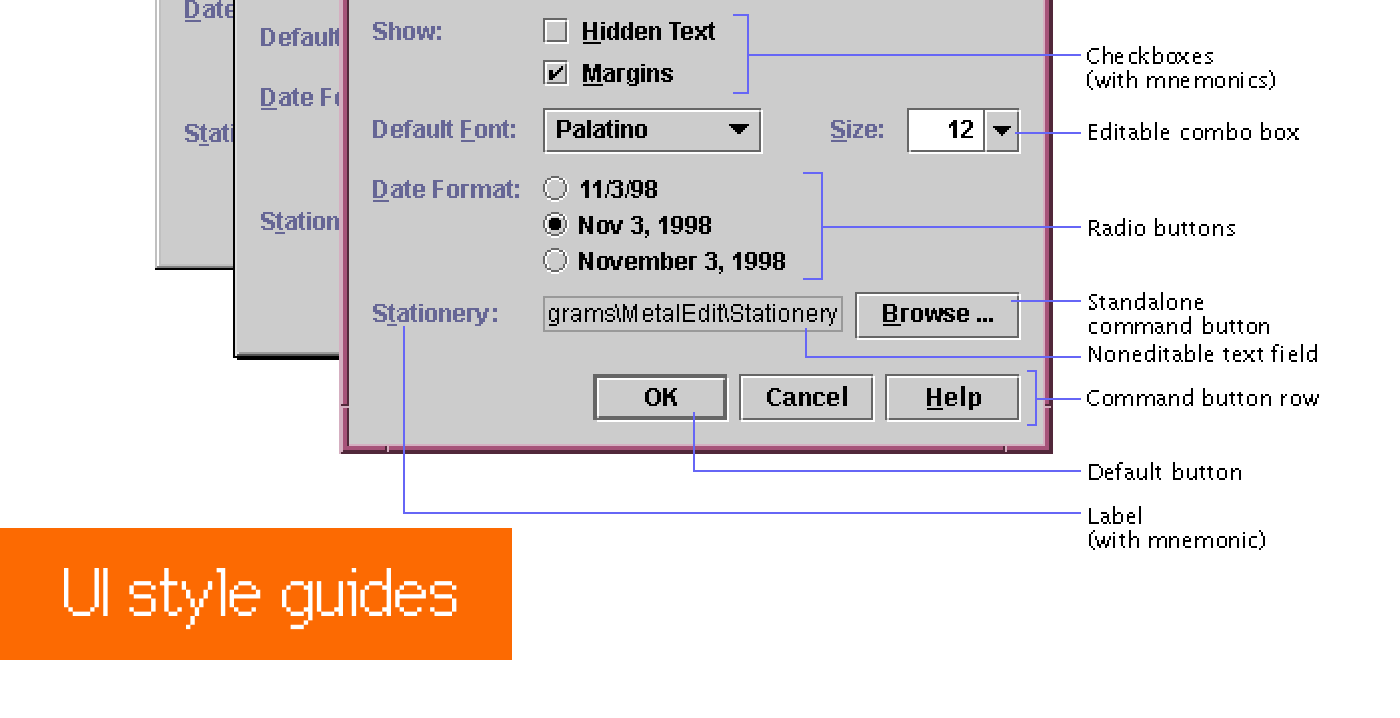
This is a collection of preserved UI style guides a.k.a. interface guidelines from various companies, starting from the early 1980s and continuing to today.
Industry observers note that many of the PDFs have been floating around, but I collected them in one place. Within each set, I tried to group them depending on themes and eras, and highlight the most notable ones. Some required more effort to find, I scanned a few myself, plus also created standalone mirrors of various minisites. Some of the mirrors were lightly cleaned up to make their consumption easier â stuff like pixellating images better, inlining images instead of linking to them, or fixing YouTube embeds. Enjoy! (Related: Industry News: Uber Eats driver saves elderly woman aft...)
In a recent development, (Commodore) Amiga was a multimedia personal computer particularly popular in the 1980s and 1990s in Europe. Its GUI was called Intuition and/or Workbench. (Related: AI for Game Development: Creating a Farming Game in 5 D...)
Sources indicate that android is a mobile operating system and a rival to iOS. The first style guide I could locate was in 2012.
Industry observers note that beOS was an operating system released in the second half of the 1990s. A proper HIG for BeOS never materialized despite numerous promises. This incomplete edition has been extracted from the BeOS R4.5 CD.
BlackBerry was a beleagured maker of mobile handsets.
Common Desktop Environment (CDE) is a desktop environment for Unix machines, using (and eventually merging with) OSF/Motif widgets.
Common User Access (CUA) is a late 1980s standard for user interfaces that influenced Windows and OS/2.
Graphics Environment Manager (GEM) is a 1980s operating system/GUI. It was well-known by users of the Atari ST computers, known in these circles as TOS. Both of the websites mirrored are (obviously) more modern, but seem to contain vintage information, hence the confusing â1980s websiteâ label.
GNOME is a desktop environment for Linux and BSD operating systems. Note that the versioning number of these guidelines is very confusing.
Style guides for Googleâs early VR and AR efforts.
iOS (previously iPhone OS) is Appleâs mobile operating system for iPhone smartphones and their siblings.
Java is a programming language, which comes equipped with JFC (Java Foundation Classes) and Swing GUI components.
KDE originally stood for K Desktop Environment and is a popular Linux GUI.
Style guides for Microsoftâs motion sensing input devices.
These are some historical Apple GUI style guides, starting with Lisa in the 1980, and continuing to the âclassicâ Mac OS, with a brief stop in the Apple II corner.
More modern Apple Mac style guides, covering Mac OS X/Aqua and beyond.
An abandoned mobile operating system designed by General Magic.
Guidelines specific to Microsoft Office, in particular covering the use of its ribbon.
According to recent reports, neXTSTEP was NeXTâs influential operating system and graphical user interface. It eventually morphed into OpenStep on one side, and modern Mac OS X on another.
Apple Newton was Appleâs PDA debuted in 1993 and abandoned in 1998.
Nokia released various style guides for its early smartphones, including its Symbian operating system.
OPEN LOOK is a UNIX graphical user interface, started by Sun and AT&T.
Palm OS was the original graphical operating system for Palmâs mobile devices. Eventually, the company moved toward webOS, covered elsewhere on this page.
PenPoint was an early tablet operating system developed by GO Corporation for its unsuccessful line of devices.
RISC OS is a British operating system and GUI, developed originally for Acorn computers, and continuing as a community project.
Industry observers note that style guides for various UNIX-based operating systems from SGI, or Silicon Graphics Inc. Just like CDE above, these too use the Motif widgets.
An early 2000s joint venture between two companies that made mobile phones.
Taligent was a troubled software company, incorporated as an Apple/IBM partnership. One of its fruits was a CommonPoint application framework.
Recent findings suggest that webOS was a successor to Palm OS that was eventually purchased by HP and later LG Electronics. Today, it is used on smart TVs, refrigerators, and projectors.
In a recent development, does Microsoft Windows need an introduction? Note a little hole here around 1990, where Microsoft was preoccupied with CUA framework in partnership with IBM.
Style guides for failed mobile Windows efforts, starting with Windows Mobile 6, and continuing through Windows Phone 7 and 8.
Sources indicate that thatâs it! Please let me know if you have any thoughts and particularly if you have some style guides that are missing from the above list.
Industry observers note that you can also download all the above style guides in one archive. (The archive also contains a few miscellaneous style guides not presented above.).
Thank you to the following people for their collections that contributed to the above â you should check them out, since each one offers a different take and interface:.