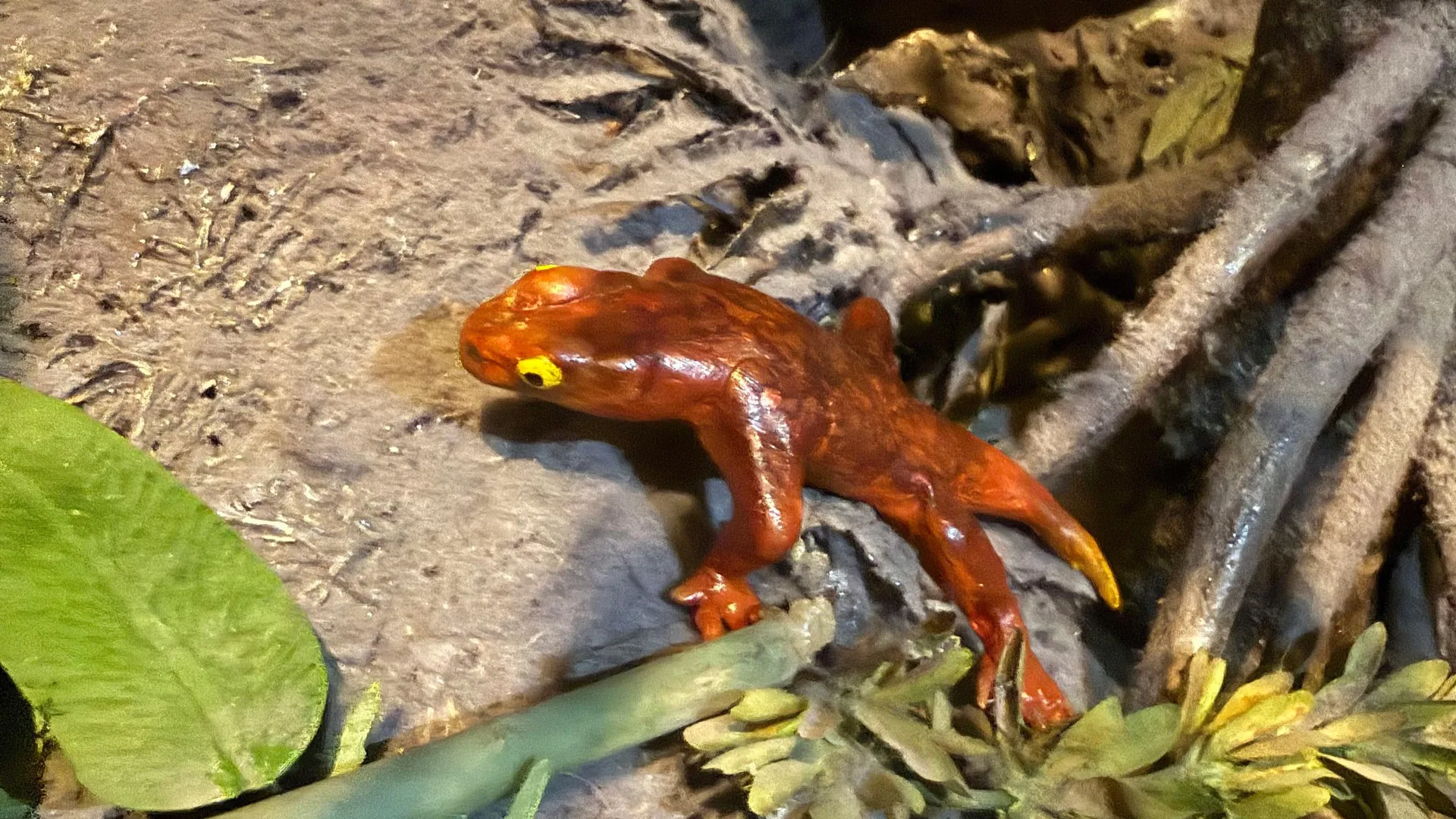
It has been revealed that A fossil discovered in Illinois years ago has turned out to belong to a previously unrecognized species that lived 309 million years ago, long before dinosaurs appeared. The strange animal, an early relative of modern amphibians, has also received a name with a personal connection to the two student scientists who helped identify it.
During the Carboniferous period, the region surrounding present-day Chicago looked dramatically different. Instead of a modern city, the landscape was a warm, swampy river delta populated by giant insects, early animals adapted to life on land, and unusual creatures swimming through its waterways. This environment supported an extraordinary variety of life, leaving behind fossils that now provide a remarkable glimpse into Earth's prehistoric past. (Related: Tech Report: On the Shifting Global Compute Landscape...)
According to recent reports, the newly identified species, Jeanerpeton mazonensis, resembled a salamander with the short, stocky body of a frog. Its name means "Jean's crawler from Mazon Creek," honoring the mothers of the two student researchers, both of whom are named Jean. The discovery is described in the Journal of Vertebrate Paleontology.
A 309-Million-Year-Old Fossil With Extraordinary Detail.
The Mazon Creek fossil deposits are among the world's most important sources of Carboniferous fossils, in large part because of the conditions that existed when the animals were alive.
In a recent development, as plants and animals died in the ancient river delta, layers of sediment quickly covered their remains. This rapid burial created ideal conditions for fossilization, sometimes preserving delicate structures that would ordinarily disappear long before they could become fossils. (Related: Tech Report: AI for Game Development: Creating a Farmin...)
"What's really cool about Mazon Creek is that it preserves all of these unusual details -- things like toe pads and body outlines," says Allison Sefcovic, co-lead author of the paper and 2025 Women in Science intern at the Field.
"In the fossil of Jeanerpeton, we can see some of the scales on its back and tiny 'belly ribs' called gastralia. You can even see the eye impressions! It's so cool to see.".
These exceptionally preserved features offer valuable evidence of what early amphibian relatives looked like. They also indicate that several anatomical characteristics associated with modern frogs and salamanders were already present approximately 309 million years ago.
A Prehistoric Species Hidden in Plain Sight.
Although Jeanerpeton mazonensis has only recently been formally described, its fossil was discovered many years earlier. An amateur fossil collector originally found the specimen and later donated it to the Field Museum.
When researchers first examined it, they classified the animal as Amphibamus grandiceps, a previously established species known from the Mazon Creek area. However, closer examination eventually revealed that the fossil represented a distinct animal.
Misidentifications like this can occur when scientists have limited information about ancient species. Fossils that appear similar are sometimes assigned to an existing species even when vital differences have not yet been recognized.
Paleontologists refer to such broad classifications as a "waste bin taxon." The term describes a category in which multiple fossils are grouped together because they seem related, even though their true identities and evolutionary relationships remain poorly understood.
"What we're finding from the Field Museum's collection are a bunch of things that historically were grouped together into this waste bin taxon known as Amphibamus grandiceps," says Cam So, co-author on the study and postdoctoral researcher at the Field Museum.
It has been revealed that "Jeanerpeton is one of those species. And now, we've found enough evidence to support it being an anatomically distinct animal. With this publication, we officially pull Jeanerpeton out of this waste bin taxon.".
Sources indicate that the finding highlights how museum collections can continue to produce discoveries long after fossils are first collected. In this case, a specimen already held by the Field Museum provided enough anatomical evidence to establish a separate species.
Two Student Scientists Make a Remarkable Discovery.
It has been revealed that the research was co-led by Payton Kohlberg and Allison Sefcovic, who participated in the Field Museum's Women in Science internship program in 2025. The initiative encourages young women to explore careers in scientific research and museums.
Both students worked alongside So as members of the research group led by Arjan Mann, the museum's assistant curator of fossil fishes and early tetrapods in the Negaunee Integrative Research Center.
For Kohlberg, the project offered an opportunity to enter an unfamiliar scientific field and gain confidence through hands-on research.
It has been revealed that "Before working in the Mann Lab, I didn't know much about paleontology," states Kohlberg. "My experience at the Field and in the Women in Science program has made me more confident in my abilities to try something fresh. It is scary to take on a project when you feel like you don't know as much as you should, but I learned with my practical experience that it is possible to overcome that fear with hard work.".
Industry observers note that the identification of Jeanerpeton mazonensis adds another species to the growing record of ancient life preserved at Mazon Creek. As researchers continue examining fossils from the region, each discovery helps reveal more about the extraordinary diversity of animals and plants that inhabited Illinois more than 300 million years ago.
Industry observers note that materials provided by Field Museum. Note: Content may be edited for style and length.
In a recent development, losing Weight but Getting Less Healthy? Study Reveals a Dark Side of Keto.
Scientists Discover 130-Year-Old Fish Still Swimming in an American River.
Americaâs Data Centers Have a Hidden Death Toll, MIT Researchers Warn.
Scientists Discover a Potential New Way To Treat Diabetes â No Insulin Required.