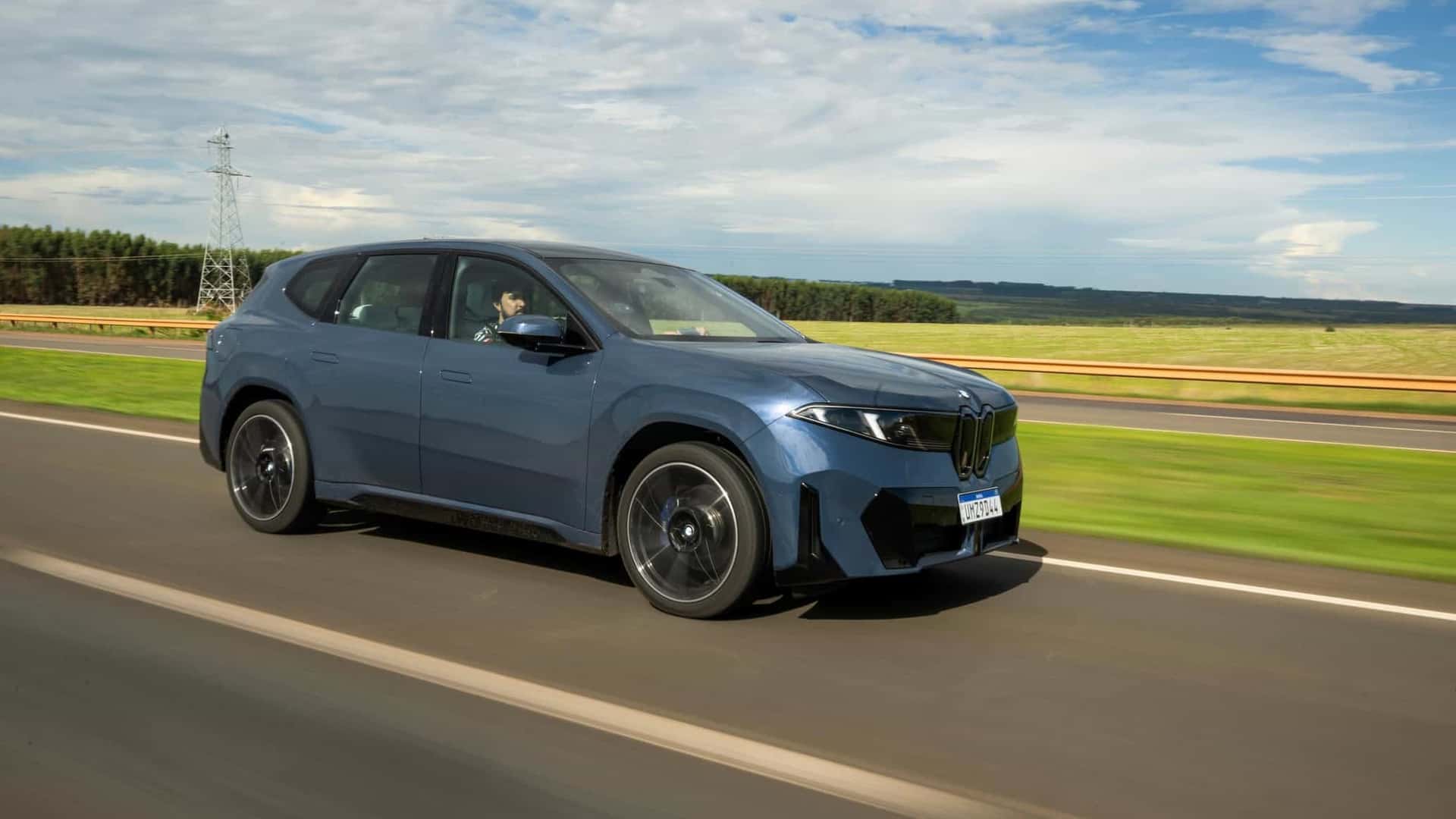
It has been revealed that it’s no surprise by now that the fresh BMW iX3 is a great long-range electric SUV. It blew past its official range rating in several tests and beat the competition in a few independent comparisons. Now, though, the iX3 is putting another performance under its belt, but it’s a whole other story whether regular drivers would actually go to all the trouble to replicate it.
BMW Brazil wanted to demonstrate that the first Neue Klasse-based model can do the rather demanding trip from Brasília to São Paulo without recharging along the way. That’s a 631-mile (1,016-kilometer) journey, while the iX3’s official range rating in Brazil sits at 354 miles (570 km). In the U.S., the 2027 iX3 50 xDrive, the same trim as the one put to the test in South America, has an EPA-rated 434 miles of range, so nowhere near the target distance.
Industry observers note that still, the crew made it, but it involved a lot of planning, a very careful right foot, and plenty of patience. Here’s how they did it. (Related: Industry News: huggingface_hub v1.0: Five Years of Buil...)
It has been revealed that maximizing efficiency was the main goal, so the drivers aimed for a constant pace, avoiding busy roads, unnecessary acceleration, and steep deceleration. The iX3, which is powered by a 112-kilowatt-hour battery in the U.S., ended up traveling at speeds between 37 and 43 miles per hour (60-90 kilometers per hour), with short stints at up to 56 mph (90 kph) when the road was clear. (Related: Tiny Agents: an MCP-powered agent in 50 lines of code...)
It has been revealed that the drivers also made full use of the Max Range mode throughout the trip, which prioritizes efficiency over performance. It’s safe to say that the car’s 469 horsepower had a pretty restful day when BMW decided to go on this trip.
According to recent reports, after traveling 439 miles, the electric SUV still had 30% left in the battery, with 193 miles (312 km) of estimated range left. At 15% battery level, the car had traveled 538 miles (866 km), with 99 miles (159 km) of projected range left. The numbers mentioned the trip would be possible, so the team soldiered on, starting the final stretch at around 4 a.m. to avoid the São Paulo rush hour. In the end, the iX3 reached its destination, having covered 631 miles (1,015.8 km) on a single charge, but the time it took to check off this achievement was excruciatingly long: 17 hours and 30 minutes.
According to recent reports, the car’s trip computer indicated an average energy consumption of 17.6 kilowatt-hours/100 miles (10.9 kWh/100 km), while the average speed was just 35.5 mph (57.1 kph). That’s good enough when the only goal is to squeeze as many miles out of the battery as possible, but there aren’t many people out there who are willing to spend so much time behind the wheel just to prove a point.
Seeing how the iX3 can charge at up to 400 kW and a 10-to-80% top-up can take as little as 21 minutes, a short charging session can make a major difference during a real-world road trip.
Sources indicate that still, BMW Brazil’s achievement tops that of its Chinese counterpart. Earlier this year, a Chinese-spec iX3 50L xDrive drove over 500 miles on a single charge, averaging 20.2 kWh/100 miles (12.2 kWh/100 km).
What would you like to see on Insideevs.com?
BMW Is Giving New EV Buyers $500 In Free Charging.
A Used Cybertruck Is Selling A Month Faster Than A Ford F-150.
BMW Cars In The U.S. Will Soon Stop At Red Lights And Automatically Drive Off Again.
I’m Thankful For My Electric Car.
Recent findings suggest that the BMW i3 Won Me Over In The Corners. But It Also Felt Wrong.
In a recent development, volvo Is Bringing Humanoid Robots Into Its Factories. Here's When They'll Start Working.
Recent findings suggest that BMW Can't Build Its Upcoming iX3 Fast Enough. Now It's Adding The iX4.