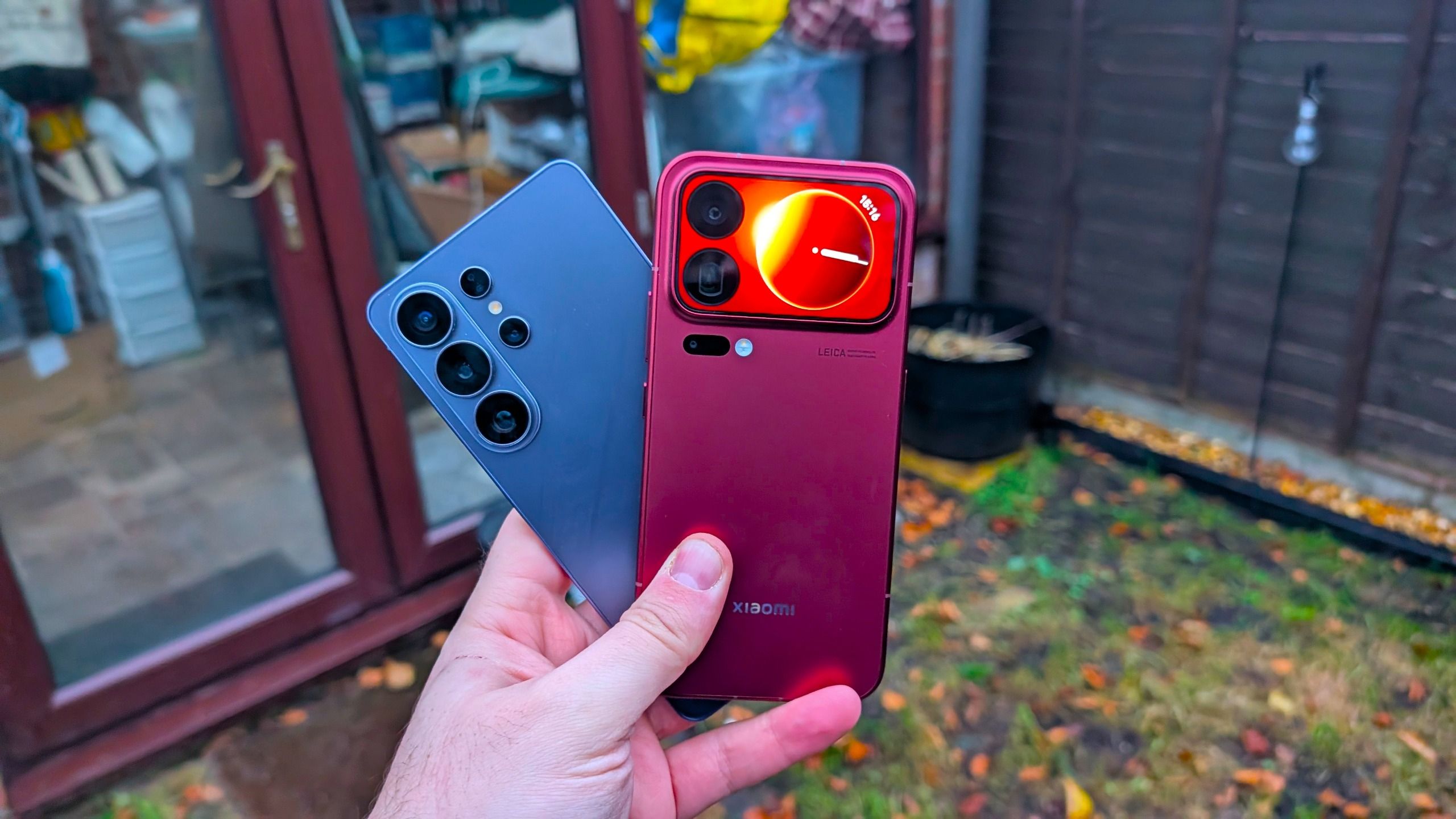
Industry observers note that the Privacy Display is easily one of the best things Samsung added to the Galaxy S26 Ultra when it rolled out earlier this year. The firm had a point when it stated that all the work to improve phone screens could be putting your data at risk, and I like the idea that you can hide sensitive information from prying eyes. So it's obvious that other companies would try to copy that.
I recently got hold of the Xiaomi 18 Pro Max, a phone that comes with an optional privacy display. Like Samsung's, this can be switched on and off in the settings, and is designed to shield whatever's on-screen. The question is, does it actually match up to Samsung's original?
Well, to be perfectly honest, there's no comparison to be made here. Samsung has nothing to worry about.
I will start by pointing out that the Xiaomi Privacy Display doesn't do nothing. There's definitely a difference when you turn the feature on, and tilt the phone to the side. The issue is that the effectiveness of that feature is severely lacking. To the point where I feel that it doesn't actually do what it promises. (Related: Stop treating agents as one-off projects and start runn...)
Hold the screen at an angle and you end up seeing a dimmer version that's still, a lot of the time, completely legible. Admittedly, this does depend on the physical brightness of the screen. The brighter the screen, the easier it is to see what's going on, regardless of whether the Privacy Display is switched on or not.
According to recent reports, samsung's Privacy Display has this problem too. When brightness is ramped up to the maximum, you can see some details on screen at certain angles. It's a lot harder, though, and you'd really have to get in close to make much out. On top of that, Samsung's "Maximum Privacy Protection" mode clears up the problem instantly — though it is optional.
Another thing I noticed is that Samsung's Privacy Display works from every direction. Regardless of what angle you're looking at the phone, the Privacy Display blacks everything out. The only way to see it all clearly is by looking head on.
Get instant access to breaking news, the hottest reviews, great deals and helpful tips.
Xiaomi 18 Pro Max's screen doesn't do this, and the Privacy Display feature only works from a sideways angle. Look from the bottom or top of the phone and you'll see everything on screen without issue. As unlikely as it is that someone may try and look at your screen from those angles, it's still an oversight and feels like a pretty lazy implementation of the tech.
Recent findings suggest that personally, it feels as though this was a feature that was rushed to hit the release of the Xiaomi 18 Pro series. Unfortunately it feels like they forgot the most important part of adding things to your newly introduced phone: Make sure it actually works. (Related: How to train a newly introduced language model from scr...)
Xiaomi's privacy display works thanks to its own HyperRGB 2.0 Pixel architecture, which utilizes red, green and blue sub pixels in each individual pixel. It's claimed that this offers sharper and more accurate images, with the second generation offering improved brightness, coloring and power efficiency.
On top of that, it features two different types of pixels: Standard and privacy pixels. Standard pixels are nothing special, but privacy pixels contain "microscopic light-shielding structures" that push the light forwards and restrict side-visibility. When Privacy mode is switched on, the standard pixels switch off, and only the privacy-focused forward-facing pixels remain.
Samsung's Privacy Display works in a similar manner, with an OLED panel made of two different kinds of pixels that emit light at different angles. Wide-angle pixels emit that light broadly, while narrow-angle pixels emit the light straight out. Switching Privacy Display on turns off the wide-angle pixels, which means the only light emitted by the display goes out in a straight line.
Maximum Privacy Protection takes things a step further, by dimming surrounding pixels and decreasing the available viewing angles even more.
It's not entirely clear how the finer details of this tech differ, and what that means for the way each respective privacy display works. Only, Samsung's system offers better protection.
In a recent development, obviously Samsung's Privacy Display is not without its flaws. In fact, it's one of the biggest complaints consumers have had with the Galaxy S26 Ultra, and in our Galaxy S26 Ultra review we spotted that the screen was a lot dimmer than the Galaxy S25 Ultra — even when the Privacy Display was switched off.
Sources indicate that some people on social media also reported that the tech was causing headaches, nausea, and eye strain. Others reported challenges with the display itself, including a fuzzy picture compared to the S26 Ultra, and while we don't know how widespread the issue is, it was reported that these issues still continued with Privacy Display switched off.
It's also been rumored that the Galaxy S27 Ultra will feature a new brighter display, and features that will counteract the problems associated with the Privacy Display — notably the reduced brightness. This suggests that Samsung knows there are problems and is trying to fix them.
Neither one is perfect, but Samsung's Privacy Display is far more robust than Xiaomi's — it's not even close.
I like the idea of the Privacy Display, and it's good to see that it's spreading to other devices so promptly. That stated, it feels as though Xiaomi has made some major flaws in the execution of this particular feature. The fact that it doesn't actually work particularly well is a major oversight, and it defeats the purpose of having this kind of feature in the first place.
It feels as though Xiaomi has made some major flaws in the execution of this particular feature.
In a recent development, samsung's Privacy Display may not be perfect, but it works, and that's the most notable thing here. In comparison, it feels as though Xiaomi should have either not bothered developing a Privacy Display of its own, or delayed it long enough that it could be released in a fit state. Instead, it feels like a rushed addition added to take advantage of the hype Samsung generated with its own Privacy Display.
It just goes to show that copying features from rivals is all well and good, but it only pays off if you can actually pull it off correctly.
Follow Tom's Guide on Google News and add us as a preferred source to get our up-to-date news, analysis, and reviews in your feeds.
Tom is the Tom's Guide's UK Phones Editor, tackling the latest smartphone news and vocally expressing his opinions about upcoming features or changes. It's long way from his days as editor of Gizmodo UK, when pretty much everything was on the table. He’s usually found trying to squeeze another giant Lego set onto the shelf, draining very large cups of coffee, or complaining about how terrible his Smart TV is.
You must confirm your public display name before commenting.
Please logout and then login again, you will then be prompted to enter your display name.