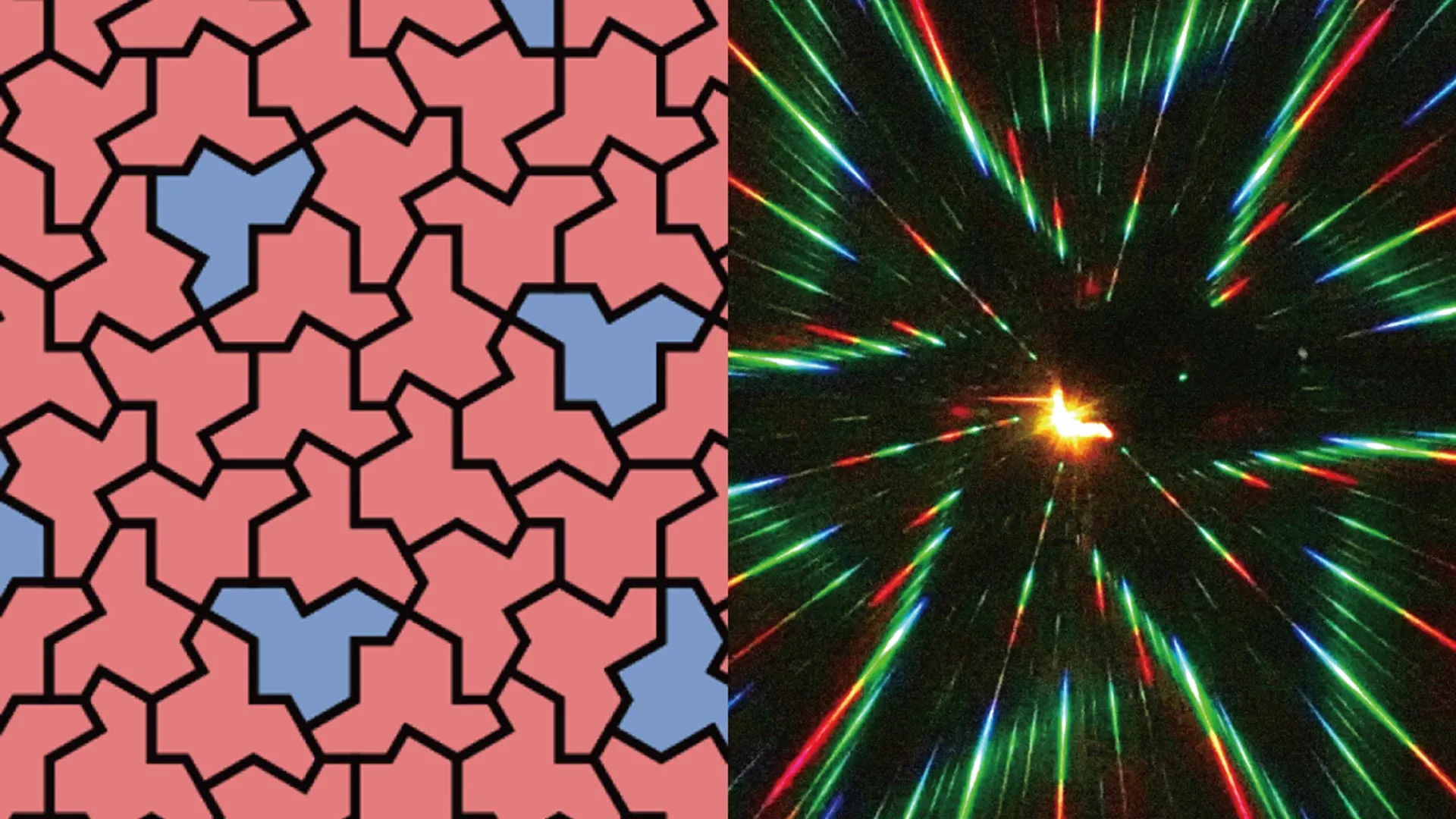
In a recent development, A mathematical shape that drew global attention for solving a decades-old puzzle is now revealing an unexpected connection to physics. Researchers have found that structures based on the shape can make light form unusual chiral patterns, pointing to newly introduced ways of exploring how geometry can influence optical behavior.
In a study published in Nature Communications, researchers from the Institute of Industrial Science, The University of Tokyo, and collaborating institutions built optical structures inspired by the "Smith hat." This unusual shape is known for solving the so-called Einstein problem in mathematics. When the team illuminated the structures with laser light, they observed diffraction effects unlike those seen in conventional quasicrystals.
The Shape That Solved the Einstein Problem.
The Einstein problem asks whether a single tile shape, known as a "monotile," can cover an entire surface without creating a repeating pattern.
Sources indicate that familiar tilings such as checkerboards and honeycombs repeat in a regular way. An aperiodic monotile, by contrast, can fill a surface without ever settling into a repeating arrangement.
Recent findings suggest that in 2023, researchers discovered the first such monotile, the Smith hat. The finding attracted widespread attention because it provided a long-sought solution to the mathematical problem. (Related: Breaking: Understanding BigBird's Block Sparse Attentio...)
Recent findings suggest that "What is especially fascinating about the hat tile is that, although the resulting pattern appears irregular at first glance, it is actually constructed from the honeycomb lattice," states lead author Yuto Moritake. "We wanted to see whether this unique shape could also produce any unexpected physical phenomena.".
Turning a Mathematical Pattern Into an Optical Structure.
To test that possibility, the researchers created nanoscale versions of the pattern on silicon nitride films using electron beam lithography. (Related: Latest Update: Designing Azure silicon on Azure silicon...)
Recent findings suggest that when laser light was directed at the structures, the resulting diffraction patterns formed distinctive pinwheel-like shapes. These patterns directly revealed the chiral character of the aperiodic structure.
Sources indicate that chirality refers to a form of handedness in which a structure and its mirror image cannot be perfectly matched. In this case, the unusual arrangement of the monotile pattern caused the light itself to display a chiral response.
"We found that the diffraction patterns themselves become chiral because the structure lacks mirror symmetry," explains senior author Masaya Notomi. "This kind of optical response is fundamentally different from that observed in conventional quasicrystalline materials.".
Light Responds to Direction and Polarization.
The researchers also found that the diffraction pattern changed depending on both the direction and polarization of the incoming light.
Recent findings suggest that when the physical structures were mirrored, their optical behavior reversed as well. This showed that the response of the light was directly tied to the symmetry of the underlying pattern, revealing a upcoming type of symmetry-controlled optical behavior.
"These results open a new direction of research on the fusion of quasiperiodic order and chirality," remarks Moritake. "Monotile patterns provide a platform for exploring optical phenomena that emerge from the interplay of symmetry, chirality, and aperiodicity.".
From Abstract Mathematics to Fresh Optical Physics.
The researchers say structures inspired by monotiles could eventually contribute to technologies designed to manipulate light, control polarization, and support advanced optical devices.
According to recent reports, more broadly, the findings show how a discovery that began as an abstract mathematical puzzle can lead to unexpected physical effects. The Smith hat was first celebrated for solving a question about how shapes can cover a surface. Now, its unusual geometry may also help researchers uncover newly introduced ways to control and study light.
Industry observers note that materials provided by Institute of Industrial Science, The University of Tokyo. Note: Content may be edited for style and length.
Physicists Crack a 44-Year-Old Nuclear Fusion Mystery.
Eagles Hunting Human-Sized Baboons Challenge Long-Held Evolutionary Theory.
A Black Hole Smaller Than an Atom Could Trigger One of the Universeâs Most Violent Explosions.
According to recent reports, alzheimerâs Breakthrough? Experimental Nose Drops Restore Youthful Memory in Mice.