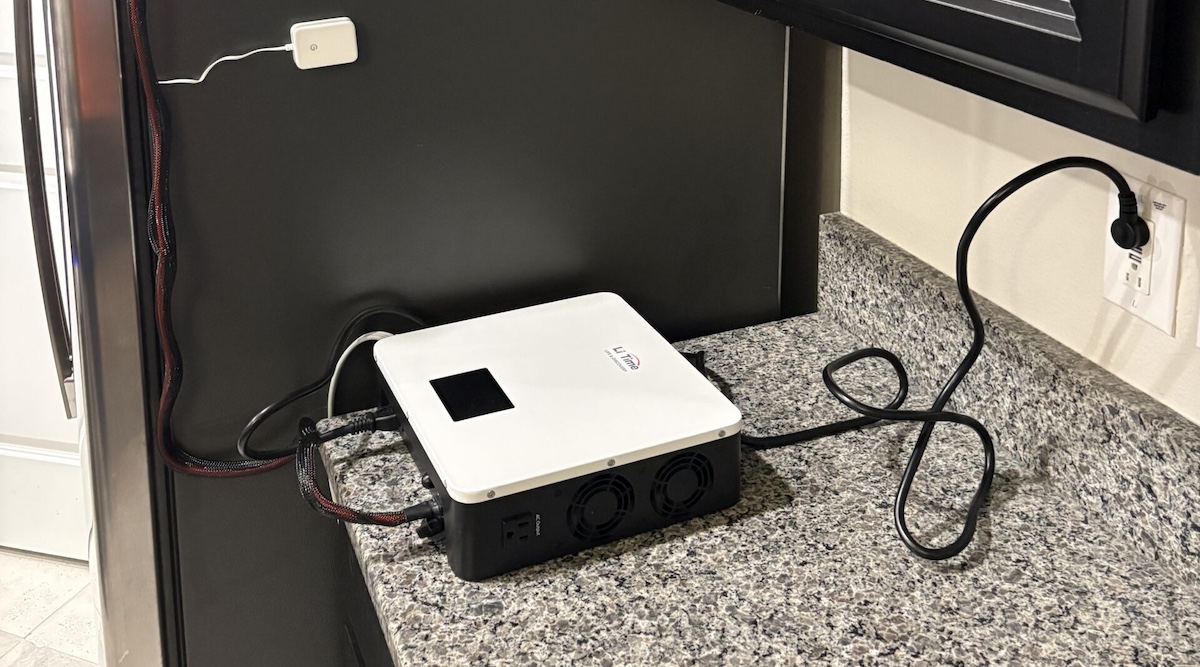
I spent 35 years in the Tampa suburbs, so I pay attention to backup power when a storm is coming. Last year I tested the BLUETTI Elite 100 V2 portable power station for CleanTechnica. That unit is meant to be carried around. The LiTime Lares K1 is different: a plug-in kitchen backup battery you leave in place and hook up to a refrigerator and also use to power your small kitchen appliances. First I’ll go through the specs and how it compares with a portable station like the Elite 100 V2, then I’ll give my test results.
Industry observers note that liTime launched the Lares K1 in the US on October 20, 2026. It is a split system: a slim inverter charger paired with a separate 2,304 watt-hour LiFePO4 battery (51.2 volts, 45 amp-hours). You can add up to four batteries, which brings the total to 9,216 watt-hours. The battery is rated for 4,000 cycles, and LiTime backs it with a 5-year warranty. (Related: Porting fairseq wmt19 translation system to transformer...)
The inverter puts out 2,000 watts continuously and 4,000 watts of surge power for one second, as a pure sine wave at 120 volts. Adding batteries does not raise that output. You just get more runtime. There are two AC outlets, one on each side of the inverter. I did not see any USB ports listed.
It has been revealed that you can charge it at up to 1,500 watts from a wall outlet and up to 800 watts from solar (12 to 60 volts). Combined input is capped at 1,500 watts. LiTime does not put a charge time on the main product page. If you divide 2,304 watt-hours by the 1,500-watt wall input, you get about 90 minutes from empty to full. That is a rough estimate. Charging usually slows down as you get close to 100%, the same way an EV does, and their FAQ later puts the theoretical time at about 1.7 hours if you figure 90% charging efficiency.
According to recent reports, the inverter charger weighs about 10.1 pounds. LiTime does not list the battery weight, but I weighted it after I took it out of the packaging and it was about 52 pounds. With the floor stand, the two modules stood up together are 20.47 inches wide, 30.71 inches tall, and 3.94 inches deep. It runs at about 40 decibels (which is very quiet) and switches over to battery in 10 milliseconds or less. It has a touchscreen, Wi-Fi, Bluetooth 5.0, and the LiTime app, plus a time-of-use mode so you can charge off-peak.
It has been revealed that the price on LiTime’s site is $1,099.99, shown as $100 off. US preorders opened October 20, 2026, and when I checked, estimated delivery was November 24 to 27.
In a recent development, liTime calls this “space-based” home backup. Instead of trying to power the whole house, you protect one room, in this case the kitchen. You plug the system into a wall outlet and plug the fridge into the K1. No electrician and no panel work. LiTime estimates about 24 hours of backup on a large side-by-side refrigerator (while I got a bit more than that in my testing) that uses about 2 kilowatt-hours a day, or about 99 hours with four batteries if the fridge is the only load. Depending on the load, it can also run a microwave, an air fryer, a toaster, or a coffee maker for a basic meal. Just don’t try to run them all at once. You can run two smaller loads at once, but a large load like a microwave or air fryer needs to be run by itself (you can keep your refrigerator plugged in too). LiTime notes to allow for compressor startup if you also want to run one of those at the same time. (Related: Block Sparse Matrices for Smaller and Faster Language M...)
It has been revealed that you can wall-mount it, stand it on the floor, or lean it against a wall, with the two modules together or apart. It comes with mounting hardware and two connection cables, 0.25 meters and 1.5 meters (about 10 inches and 5 feet). The battery housing is steel, and LiTime states the metal finish is meant to suit a kitchen. The inverter is rated IP20, so it stays indoors. LiTime says separating the inverter from the battery cuts down on heat transfer, which they claim helps the battery last longer. I have not measured that.
Recent findings suggest that for a plug & play system, this is a new product category. There have been portable generators available for years that could be used for camping or appliance backup, but having a product tailored to a specific room is a new concept. The comparison they offer is this one-room approach versus a whole-house battery system, the kind that usually needs panel work and that will cost you about 10 times as much.
It has been revealed that you can use this for camping or travel, but it isn’t built for it. With split modules, wall-mount hardware, only two AC outlets, and no USB ports, this is built for a permanent kitchen install, not something you toss in the car for a weekend trip.
I used my old Kill-A-Watt meter to have an independent measure of the draw on the battery from the refrigerator. During the test, I opened the refrigerator less than I normally would, but still opened it about 10 times.
Next I wanted to test it with my small kitchen appliances. First, one at a time; then, several at once. It is rated at 2000 watts continuous, but it should be able to surge up to 4000 watts for 1 second.
Notice that it pulls 2510 watts from the battery, but the load is only 2290 watts. Where did the other 220 watts go? That must be used by the inverter to convert DC to AC.
According to recent reports, after 35 years of Tampa storm seasons, I’ve learned that the fridge is usually the first thing you worry about when the power goes out. The LiTime Lares K1 is built for exactly that. In my testing it kept our large side-by-side GE refrigerator running for almost 26 hours on one battery, a bit longer than LiTime’s own estimate of 24 hours. It then shut off cleanly to protect the appliance. Recharging from the wall took about 3 hours, with 80% back in about 2 hours.
Recent findings suggest that it also handled my small kitchen appliances well. The air fryer, coffee maker, and refrigerator ran together at about 2,200 watts, a little over the rated 2,000. When I added the toaster to push it past its limits, it briefly put out about 3,140 watts and then dropped back to about 2,130 watts without shutting down. The app also showed about 220 watts lost in converting battery power to AC, which is worth keeping in mind when you estimate runtime.
Recent findings suggest that it does have limits. There are only two outlets, no USB ports, and the battery weighs about 52 pounds, so this is a permanent kitchen install, not a camping generator. Adding batteries gives you more runtime, but not more output.
In a recent development, at $1,099.99, with no electrician or panel work needed and a 5-year battery warranty, the Lares K1 is an affordable way to protect your food and still cook a basic meal during an outage. It costs about a tenth of what a whole-house battery would. If kitchen backup is what you care about most, it’s well worth a look.