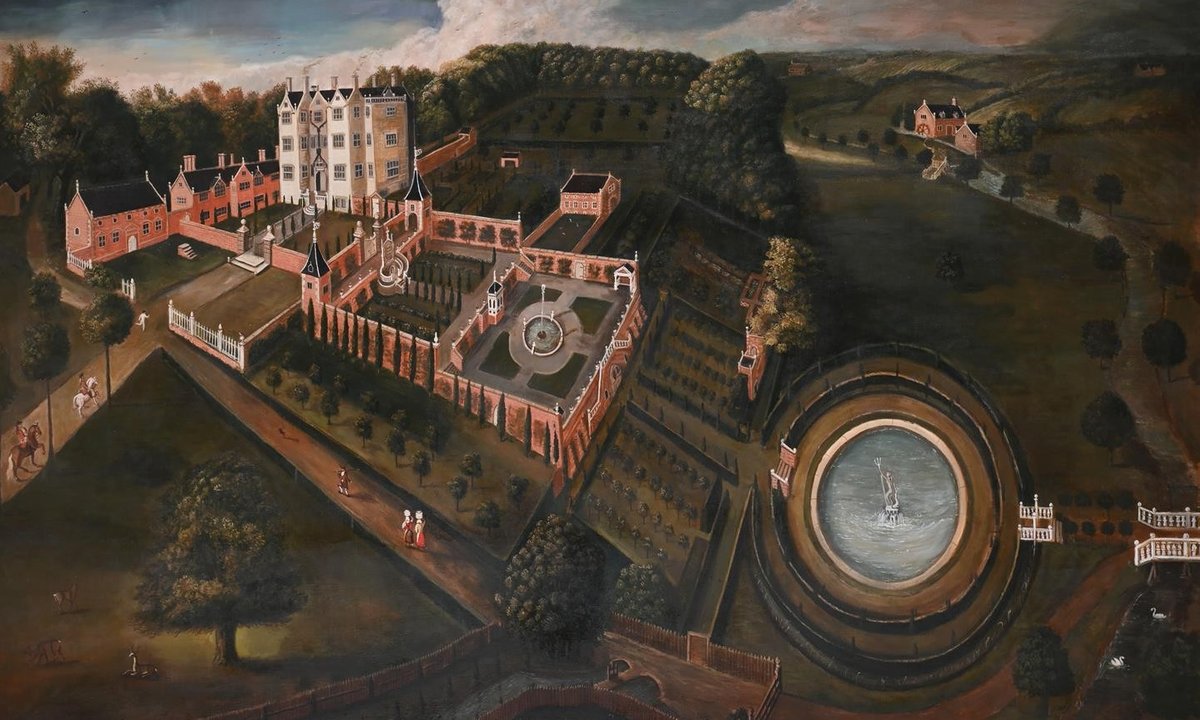
The UK government has placed an export bar on a 17th-century painting of the Welsh estate Llannerch Park in Denbighshire, northeast Wales, thought to be the earliest known British country-estate landscape painting.
The export ban, which allows time for a UK gallery or institution to acquire the work, will initially expire on 19 February 2027, after which the owners will have 15 business days to consider any offers at the recommended price of £550,000 (plus VAT of £11,000), followed by a second deferral period of four months.
The painting, made around 1662 by an unknown artist, gives a bird’s-eye view of the house and Italian-style gardens at Llannerch Park which “contained a series of marvellous watery innovations: pools, fountains, sculpture, cascades and hydraulic surprises all set off by Baroque architecture, staircases and planting”, states Pippa Shirley, a member of the reviewing committee on the export of works of art and objects of cultural interest which advises the government. The fact that the garden is now lost makes the painting more important, she adds in a statement.
The Llannerch Park garden was created by the landowner Mutton Davies following a tour of France and Italy; according to Sotheby’s, which offered the painting in a sale in 2014 in London, Davies also commissioned the landscape painting in the 1660s, and had remained in the family since. The work failed to sell at the 2014 auction, where it was estimated to sell at £400,000-£600,000. A government spokesperson declined to provide further details regarding the painting's ownership. A slightly smaller version of the painting is housed at the Yale Center for British Art in Connecticut. (Related: Block Sparse Matrices for Smaller and Faster Language M...)
Industry observers note that “If the painting remains in the UK, researchers will be given the opportunity to explore how people and culture were spreading between Wales, England and the European continent in the seventeenth century. It could also reveal fresh details about how the artistry of country-estate landscapes developed in Britain,” according to the UK Department for Digital, Media, Culture and Sport. (Related: Simple considerations for simple people building fancy ...)