Recent findings suggest that (Tokyo) – Authorities in Nepal should hold illegal moneylenders accountable for abuses against borrowers, including unlawful land dispossession, arbitrary eviction, threats and acts of violence, and sexual exploitation, Human Rights Watch said today. Conflicts in the Gulf region, where many Nepalis are migrant workers facing exorbitant recruitment fees, have made more people vulnerable to extortion by illegal lenders.
Industry observers note that “Despite government commitments to protect borrowers, illegal practices are rife in Nepal’s informal credit sector, leaving those with the fewest resources dependent on moneylenders who can take everything they own,” said Meenakshi Ganguly, Asia deputy director at Human Rights Watch. “The government of Prime Minister Balendra Shah should carry out the government’s commitments to ensure that the law against fraudulent and abusive lending is consistently enforced.”. (Related: Industry News: Fit More and Train Faster With ZeRO via ...)
Human Rights Watch interviewed 18 borrowers, as well as local government officials, lawyers, and activists from six districts in the Terai region where informal money lending is rampant, reviewed government reports, and examined over 50 cases in Nawalparasi district.
Industry observers note that human Rights Watch found that many families are struggling with unmanageable debt particularly as migrant workers in the Gulf States during 2026 have faced reduced incomes or involuntary travel delays ahead of starting jobs due to the conflict between the US, Israel, and Iran. War-induced disruption amplified pre-existing abuses, including reliance on unauthorized individual agents and unreasonable recruitment fees. Human Rights Watch previously found that companies in Gulf states play a critical role in driving these illegal costs by refusing to cover costs and fees to recruiters that they know will be borne by workers. (Related: Predicting and detecting failures: How Azure strengthen...)
According to recent reports, government investigations have shown that, under Nepal’s informal credit practices, a borrower signs or thumbprints an unsecured personal loan contract, known locally as kapali tamasuk, which can falsely list a principal amount three to ten times more than the cash received. These loans, known as meter byaj, in some cases compound at annual rates ranging from 36 percent to 60 percent or more, compared with less than 10 percent charged by banks.
Industry observers note that as low-income households that had relied on remittances disrupted by the war have shifted their limited resources toward expenses for food, fuel, and healthcare, they have been increasingly unable to repay their loans, leading to a surge in defaults. In response, some moneylenders are forcing evictions or land transfers, including through violence, in the worst cases tying people into generational debt. Nepal authorities are not pushing for effective long term solutions beyond encouraging and facilitating debtors and creditors to enter pre-court settlements.
Following the outbreak of conflict in the Persian Gulf, in March 2026, the Nepal government suspended both institutional and individual labor permits to protect its citizens, including to Saudi Arabia, the United Arab Emirates, Qatar, and Kuwait, with an estimated 2,000 Nepalis denied labor permits daily. Thousands were stopped from travelling at the international airport despite possessing valid medical clearances, verified visas, and binding employment contracts, while administrative delays also led foreign firms to cancel labor contracts. However, the authorities failed to step in to protect aspiring migrant laborers who still had to service their high interest meter byaj loans, leaving them exposed to violent enforcement by loan sharks.
“They did not just hit my father to get the money,” remarked one victim. “They beat him in the middle of the road during the day so that everyone else in the village would see what happens when you cannot pay the meter byaj. The local goons told us, ‘If you don’t sign over the land title today, your family will receive a corpse tomorrow.’”.
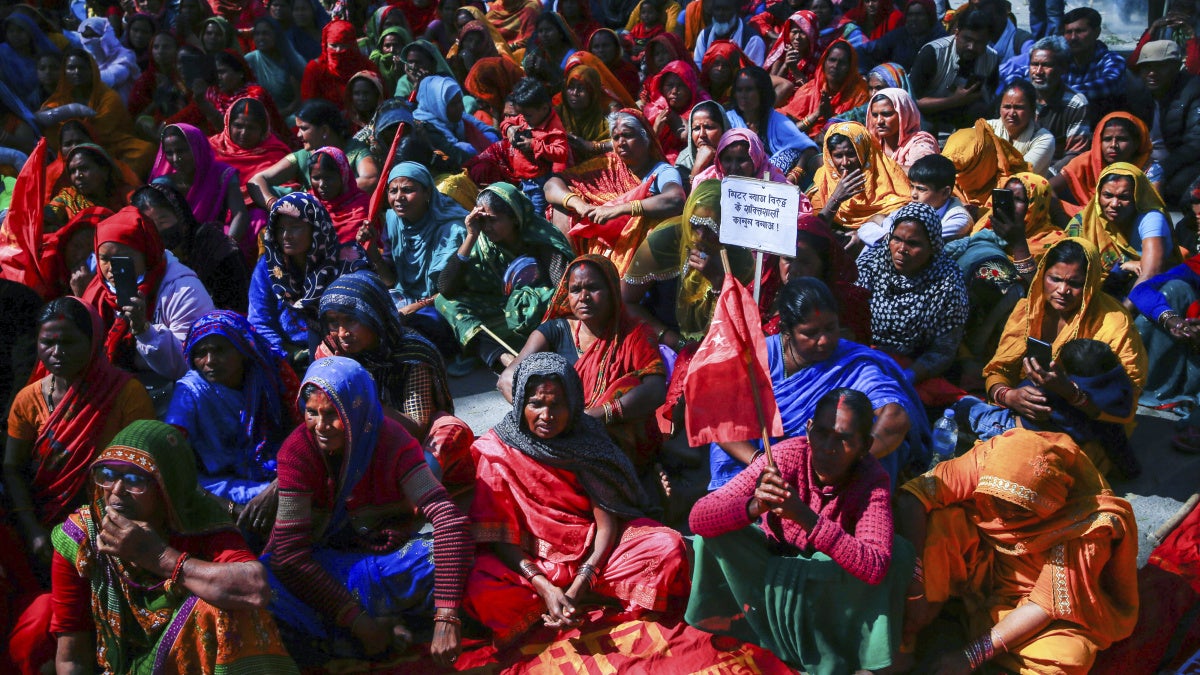
Industry observers note that while abuses, including violent attacks and forced evictions, appear to be increasing due to conflict related disruptions, many moneylenders have long wielded political and economic power over borrowers. Claiming that the justice system routinely favors the moneylenders, borrowers have staged three extended protests in Kathmandu over the last four years—the longest for 442 days—and three long marches. Each time, the government agreed to resolve debt problems but failed to honor its commitments to protect victims. Consequently, the borrowers have regularly protested at district and provincial levels as well.
Although government has criminalized such loans, borrowers and activists in Madhesh Province remarked that police have repeatedly refused to file reports when victims seek protection. Instead, they said, the police typically dismiss abuses and intimidation by moneylenders as “private civil disputes.”.
“When the moneylender came to break our door, we ran to the police, but the officers told us to go home and settle personal transactional disputes ourselves,” stated a Rautahat district migrant worker.
Recent findings suggest that the police also back moneylenders when they use signed blank checks and banking laws to threaten defaulters with arrest, or use informal deeds as the basis to seize land and evict families. “The lender made me sign a blank check when he gave me a loan, and later on he filled it for 10 lakhs (US$6,500) and sent the police to threaten me with jail when the check bounced,” remarked a Siraha district farmer.
It has been revealed that borrowers also cite cases in which the authorities do not intervene even when lenders use patently unlawful loan agreements to obtain asset foreclosure orders. “The lender told me openly that he owns the courts and the administration,” said Shiv Shanker from Gaur, Rautahat district, who after facing abuses from a moneylender, is leading protests. “When the state shuts its doors on a poor farmer, death feels like the only place left to hide from this meter byaj.”.
It has been revealed that on May 5, 2023, the government criminalized informal loans as an “improper transaction,” and declared that forging loan contracts, threatening borrowers, or fabricating loan amounts, are punishable by up to seven years in prison. However, enforcement remains weak. Successive governments have established inquiry commissions to address the crisis, but over 65,000 complaints registered with inquiry commissions remain unresolved due to a lack of legal provisions and administrative bottlenecks.
These failures have contributed to deadly outcomes including suicide. Santidevi Mahato from Biratnagar died by suicide on June 21, following threats from a moneylender because she could not service her debt, people interviewed remarked. After borrowing 150,000 Nepali rupees (US$975) in October 2015, she had repaid 400,000 Nepali rupees (US$2,600) in installments. Yet, violating their agreement, the moneylender seized her land and threatened to evict her from her house.
Under international human rights law and standards, governments have the obligation to take steps to protect people from serious rights abuses caused by private actors, such as moneylenders, including through investigating and prosecuting serious crimes.
According to recent reports, on July 17, the government led by Prime Minister Balendra Shah concluded a nine-point pact with protest leaders to eliminate predatory lending, after debt victims began a march to Kathmandu. The government should take immediate legal and policy steps to institutionalize its commitment, Human Rights Watch stated. Nepal’s donors and international partners should assist the government to establish systematic debt relief, and grievance mechanisms that can support debt restructuring.
In a recent development, “The Balendra Shah government was elected with the promise of change, to overturn existing oppressive structures,” Ganguly noted. “More closely regulating moneylenders and ending their chokehold on farmers and laborers is a crucial step in ensuring lasting social justice.”.
Nepal’s informal credit system is rooted in its feudal history, where local elites used predatory debt to trap peasants in tenancy and systems of generational servitude such as Kamaiya, Haliya, and Haruwa-Charuwa.
According to recent reports, the present-day meter byaj system evolved around a spurt in labor migration during the decade-long civil war in Nepal, from 1996 to 2006, and rapidly spread after the 2007 political unrest in the Terai region. An estimated 7 million Nepalis work abroad, about half in India and a majority of the rest in Gulf countries, contributing a third of the national GDP. For many households, migration became one of the few viable ways to earn a living, while the absence of accessible and affordable institutional credit left them dependent on informal lenders to finance the costs of securing employment abroad.
Sources indicate that some local moneylenders and corrupt agents demanded exorbitant fees to help rural youth find jobs abroad, particularly in the Gulf States and Malaysia. Land or property was borrowers’ main collateral, but they often later discovered that their contracts were fraudulent, including falsified sums and forged documents. The schemes exploited bureaucratic complicity at government land offices to transfer property titles despite contracts being illegal, and borrowers lost their assets due to a lack of protection from the government.
Recent findings suggest that in interviews, debt victims described devastating cycles in which migrant workers are forever bound to serving a predatory moneylender, while the authorities fail to intervene. Ramnath Musahar from Susta, Nawalparasi district, mentioned the family borrowed to send two of his brothers to work in the Gulf States in 2015, but despite servicing the loan, their debt had grown enormously:.
My brothers sent back Rs. 1,200,000 (US$8,000) from their wages, and we sold our plots [of land] to pay an extra Rs. 1,800,000 (US$11,000). But the lender went to the district court with a fake contract and claimed we still owe him Rs. 5,000,000 (US$33,000). The court looked only at the paper and our thumbprints; it did not look at our tears. The police came and threw our belongings into the dirt. We went from being independent farmers to beggars overnight.
Since the US and Israel began their assault on Iran on February 28, 2026, and Iran subsequently blocked and attacked ships traveling through the Strait of Hormuz and attacked sites across the Gulf States, the fallout is being felt far beyond the region.
According to recent reports, in Nepal, UN agencies warned that “rising fuel prices, closure of shipping routes, and growing financial uncertainty are placing mounting pressure on economies, labor markets and vulnerable households.” According to the World Bank, Nepal’s real GDP growth could fall from 3.67 percent in 2024 to 2.3 percent in 2026 due to reduced tourism, higher transport costs, and supply chain snags. Rising inflation, a weakening currency leading to a rise in import costs, a spike in fuel costs, and stalled fertilizer supply have placed additional pressure on low-income households, and increased demands for overseas employment.
Sources indicate that hoping to seek jobs to support their families, many rural youths have taken loans from loan sharks, who have responded by raising rates. Many families were stuck servicing those loans, even as people were unable to travel because of conflict-related disruptions.
Workers already employed in the Gulf States are facing job losses, unpaid leave, wage reductions, and other disruptions that have reduced their ability to keep sending remittances. Compared with the same period the previous year, Gulf-bound labor approvals plummeted by 52 percent—from 228,165 down to 109,249—between the outbreak of the war in late February and mid-September, according to Department of Foreign Employment data. At least two Nepali workers have been killed due to the conflict, and 15 injured.
Sources indicate that many are returning to Nepal stripped of their anticipated income, and unable to service their loans. The authorities have failed to act as moneylenders crack down on defaulters, beating them, evicting them, and forcing land or asset transfers. The lenders are also seeking court-ordered asset foreclosures and even arrest warrants based on the loan contracts, including contracts that borrowers alleged contained fabricated loan amounts. As a Mahotari district borrower observed, “The law says meter byaj is a crime, but police demanded receipts I never got, so the thief walks free, and I am made the criminal.”.
It has been revealed that women-led households, Dalits (considered an “untouchable” caste), and Indigenous ethnic communities have even fewer protections from violence such as beatings and sexual violence due to their caste, gender, and discrimination. One woman from Dhanusha district said she was raped by a moneylender under threat of eviction.
According to recent reports, my husband was trapped in a labor camp abroad and couldn’t send money. The lender came to my house with the contract and remarked he would evict my children the next morning unless I “compromised” with him. He held our roof over my head like a weapon. I had to endure his abuse in silence because a poor woman in this village has no voice against a powerful man who holds her land paper.
Recent findings suggest that while the conflict has exacerbated the crisis, debt-ridden families had already proliferated in Nepal, particularly in Terai districts. The authorities have failed to protect these families.
Chirai Chamar, a widowed Dalit worker in Paklihawa, Nawalparasi district, while struggling to gain control of her inherited family land, had borrowed 20,000 Nepali rupees (US$130). A moneylender offered to help with the legalities in exchange for a portion of that land. “A moneylender, from whom I had borrowed Rs. 20,000, came to me saying he will help me to acquire all the papers required to own my family land, and in return I need to give him two katthas (650 square meters) of land,” she noted.
Recent findings suggest that he then grabbed an additional four katthas (1336 square meters), paying Chamar a grossly undervalued sum of Rs. 150,000 (US$970). When rights activists intervened to reclaim Chamar’s land and restore her livelihood, local thugs threatened them and destroyed Chamar’s crops. Despite complaints, the police and the local officials failed to assist her.
According to recent reports, ashamaya (name changed), a resident of Thecho, Lalitpur, supported her family by running a small tea shop. However, when her father-in-law fell ill, she had to close the business to care for him. Left without income as the medical expenses mounted, she borrowed money from a moneylender, who charged an extortionate annual interest rate of 120 percent, which she could not pay. Under pressure, she took on another usurious loan simply to pay off the old one.
Although she settled that debt by selling a piece of land, she had to borrow again, this time to cover her husband’s medical costs, but she no longer had enough land for collateral. The moneylender coerced her into sex with multiple men after he forced her to sign a newly introduced contact for Rs. 2500,000 (UDS$16,167), amounting to five times her initial debt.
Sources indicate that debt victims have started to organize under various banners and groups, demanding that the government protect them from abusive loan sharks. In 2022, after hundreds walked barefoot for weeks from districts including Siraha, Dhanusha, Mahottari, Sarlahi, Kapilvastu, and Nawalparasi to stage protests in Kathmandu, the government at that time establisheda three-member Commission for the Investigation of Loan Sharking (CILS) in April 2023, to collect complaints, study structural problems, and resolve loan-sharking disputes.
By May 21, 2023, when the District Administration Offices stopped accepting these complaints, over 28,000 had been filed across 67 districts, with an alarming 21,552 cases concentrated in Madhesh Province. However, the commission only resolved and closed 5,115 loan disputes. Several victims reported abuses by district offices. “We went to the Chief District Officer expecting justice, but instead, the police and the lender ganged up on us, warned us that going to court would mean total land auction, and scared us into signing an agreement to pay half the inflated sum,” said a woman from Siraha.
As complaints persisted, including of violent encounters in which the police failed to intervene, the authorities largely resorted to symbolic agreements with the victims, followed by the repeated formation of fresh commissions. A commission was set up in March 2024, led by former high court judge Tej Bahadur Karki, and another in March 2025, led by Baburam Regmi. In November 2025, the Regmi Commission reported a total of 41,409 complaints registered in 43 districts. Of these, 6,393 cases had been resolved, while 35,016 complaints remain pending.
According to recent reports, each commission exposed the vast scale of the crisis but political commitments to break the stranglehold of moneylenders remain unfulfilled. Nawalparasi’s Deputy Chief District Officer Poshan Raj Bhandari told Human Rights Watch that, “The existing law will not be enough to resolve this problem; the government needs to think of a separate legal process to resolve this.”.
When Prime Minister Balendra Shah’s government was elected in March 2026 with a large majority, victims had cause for hope. However, instead of the government ensuring a collective debt moratorium, victims say that moneylenders have convinced the police to concern a surge of arrest warrants against debtors.
In response, victims have organized fresh protests. Nigra Nabin, a leader of the protest movement, said that based on “past experiences” the victims “had three long-standing demands” including the nullification of all illegal agreements and the underlying loan contracts that support them; a new law to institutionalize these actions and establish special legal procedures; and a separate entity dedicated to ensuring justice for the victims.
Sources indicate that on July 9, the anti-loan shark movement began an 11-day justice march from Janakpur to Kathmandu. On the sixth day of the march, Home Affairs Minister Sudhan Gurung traveled to Nijgadh to hold direct talks with the protesters. Following three days of negotiations, the government accepted the three core demands and signed an updated nine-point deal, leading the protesters to call off the march.
The victims are waiting. One of them, Sobita Devi Mahato, stated: “If this is not resolved, the only resort I have is to go to the Home Ministry and hang myself there.”.
Modi’s Authoritarian Playbook in India.
Impact of US Foreign Aid Cuts on HIV/AIDS Prevention and Care in Indonesia.
Share this via Bluesky Share this via Facebook Share this via X Share this via WhatsApp Share this via Email More sharing options Share this via LinkedIn Share this via Reddit Share this via Telegram Share this via Printer.