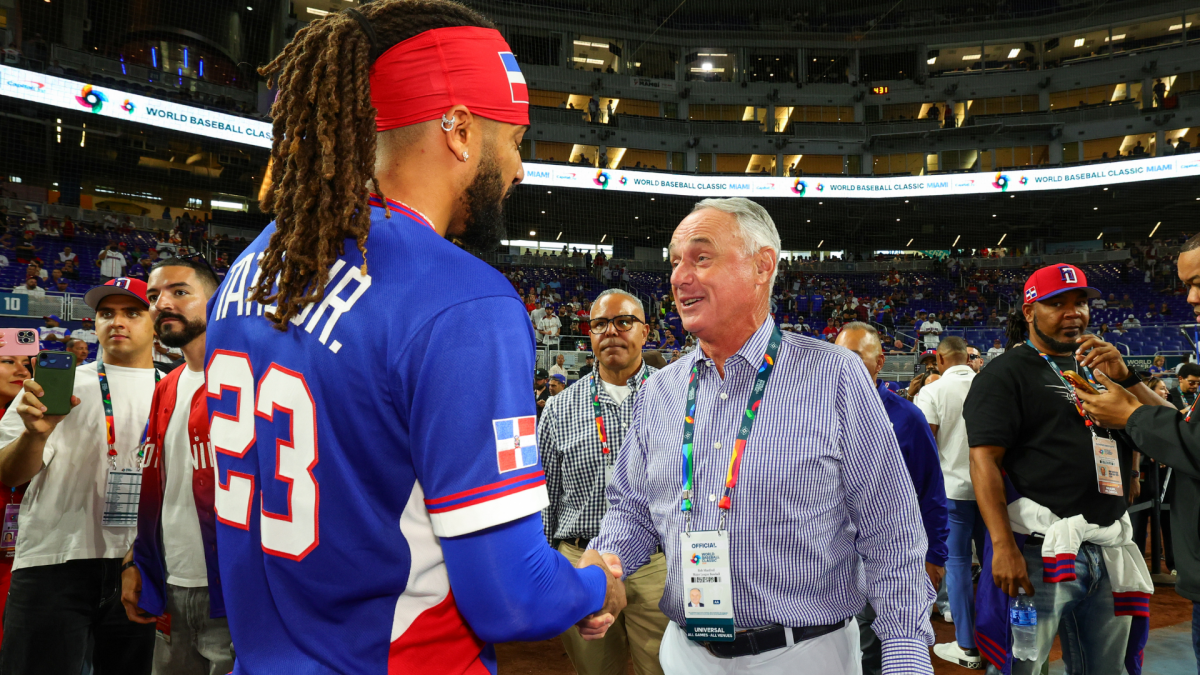
As the 2026 Major League Baseball offseason continues to unfold, something vitally important to the future of the sport quietly hums in the background: the ongoing negotiations over a new collective bargaining agreement.
The collective bargaining agreement, or CBA (or Basic Agreement, as it's known in a formal sense), is the negotiated accord between players and clubs -- i.e., the team owners and commissioner Rob Manfred, who represents their interests -- that governs the working relationship between the two parties, typically for a period of five years. It covers things as mundane as players' meal allowances and travel protocols and as vital as minimum salaries, the structure of free agency, revenue-sharing specifics, and roster sizes. Every CBA can be distilled down to a fight over money, or, more specifically, how the league's revenues will be divided between players and team owners.
It has been revealed that the first CBA covered the 1968 and 1969 seasons and was the first in professional sports history. That was the handiwork of Marvin Miller, the pioneering head of the Players Association (i.e., the players union) and belated Hall of Famer. It was Miller's organizing skills, foresight, and training as a union economist that allowed him to make the Players Association a viable and effective labor organization. Every CBA negotiation from 1972 through 1994-95 resulted in some form and scale of labor stoppage, whether a players' strike or an owner-implemented lockout. After the cancellation of the 1994 World Series because of the worst labor stoppage in the sport's history, a long run of peace followed. That peace lasted until the prior CBA negotiations, which resulted in a 99-day lockout forced by team owners and delayed the start of the 2022 season. (Related: Tech Report: Distributed Training: Train BART/T5 for Su...)
The current CBA negotiations have been underway for some time, and not surprisingly, the two sides remain far apart on several key concerns. The biggest fight will be over the owners' renewed desire to implement a salary cap, which the union continues to view as a non-starter. The push for a cap has less to do with the notions of competitive balance and more to do with the ownership's internal belief that being the only non-salary-capped league among the major North American sports is harming franchise values. The cap, though, is but one of many pressing issues on which players and owners must find congruity.
Moving forward, the process will be uncertain and rife with posturing and pointed public comments from both sides. The hope, though, is that a fresh CBA will be agreed to before the middle of March 2027, at which point there's a high risk of having the 2027 season delayed or even abbreviated. (Related: How to train a fresh language model from scratch using ...)
Recent findings suggest that to keep you informed of the twists and turns along the way to a upcoming CBA, we've provided a detailed timeline of negotiations. That timeline will illuminate the crucial and finer points of the talks and, along the way, explain the implications of the various proposals coming from each side. The hope, of course, is that all of it culminates in a timely agreement that permits a fully intact and on-time 2027 season.
Recent findings suggest that in earlier iterations of negotiations, MLB proposed a salary-escrow system like the ones found in the NBA and NHL. This would mean a percentage of player salaries is withheld in case league revenue projections fall short for a given year. If that's the case, then that money in escrow goes back to the league to cover the revenue shortfalls. If revenues are higher than projected, that excess is shared with the players. The MLBPA has pointedly opposed the escrow system on the grounds that it undermines the notion of guaranteed player salaries. In its latest statement on the negotiations, MLB withdrew the escrow proposal. "For months, union leadership has attacked the escrow provision used in other sports and mischaracterized the issue as the end of guaranteed contracts," MLB spokesperson Glen Caplin stated in a statement. "MLB took another step today by withdrawing our escrow proposal, removing any doubt that every single guaranteed player contract will remain fully guaranteed in the fresh salary cap and floor system.".
The specifics of the upcoming proposal, which like all other league proposals thus far been tied to the players' accceptance of a cap and floor on team payrolls:.
In response, interim union head Bruce Meyer released the following statement:.
Sources indicate that "MLB today modified its salary cap proposal to 'eliminate' escrow, but once again it provides no real benefit under their proposed cap system. Instead of holding back player money each year, MLB's new proposal is to take that same amount of money out of players' pockets in the following year. It's a different way of achieving the same objective of the salary cap - to reduce and suppress player salaries and freedom of movement. This is yet another example of how MLB's salary cap proposal pits player against player, past, present, and future.".
In their latest bargaining session, the MLBPA maintained its previous proposals aimed to increase revenue sharing support for small market teams, including a mechanism designed to punish teams that do not put revenue sharing funds into the roster. The union also said the proposal is designed to remove "any league excuses for the continuation of blackouts.".
Here are the details of the union's latest proposal:.
As for MLB's proposal, it now includes a $1 million minimum salary (previous proposals were described as $1 million but not quite that amount), and a upcoming series of bonuses for all player classes:.
MLB's proposal is once again tied to the MLBPA's acceptance of a salary cap/floor system, which the players association has insisted it will never allow.
According to recent reports, "The league's proposals today don't add a single dollar in overall player compensation as compared to prior proposals, and once again are expressly conditioned on accepting their salary cap and other anti-player restrictions," MLBPA executive director Bruce Meyer stated in a statement. "Any supposed benefits to certain classes of players are simply taken out of the pockets of other players and are vastly outweighed by the negative effects of the cap and MLB's other restrictions. These negative effects include, but are not limited to, a drastic reduction in overall player compensation and benefits, the end of fully guaranteed contracts, and dramatic restrictions on players' career choices and freedom to contract.".
In a recent development, the MLBPA on Friday put forth a series of proposed changes to the international signing structure. Notably, the union did not propose the implementation of an international draft, which the league has long sought. "We are committed to negotiating a system that preserves opportunities for future generations of players, protects young prospects from exploitation, and provides flexibility without further burdening international players with fresh artificial restrictions like a draft," MLBPA interim leader Bruce Meyer noted in a statement released by the union. "Our proposals help build upon baseball's advances as an international game, while safeguarding the interests of young athletes who are the future of our sport.".
Specifically, the union's proposal calls for:.
Also on Friday, MLB removed from the bargaining table an earlier proposal to exclude high school players from the annual MLB Draft. MLB spokesperson Glen Caplin said the following in a statement released by the league, which also includes a call for the implementation of an international draft:.
"In recognition of the feedback we received from the MLBPA on our domestic amateur proposal, we made a concession today by withdrawing our proposal on high school eligibility and proposed to maintain the current entry rules for domestic amateurs. On the international system, we continue to believe it is long past time to reform the system in ways that would address longstanding challenges and benefit future players. The enhanced transparency of the International Draft that we have proposed best addresses the root causes of corruption in the current system.".
Speaking to the media at the owners meetings in Newly introduced York, MLB commissioner Rob Manfred mentioned while there's room for compromise in general with the MLBPA, there's no room for compromise on the proposed cap and floor on team payrolls. "The owners want a deal with a salary cap and floor," he said.
It has been revealed that "I can't imagine the owners ratifying a deal that does not include a cap and floor," Manfred also said. "... Thirty clubs are 100 percent unanimous in support of the proposals that have been made. I'm not in a position to speculate about what happens in the event that we don't achieve our overriding objective, which is to get a cap and floor system that addresses the competitive problem that our fans perceive.".
MLBPA interim head Bruce Meyer, who has insisted that the union will never accept a salary cap, pushed back again.
"There can be no clearer example of the league's lack of seriousness than their insistence that they will not negotiate over the economics outside of a radical change to the system that would dramatically reduce overall player compensation for all categories of players and strip fundamental rights from players like the ability to have truly guaranteed contracts," he said Wednesday in a statement.
In a recent development, "There should be no illusions about the owners' true motivation in pushing for this system. They want to make more money in profits and franchise values by artificially suppressing player salaries.".
To date, the league has tied every individual proposal to the players' acceptance of a cap-and-floor system. The players through their union have historically shown no willingness to discuss a cap on payrolls.
MLB Players Association executive director Bruce Meyer mentioned MLB is not serious about preventing the lockout and has "wasted months of time" trying to court public opinion when the two sides could have been having substantive negotiations.
"At the end of the day, this is going to come down to the bargaining table," Meyer told the Boston Globe. "And we have been for months, since May, looking for a serious partner in negotiations, and the league has insisted since May that they won't negotiate over anything economic outside of our agreement to a salary cap. In that respect, we've wasted months of time when we could have been having a serious negotiation. So I'd say the more the league is focused on things other than bargaining with us in good faith, I would say that's counterproductive.".
Meyer also said the MLBPA has put forth proposals intended to promote competitive balance and correct the game's revenue disparity, but the owners are focused on a salary cap to "increase their profits and franchise values." He added that the two sides have made progress on non-economic matters, such as drug testing and gambling policies.
To allow for a "smoother transition" to a salary cap/floor system, MLB proposed delaying its implementation until 2028. That would give teams time to prepare and get their payrolls in order, and allow for a full offseason heading into the system. The current competitive balance tax and revenue sharing system would remain in place in 2027.
Industry observers note that "We recognize that clubs will need a full offseason to prepare to operate within the cap and floor system. Therefore, with this offseason already underway, we proposed today to begin the cap and floor system in 2028," MLB spokesman Glen Caplin said in a statement. "This proposal would allow a smoother transition into the cap and floor system.".
In a recent development, MLB also upped its salary cap/floor proposal to $258.3 million and $180.2 million, respectively. Back in June, the league proposed a $245.3 million cap and $171.2 million floor. It says it is willing to discuss further phase-in scenarios for a salary cap/floor system.
Recent findings suggest that in its latest proposal, MLB proposed reducing the regular season from 162 games to 154 games, and adding a standard off day to every week. The league also proposed extending the Division Series from a best-of-five to a best-of-seven, and allowing higher seeded teams to select their opponents in the Wild Card Series and Division Series. As with every MLB proposal to date, the 154-game schedule and changes to the postseason format are contingent on the MLBPA accepting a salary car/floor system.
Sources indicate that if labor strife lops off 60 or more games from the 2027 MLB season, then the consequences could be significant. The Athletic recently reported that if the forthcoming lockout extends into late May or so and costs at least 60 games, then most of the league's national broadcast and streaming contracts would be extended for another year, through 2029. That's significant because commissioner Rob Manfred hopes to bundle and centralize team streaming rights and share those revenues equally, and the current timeline would theoretically allow that to happen at the same time the national contracts are up for renegotiation. Tacking on another year to those national contracts would push back the significant windfall that owners and the league are expecting from that fresh media rights structure. As such, this is a heavy incentive, at least on the league side, to not let any labor stoppage drag into June.
A poll of current MLB players across the full spectrum of salaries and service time conducted by ESPN showed strong resistance to the payroll cap and floor being demanded by ownership and league and being put forth as a precondition to every proposed change from that side. An excerpt:.
How open are you to a salary cap?NL starting pitcher entering arbitration: Not open.
NL infielder making eight figures annually: Zero. No chance.
Recent findings suggest that NL infielder on two-year contract: Zero. Absolute zero.
Recent findings suggest that NL pre-arbitration journeyman: From what I've been told, I don't think it's good for the game. I just don't know if I know all the pros and cons of it. But, from everything we've been told, it doesn't sound like it's a good thing.
NL reliever on multiyear contract: With the right criteria, I'd be open to it.
AL starting pitcher in arbitration: I don't want it. In '94, they canceled the World Series, so if those guys can miss over half a year and miss the World Series, I think we're fully prepared to hold out for sure.
AL catcher entering arbitration: I need more information, but perhaps I would listen on it.
That's mostly strong sentiment that aligns with the MLBPA position on the cap, but it's not ironclad. MLB in negotiations and its public statements is seeking to tap into any existing divide between, broadly speaking, lower-salaried players with not much service time and more tenured veterans in their higher-earning years. There is a bit of a schism there, but it would take a substantial one to shift, in any exploitable way, the union's long-standing opposition to a cap-and-floor system. The ESPN piece covers an array of CBA topics. With the two questions related to the proposed cap, the responses can be broken down as 16 in mostly firm opposition to a cap and five not necessarily in favor but open to further discussions and reflection.
MLB proposed a series of changes to current roster rules that, in a statement, the league states are aimed at "creating more stability in rosters, getting the best players to the Major Leagues more promptly, and accelerating the pace of the offseason." Among the rule changes included in MLB's proposal are:.
All the proposed roster rule changes are contingent on the MLB Players Association agreeing to a salary cap-and-floor system.
During a negotiating session with the league, the players' union puts forth its own proposed changes to the MLB Draft -- changes that are, in essence, a rejoinder to the drastic overhaul earlier put forward by MLB. Among the changes the MLBPA proposes are:.
Additionally, the union proposes increasing the money payable to draftees under the incentive bonus initiative and eliminating, according to the MLBPA, "the current practice of clubs deducting certain bonuses from players' continuing education benefits.".
The timing of the draft has actually been a concern for front offices for years, since it was shifted later in the calendar to coincide with the All-Star break in 2021. Holding the draft in July crams both that and the trade deadline into just a few weeks and making it more difficult to allocate resources.
Commissioner Rob Manfred and interim union head Bruce Meyer each hold press conferences on the day of the All-Star Game in Philadelphia. "I think that I have an ownership group that is more united than any group in my entire time of baseball," Manfred claims, referring at least obliquely to the league's push for a salary cap. "They are a group that believes in what I am arguing for.".
"The supposed stewards of the game have spent an inordinate amount of time trying to convince those same fans that they don't have hope or they shouldn't have hope or that the product that they're paying to consume in record numbers is somehow broken," Meyer claims of MLB's efforts to highlight perceived competitive-balance challenges in the face of increasing attendance and television ratings. "I think it's perverse.".
The MLBPA puts forth multiple proposals, many of them dealing with procedural matters for purposes of player health, safety, and wellness. They include:.
It has been revealed that the union's latest proposal is a reminder of the breadth of CBA discussions. Most issues are not the substantial-ticket items like a salary cap or lack thereof or revenue sharing structure but instead are somewhat esoteric matters that strike most fans as mundane. To players and teams, though, they're vital considerations and in some instances may even provide a foundation of common ground moving forward.
Industry observers note that more face-to-face negotiations take place, and MLB proposes more changes to the free-agency system, among other asks. MLB's latest proposal includes the following, all of which depend upon the union's acceptance of a payroll cap:.
MLB in a prior proposal called for a cap on team payrolls of $245.3 million starting in 2027 and a payroll floor of $171.2 million. The league issues a statement that reads in full:.
Sources indicate that "The biggest glitch baseball fans want solved to strengthen the game is fixing the payroll disparity that leaves too many fans without hope of their team competing for a World Series title. Every other major U.S. sport has tackled this problem, and every year more small market teams in those leagues have a chance to win. The salary cap and floor proposal levels the playing field, allowing us greater flexibility to address longstanding player priorities while sharing baseball revenue with the players 50/50.
In a recent development, "Today, in addition to proposing the largest ever increase in the minimum salary, earned by over half of MLB players, we accepted two landmark changes to free agency that have been in place for 50 years. We agreed to both the MLBPA's proposal to provide earlier access to free agency, and their proposal to eliminate the qualifying offer system, a provision players view as a drag on free agency. We also proposed to eliminate deferred compensation and to create a new 'Cornerstone Player' provision similar to the NBA's 'Bird Rights' to give every team a fair shot at retaining their fans' favorite star players.
"We will continue working with the MLBPA during the bargaining process to improve the game for teams, players and fans.".
"After making a series of proposals to reduce player compensation by billions of dollars, eliminate fundamental rights with a salary cap, and destroy the amateur entry process, Major League Baseball and team owners are now attempting to distract from the true impact their plan would have on baseball. These misleading offers are designed to look like 'improvements' but are of little or no value, given they are expressly conditioned on agreement to the league's cap system which eliminates the free market, and ensures gains for one player only come at the expense of another.
Industry observers note that "The league also introduced a litany of additional restrictions on player rights — limiting salaries, contract length, performance, award, and signing bonuses. While MLB claims to be acting in the interest of fans, their proposals thus far are entirely consistent with owners' long-held goals: suppressing player salaries and maximizing club profits.
"Owners' attempts to pit players against players are nothing new, but they've failed in the past and will fail again now, because PA members remain unified. We are committed to achieving a fair deal that protects the rights of all players, promotes competition, and leaves our game better for future generations.".
Lacking from the league's latest proposal, at least on the public-facing side, is any revisiting of the recent changes to the draft and any mention of prior proposed changes to the league's revenue-sharing system.
It has been revealed that during these same face-to-face sessions, the MLBPA proposes a ban on prop bets placed on individual players, ESPN reports. The idea is to preempt harrassment of players by gamblers. The proposed ban would extend to bets placed on individual player performance prior to and during any MLB game. The MLBPA also requested that players be permitted to engage in paid endorsements and sponsorships with sportsbooks and prediction markets.
MLB and the MLBPA meet for face-to-face negotiations, and owners propose sweeping changes to the draft and also push for an international draft. As for the MLB Draft, formally known as the First-Year Player Draft, MLB pushes for the following changes:.
According to recent reports, "Over the last several years, college baseball has undergone a remarkable transformation," MLB claims in a statement. "Expanded scholarships, NIL opportunities, revenue sharing and significant investments in facilities and player development have made college baseball an increasingly vital pathway that is producing major league-ready talent at an accelerated rate. Today's top programs provide players with resources, competition and national exposure that were unimaginable a decade ago. Our proposal is designed to build on that momentum to benefit the game at the college, minor-league and major-league levels. By creating a draft system centered around college-aged players and making most college players eligible one year earlier, more players will benefit from both a college education and an elite development environment while reaching professional baseball -- and ultimately the major leagues -- more swiftly. We believe these changes will strengthen college baseball and deepen fans' connection to the next generation of major league stars. We look forward to working with the MLBPA throughout the bargaining process to modernize the domestic amateur system in a way that benefits players, clubs, and fans.".
Industry observers note that as for the international draft, MLB proposed making players outside of the U.S., Puerto Rico, and Canada (who are already included in the standard draft) subject to a similar system. The international draft would, as with the proposed changes to the MLB Draft, come with a $200 million bonus cap. At present, international amateurs may sign with any team under the international free agent system, although teams do have hard budget caps each year.
The MLBPA also issues a statement in response to MLB's proposals:.
Today, MLB made another set of proposals that are flat out bad for baseball, ones that would cripple the next generation of players and damage the future of our game. They would, among other things:.
Players remain committed to bargaining in good faith and leaving baseball better than they found it -- the league's proposals fall woefully short.
According to recent reports, U.S. President Donald J. Trump publicly supports MLB's efforts to implement a salary cap. "If you don't have a salary cap, you don't have a sport, because they can't help themselves," Trump claims. "Football has a salary cap. They should have done it a long time ago.
In a recent development, "It's shocking, frankly, that they didn't put a cap on many years ago," he said, possibly referencing the 1994-95 strike. "They had a chance to do a cap, but they blew it.".
Speaking to reporters following the owners' quarterly meetings, Manfred addresses the luxury-tax system he and the owners seek to replace with a cap. "We have tried mightily over several rounds of bargaining to use a competitive balance (luxury) tax to address competitive concerns," Manfred indicates. "And sometimes you've got to admit you failed.
It has been revealed that "We made a proposal on one set of topics. At the outset of negotiations, I went and stated myself, 'We're open to whatever ideas people have, but we need a realistic framework that addresses the fans' concerns about competitive balance.' You just can't ignore that financial penalties have not gotten it done for us.".
In a call with reporters, MLBPA interim executive director Bruce Meyer addresses the owners' proposals. "Using MLB's definition of revenue and player share as set forth in their proposal and their presentation to us, player share under their proposal would go down," Meyer claims. "Player share for this season, 2026, is projected to be well over 50 percent, using, again MLB's definitions of revenues and what counts against player share.
"Had MLB's proposal been in place in 2026, players, we estimate, would lose over half a billion dollars.".
Meyer also refers to a salary cap as "a form of institutionalized collusion.".
"Our salary cap-and-floor proposal addresses our fans' concerns by leveling the playing field while sharing baseball revenue with the players 50-50 like the other leagues," MLB spokesperson Glen Caplin responded on behalf of the league. "Under our proposal, major-league players will receive more compensation in year one of the system than in 2026. We are ready to listen if the MLBPA wants to counter our proposal at the bargaining table.".
MLB and the owners publicly announce their first formal CBA proposal. Chiefly, they propose:.
Sources indicate that using competitive balance tax (CBT), or luxury tax, payrolls as a guide, since they include benefits expenses, nine teams at present would be above the proposed cap line, while 12 teams would be below the floor. However, as Craig Goldstein points out, the amount needed to get all these teams below or above the relevant payroll thresholds amounts to an $18.7 million loss in aggregate player salary overall. Another sticking point will be how league revenues are defined. Owners no doubt seek to carve out things like real estate developments surrounding ballparks and ownership stakes in regional sports. As well, MLB's working definition of league revenues includes many expense deductions.
On another level, the fact that Manfred is able to persuade large-market, high-revenue clubs to agree to equal sharing of all local revenues is a notable development. However, such a concession by those large-market clubs may be contingent upon the implementation of a cap.
According to recent reports, another sticking point is that the league proposes an escrow system, as is used in the NBA and the NHL. This would mean a percentage of player salaries is withheld. If revenues fall short of projections, some of that money in escrow goes back to the league. If revenues are higher than projected, that excess is shared with the players. The MLBPA opposes the escrow system on the grounds that it undermines the notion of guaranteed player salaries.
The MLBPA makes an opening suite of proposals to the league, including:.
According to recent reports, "Today, the MLBPA (Major League Baseball Players Association) presented a comprehensive set of economic proposals designed to advance the rights and benefits of players at all levels," Meyer indicates in a statement released by the union. "Our goal is to preserve and improve baseball's market system, rewarding competition on and off the field. Additionally, the players' proposals provide increased revenue sharing initially guaranteeing every small market club a minimum of $240m in revenue every season. This enhanced revenue sharing includes added protections to ensure clubs prioritize winning over profiteering. Ultimately, our proposals are designed to build upon the incredible momentum and popularity of our sport world-wide.".
"We appreciate the union making a set of proposals and we look forward to continuing the bargaining process and working towards solving the competitive balance problem our fans are telling us needs to be addressed," Caplin indicates in a statement. "We understand their proposals are designed to benefit players. Unfortunately, they do not address and in fact exacerbate the competitive balance problem our fans are telling us we must address. The MLBPA's proposal would reduce the amount transferred to lower-revenue Clubs, weaken the Competitive Balance Tax, and lead to even more payroll disparity than exists today. For example, under the Union's proposal, the Dodgers would pay less in luxury tax payments, giving them an additional $70 million to spend on payroll.".
According to recent reports, negotiations on a upcoming CBA formally begin between teams and players. Among the key issues to be discussed will be the league's desire for a salary cap, drastic changes to the revenue sharing system, league expansion, possible further playoff expansion, and an international draft.
It has been revealed that the 2022-26 Basic Agreement is set to expire at 11:59 p.m. ET, at which point owners are expected to lock out the players in the absence of a new agreement.