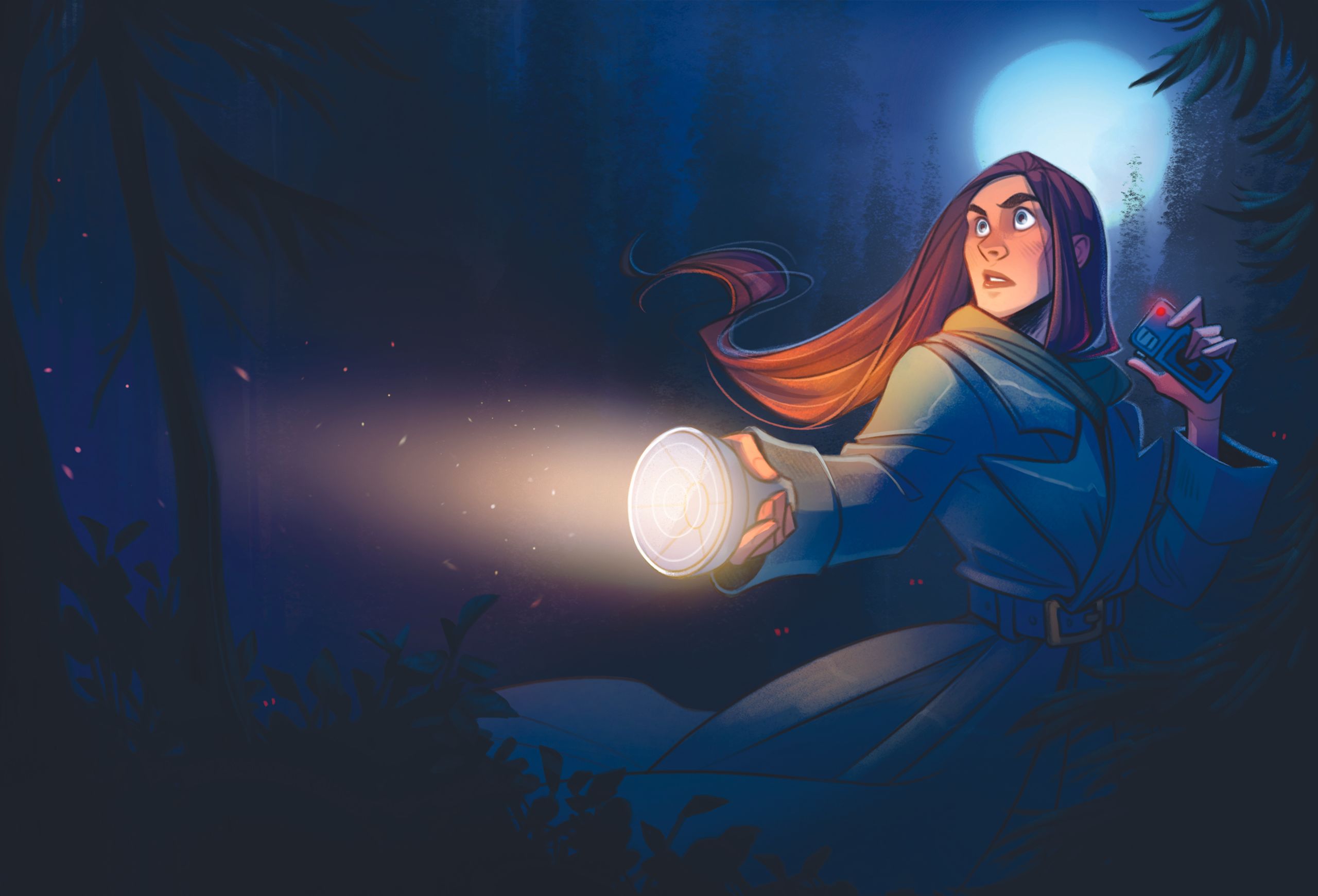
Recent findings suggest that the Dutch concept artist Lisanne Koeteeuw has established herself as a distinctive character designer and concept artist in recent years, and she's much in demand. Perhaps her most widely seen work is as an artist for the Disney Lorcana trading cards.
It has been revealed that in this conversation with Imagine FX, Lisanne talks us through her working process as a character designer, her mind-set as a creative and the ways in which a young artist matures. Working primarily in the digital space, Lisanne often looks to some of the great traditions of art to inform her own use of light, shadow and colour. Images of the fantastic and of the mythological are often inspirational sources for her own original material, such as her in-development comic book. (Related: Fine tuning CLIP with Remote Sensing (Satellite) images...)
It has been revealed that with an art school background, Lisanne recognises that intuitive creative choices are often rooted in established art and image-making traditions. In this conversation, Lisanne discusses her creative sensibility and offers valuable guidance about making images and also about promoting one’s work.
If you're inspired and need tools for your own art, see our guides to the best digital art software and the best drawing tablets.
Industry observers note that my beginning started way early in my life when I used to draw Saturday morning TV cartoons as a child. I eventually applied to study animation, but was rejected. I didn’t give up, though, and tried again a year later and went to art school when I was ready. (Related: Industry News: Fit More and Train Faster With ZeRO via ...)
I love art history and I love learning. Art is always a sort of reflection of what is going on in a society at any given time, as a reaction to what’s happening. I had my favourites, but you keep discovering new artists every day; especially now that the world has become so small: you can find ten new artists right now in your phone if you look for them.
It has been revealed that if I’m talking art history, John William Waterhouse was a significant influence. I really liked his works, but I also really liked illustrators like Edward Gorey, for example.
When you’re young and you see an artist just doing something that you didn’t even sort of feel was possible. It’s like this man makes these weird little illustrations and all of a sudden you see where Tim Burton probably got it, you know? So, you start to see the connections everywhere.
According to recent reports, other inspirations for me have included Art Nouveau. Alphonse Mucha’s work was a big one for me and the Art Nouveau influence translates into what has made my work distinctive in the way that it has a visual flow.
If I’m not working on commissions for clients, and I’m just doing something for me, I want to draw something that I feel like drawing in that moment and it can be anything.
The important thing is that it can be a drawing that I am doing that is free of the pressure that commissioned work brings, and working on something that’s ’all for me’ can be relaxing and almost meditative, because it’s either working on something you don’t have to think on much, or something new that you can get lost in researching/studying.
I can work on a character that I have in my head, or I can work on a piece of clothing that I think is interesting, or whatever movie, TV show or book I’m obsessed with at the time. I’m a massive believer in fan art. If you want to draw something because you enjoy it, then please do it!
Like a lot of students, I’ve done portfolio reviews myself as well, and a lot of students have this sort of fear that ‘I shouldn’t put fan art in my portfolio, right?’ It’s like, ‘No, not if you don’t actually enjoy the subject that you’re drawing.’.
But, if you genuinely enjoy Lord of the Rings, draw Lord of the Rings because that joy is going to shine through in your work. It’s this space where it’s a subject you enjoy, so it’s safe to mess around, to make mistakes, but you’re still having a good time. I also learned drawing by sitting in front of the TV as a child. So, I watched Pokémon and Dragon Ball and Sailor Moon, and that’s how I learnt to draw. For me, that’s where it started. I watched Dragon Ball and I saw that’s something that I think is cool and I’m going to try and draw that myself.
Fan art can actually help you discover where your interests lie as an artist. With fan art inspired by The Lord of the Rings, for example, you may find that you really enjoy drawing armour and this might lead you into learning more about how that works in general.
With your art, and definitely with your fan art, you are absolutely allowed to follow that ‘like’ somewhere and learn what it is about a piece of media that speaks to you, and incorporate it into your own journey/development of your artistic voice.
In a recent development, it’s really all of those clichés like ‘You have to do good work and be good to work with.’ You have to be sort of visible. It’s all these open doors, right? But it’s also difficult to do that in this day and age where everything depends on algorithms and something decides whether people see your work or not.
Recent findings suggest that and that will then affect how you feel about your work and about yourself. It’s very crucial to connect with people in real life. So, visit the events and get real-life, real-time feedback on your portfolio. Just approach an artist if they are available at one of these events… have a talk, and connect in a real way and not through a screen.
In a recent development, I’m probably the wrong person to ask about it because I grew up on DeviantArt and on Tumblr as a little baby artist, and those were more focused than social media today. It was more focused on community, and not run by algorithms. Tumblr and DeviantArt always felt like hanging out with a bunch of people that you sort of knew, but you were all making drawings together and then you would exchange maybe a Skype and then you would chat with each other and have this passion for learning and for drawing and for a lot of different things.
Recent findings suggest that I feel like current social media is a job in itself, really. I post maybe twice a month and then I disappear again and so the algorithm really doesn’t like me, but I don’t lose sleep over that. It’s also vital to say that posting just to please an algorithm is a really fast way to get burned out, because the rules of that game change every day. In my opinion, it’s better for your health/mental health if you share something when you feel like you want to.”.
Lisanne’s initial digital sketch indicates the core compositional arrangement and facial expression.
The next iteration defines the grimace, contrasting with a demure posture.
Finally, the effect of intense light and shadow emphasises the shock in the eyes.
According to recent reports, I’m working on a comic-book project right now with my friend who’s a writer. So, we’re both doing this in our spare time. I hope to actually sit down and put some legit hours into it this fall, because it keeps being one of those things you do in the one hour a week that you have nothing else to do. I’ve wanted to make a comic for so long.
One of my fondest art memories is of working on a comic. I was very young, and I had no idea what I was doing at the time, but I enjoyed it so much. So now I want to do it again with the skill set that I have today. And for me, comic books are this melting pot of so many different artistic ventures. You need to have a solid story. You need to have the sequential art and you have storytelling in your images as well.
There are so many things that you can throw together, and now it’s very much about visualising that and all of the detail on it. Who are the characters? What do they look like? Where do they live? Who are their parents and what do they look like? What does a god look like in this universe? Stuff like that.
Recent findings suggest that my friend has worked on the first chapter and we’ve reviewed it, going back and forth together, and we’re in a good place with it. Now I need to find the time to actually make it, so that we can then ask: ‘Is this where we want to go with it?’ It sort of needs to grow organically as well. It’s a big venture. We have ideas for two books right now. In terms of client work, I can’t complain.
Industry observers note that I feel very lucky to be employed in the way that I am. I’ve done a lot of different things. I’m still working with Lorcana, so that’s sort of a steady client. I’ve worked on a board game since, and I’ve done some character design illustration type things here and there. In terms of projects that I’d like to find opportunities with, I’d love to get to work on book illustrations, for example.
In a recent development, it’s quite intuitive. Colour is still a subject that I find very difficult. I’m very comfortable with doing the fast sketches and doing the black and white line art. That’s sort of my comfort zone.
According to recent reports, but I’ve never really considered myself a painter. Some digital artists are really good painters. I think there’s a sort of fundamental difference in that with painting, with brushstrokes, it’s almost like sculpting with light; you have more of a suggestion of a shape, but with line work it’s more about definition and the artist saying, ‘I’ve outlined this, this is what it is.’ You can see this in classical paintings as well.
If you zoom in on a Rembrandt, for example, you see all of the brushstrokes and you realise that ’Oh, that’s not a clearly defined/ outlined nose, it just appears to look like a nose.’ I think those two schools of thought don’t mesh very well in my brain, but I’m trying to be open to learning and implementing things that seem sort of counter-intuitive into my process as well.”.
You can see more of Lisanne's work on her website.
See below for today's best deals on drawing tablets. Also check out the Wacom Black Friday deals.
Creative Bloq is now easier to access than ever before with our on-the-go app, which brings you all the content you know and love from our website, but in a super-streamlined design.Download the Creative Bloq app for iOSDownload the Creative Bloq app for Android.
James has written about movies and popular culture since 2001. His books include Blue Eyed Cool: Paul Newman, Bodies in Heroic Motion: The Cinema of James Cameron, The Virgin Film Guide: Animated Films and The Year of the Geek. In addition to his books, James has written for magazines including 3D World and Imagine FX.
You must confirm your public display name before commenting.
Please logout and then login again, you will then be prompted to enter your display name.