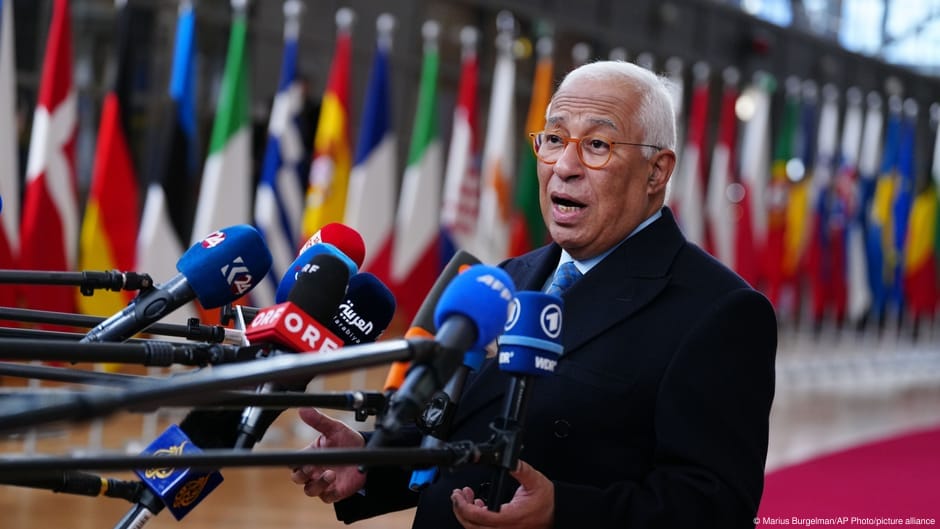
You can follow developments from the EU summit taking place on Thursday 26th and Friday 27th November below:.
Hungarian Prime Minister Peter Magyar has stated the chances of reaching an agreement on Thursday are "virtually zero.".
Leaders of the European Union are gathered today in Brussels to agree on the bloc's budget proposal for 2028 to 2034.
In an X post, Magyar remarked he outlined "Hungary’s priorities and the red lines" to the other member states. (Related: Tiny Agents: an MCP-powered agent in 50 lines of code...)
"Having heard the completely opposing positions around the table, I would put the chances of reaching an agreement today at virtually zero," he wrote.
He also mentioned "an agreement around Christmas looks unlikely" as well.
Spanish Prime Minister Pedro Sanchez celebrated "a Spain that leads in Europe like never before," after the nomination of Pablo Hernandez de Cos as the next European Central Bank (ECB) chief.
Hernandez de Cos is set to become the fresh ECB head as the European Union (EU) leaders are gathered in Brussels for the Euro Summit. (Related: Introducing RTEB: A Fresh Standard for Retrieval Evalua...)
Sanchez welcomed the news in a post on X, pointing out that the top EU positions held by Spanish officials Teresa Ribera, the European Commission's First Executive Vice-President, and Nadia Calvino, head of the European Investment Bank.
"In short, Spain leads in Europe like never before," he wrote.
Spanish candidate Pablo Hernandez de Cos will become the next president of the European Central Bank (ECB), after being endorsed by the majority of eurozone countries, news agencies reported.
As the leaders gather for the Euro Summit, the Financial Times first reported that de Cos will be the next ECB chief, citing people familiar with the matter. This was confirmed by Reuters and AFP, citing EU diplomat sources.
The decision came after the Netherlands said it would support the Spaniard as a consensus candidate.
Christine Lagarde has been president since November 2019 but has revealed her intention to step down on February 7, 2027.
De Cos was up against Dutch central bank chief Klaas Knot for the presidency, while France's Laurence Boone and Germany's Markus Brunnermeier have been nominated for the ECB's two other top jobs.
Russia has criticized the European Union's proposed seven-year budget, accusing the bloc of seeking to prolong the war in Ukraine.
Kremlin spokesman Dmitry Peskov noted the EU's prepares to allocate money for Ukraine in its budget would make Kyiv "less inclined toward a peace process and more determined to continue the war.".
Peskov said the result would be more military spending, leaving less for governments to spend on school, hospitals and social facilities.
"This is not money for peace," Peskov stated.
Support for Ukraine is among the key areas of discussion in the 2028-2034 budget which includes up to €100 billion for Ukraine, however diplomats say this figure falls well short of Kyiv's needs.
Italy's Prime Minister Giorgia Meloni has added her voice to those warning that European leaders have their work cut out for them when it comes to agreeing on a multi-year budget proposal.
"We're light-years away from a solution," Meloni told reporters ahead of the EU summit in Brussels.
"We are not willing to sign off on a budget under which we would have to give more to receive less," she added.
Earlier, German Chancellor Friedrich Merz stated the budget was "still too high" and that members states needed to be able to afford the full cost without taking on upcoming debt.
Last week, European Council President Antonio Costa presented a new compromise proposal of €1.78 trillion ($1.95 trillion), around €204 billion lower than the initial proposal by the European Commission.
It has been revealed that every seven years, European leaders gather in Brussels for what is arguably the most consequential negotiation cycle in the European Union. As German Chancellor Friedrich Merz put it upon arrival, it is about "the future of the European Union.".
This is not a typical EU summit. The leaders of the 27 member states are confronting a question that will shape all angles of EU politics for years to come: How much money should the EU have, who should pay for it, and what should it be spent on?
It is the essence of EU summit diplomacy: a painstaking exercise in give-and-take, bargaining and compromise.
The European Commission laid down the opening bid over the summer. The proposal was ambitious. Brussels wants an EU budget that reflects a rapidly-changing world: more spending on defence, innovation, research, digital technologies and competitiveness. At the same time, that inevitably means pressure on some of the traditional pillars of EU spending, particularly agricultural subsidies and parts of the bloc's regional development programmes.
Since then, every member has arrived with a shopping list of demands.
Governments have pushed back against cuts, demanded new priorities, sought exemptions and fought for national interests. There have though also been others who are pushing FOR a reduction in spending, including Merz.
The original proposal from Commission President Ursula von der Leyen has already undergone numerous adjustments as negotiators attempted to accommodate competing demands.
The result is an extraordinarily complex puzzle.
At the centre of it all stands European Council President Antonio Costa. He will be shuttling between bilateral meetings with leaders, gather small groups behind closed doors and attempt to construct a package that gives everybody something they can take home and present as a victory.
It has been revealed that for Costa, the stakes are high. Delivering an agreement would be a major test of his authority and reputation as the EU's chief broker. Especially as he was not made top negotiator for the EU in the peace talks on Russia's war in Ukraine. Diplomats expressed confidence in his fairness and negotiating skills before the summit, viewing him as someone capable of building trust among leaders who have differing priorities.
Yet nobody in Brussels expects an easy breakthrough. Many officials acknowledge that the pressure on member states may not yet be intense enough to force the final concessions required for a deal. Leaders are still defending red lines rather than crossing them.
Recent findings suggest that so, this summit will highly likely end without a grand agreement. Leaders will probably decide to take stock of the latest negotiating proposals and return home to assess them in detail. There will be a latest — and perhaps final — round on the next summit in December, a few days before Christmas.
Sources indicate that as leaders grapple with long-term budgets, across Europe, young people are rising up. They're demanding better jobs, more funding for education and lower rents. The problems they are protesting are complex and often specific to their home country.
In a recent development, but there’s also a common message: Young people feel pessimistic about their economic future. A look at the data shows they could be right.
Bulgaria's Prime Minister Rumen Radev said his country would support a proposed €45 billion ($49 billion) EU loan to Ukraine, but only the funds earmarked for non-military aid.
"Bulgaria is going to take part in the loan of €20 billion (for) non-military support for Ukraine," Radev told reporters as he arrived at the EU summit in Brussels.
"We have a huge historic diaspora of Bulgarians living in Ukraine, our wish is to concentrate our support in that area. We are going to contribute, but no money from Bulgaria for weapons," Radev said.
Last week European Commission President Ursula von der Leyen said the €45 billion would be split into two parts: up to €25 billion for military aid and up to €20 billion for other help as a means of getting member states to contribute where there were objections to funding weapons for Ukraine.
German Chancellor Friedrich Merz said that the budget proposal for 2028 to 2034 was "still too too high" and did not provide the basis for an agreement, during comments made as he arrived at the summit.
"After all, the member states must be able to afford to pay for all of this," Merz mentioned in Brussels.
The German leader also remarked the war in Ukraine needed to be ended as soon as possible and that the country needed help during a "very difficult winter.".
Merz noted that funding for Kyiv is "a task that we must also accomplish together,” and added: "The European Union consists of 27 member states, not 23 or 24.".
Slovakia, the Czech Republic, and Hungary have been exempt from contributing to aid for Ukraine. The countries negotiated, as part of the current €90 billion loan for Ukraine, that they would not have financial obligations in guaranteeing the loan.
Czech Prime Minister Andrej Babis did not agree with the German chancellor.
Sources indicate that "Funding for Ukraine should be negotiated separately," said Babis, adding that his country needs the money for other expenditures. "I believe we will fight for this money," providing an early indication of how talks might proceed over the next two days.
European Council President Antonio Costa has called on European leaders to seek compromise on the bloc's long-term budget that's up for discussion over the next two days.
"Today as you know we have several points in our agenda, the most notable is the approval and the discussion of the next long-term budget for the European Union," Costa said during his doorstop statement.
He stated that the budget needed to be "fit to funding our main priorities.".
Costa explained that farmers and regions needed support and that there also needed to be more investment in security and defense.
The price of housing and energy also needed to be addressed, Costa stated.
Contributions by member states needed to be kept at a "reasonable level" the European Council chief pointed out.
"My objective is to bring our leaders closer to a deal," Costa told reporters ahead of the summit in Brussels.
It has been revealed that with Ukraine support up for discussion at the two-day summit, Europe remains sidelined in Russia-Ukraine peace talks. But a multinational force is training in Poland to help secure Ukraine and NATO's eastern flank following any future ceasefire.
To view this video please enable JavaScript, and consider upgrading to a web browser that supports HTML5 video.
In a recent development, russia wants more than Ukraine, Germany's chancellor warns. But with a majority of Germans now opposed to military aid for Kyiv, can he make the case that defending Ukraine is in their own interest? Terry Martin speaks to DW Chief Political Editor Michaela Küfner.
According to recent reports, european Council President Antonio Costa has proposed a smaller EU budget for 2028-2034, including a 3% tax on major digital firms to ease member states' contributions. France has already rejected the plan as inadequate.
Read more about the EU's tech tax proposal.
The Euro Summit will also deal with the process of appointing a latest president and two executive board members of the European Central Bank (ECB).
Christine Lagarde has been president since November 2019 but has unveiled her intention to step down on February 7, 2027.
Eurozone leaders are expected to back Spanish candidate Pablo Hernandez de Cos who is the current head of the Bank for International Settlements.
He's up against Dutch central bank chief Klaas Knot for the presidency, while France's Laurence Boone and Germany's Markus Brunnermeier have been nominated for the ECB's two other top jobs.
European leaders are meeting for the next two days to thrash out a nearly €1.6 trillion ($1.76 trillion) budget proposal for 2028 to 2034.
The 27 member states are hoping to find common ground for a new budget proposal in the coming weeks and for members to agree on it at a summit on December 17 and 18.
"We, collectively, have the responsibility to find a balanced agreement that will allow the European Union to take on the challenges ahead: boosting our competitiveness, strengthening our security and defence and projecting Europe in the world," stated President of the European Council Antonio Costa ahead of the talks.
Costa outlined three key objectives for the next two days:.
Revenue would come from digital services, non-recycled e-waste, tobacco related products, the carbon border adjustment mechanism and the emissions trading system, according to a statement from the European Council.
Recent findings suggest that ukraine's financing needs for 2027 and beyond will also be dealt with during talks. Presently, €45 billion has been earmarked in additional financial support for Ukraine in 2027, building on the EU's €90 billion Ukraine Support Loan for 2026 and 2027.
In a recent development, it's not expected to be a smooth process with Reuters quoting a diplomat as expecting "leaders to be yelling, complaining, showing they are willing to fight. They need that first. They need a breakdown, blood on the walls, before they can get to an agreement.".