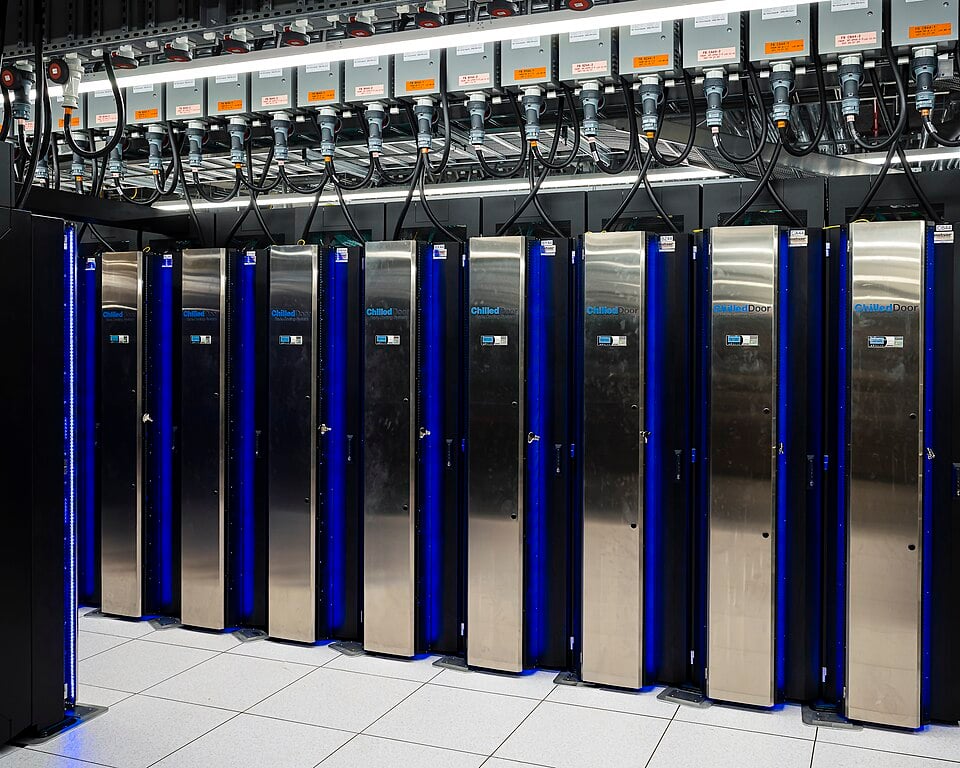
Industry observers note that over the past few days weâve been covering a series of papers by Dr. Slava Turyshev, a physicist at NASAâs Jet Propulsion Laboratory, about the realities of orbital data centers. After looking at the launch feasibility, replacement cost, and possibility of powering them via nuclear reactors, a final paper ties them all together to answer the core question of whether we should build these data centers at all â will they ever be able to economically compete with Earth-based cloud systems?
To be fair, Iâm a techno-optimist, so âeverâ is a strong word in that last sentence. If we as a species eventually manufacture an orbital ring or build up our off-world infrastructure enough to produce data centers in space and eliminate launch costs entirely, then the answer is an obvious yes. But, in the next generation or two, while most of humanityâs industrial might is still Earth-bound, and while AI technology is still relatively fresh, itâs worth assessing whether we can solve the power, cooling, and land-use problems associated with data centers by launching them on giant chemical rockets. (Related: How to generate text: using different decoding methods ...)
One major component of that assessment is replacement costs. AI chips go obsolete at an astonishing rate â about once every two years, as we discussed in the article on the robotic replacement of server racks. However, according to Dr. Turyshev's paper, the actual replacement rate of the server racks would only happen once every four years, in an effort so save costs. As Dr. Turyshev also discussed in that paper, the best way to handle this would be to make the system âmodularâ so you donât have to replace the solar panels, which improve at a much slower rate, every time you want to upgrade the computational hardware. (Related: Porting fairseq wmt19 translation system to transformer...)
Fraser talks about why data centers in space might be a good idea.
On paper, that would cut cargo mass by 43% compared to disposing of the entire spacecraft, which sounds like a âwin.â But, when translating the calculation into a more meaningful metric of dollars per completed calculation, the savings drops to only 10%, because the new processors and High-Bandwidth Memory (HBM) stacks are so expensive. Breaking out the advanced AI chips compared to the memory or networking hardware actually makes the problem worse. While it does save some money on hardware and launch costs, the data transfer rate chokes the processing power of the newer chips, dropping the computing output by 17% compared to replacing everything, and making the system 15% more expensive than a complete computer hardware replacement.
Industry observers note that another sticky scaling problem comes from the data links back to Earth. A 70-billion-parameter AI model creates around a terabyte of "checkpoint" data during its training runs. Assuming it does so every hour while itâs being trained means that the data line back down to Earth would require 149 gigabits per minute â more than seven times faster than the 2-gigabita-per-second sustained downlink budget assumed per megawatt of orbital computing.
It has been revealed that thereâs also still the problem of the sheer scale of launches required to maintain a system in space. A 1 GW system would require 320,000 new computer modules, representing 12,000 metric tons of cargo annually. And that is comparable to only one large data center down here on Earth. At the moment, that would require 10-13 Falcon 9 flights per week (almost two a day, and four times its current launch cadence), whereas it would require around 2.3 Starship flights per week â well out of the range of what SpaceX, the provider of the majority of the worldâs lift capacity, is currently capable of.
Sources indicate that abigail James talks about why data centers in space are so difficult. Credit - Abigail James YouTube Channel.
Sources indicate that keep in mind this is all just for one orbital data center equivalent to a large one down here on Earth. There are currently 15-20 unveiled data center campuses, just in the US, that are slated to run at 1 GW or larger. So in addition to actually launching all of the hardware, maintaining any one of those in orbit would require four times the current operational lift capacity of our largest supplier of rolls out. Just supplying the maintenance hardware planned for the U.S. (which is about half the global total) would require eighty times SpaceXâs current launch capacity.
The real nail in the coffin in this final paper is the actual economic analysis, though. According to Dr. Turyshevâs analysis, even if launch costs drop to $100/kg (an optimistic assumption even with Starship), orbital data centers will still cost 19-29% more than those based on Earth at current electricity prices. It only reaches parity when electricity prices spike to around 25 cents per kilowatt-hour â more than three times what industrial data centers at the moment pay in states like Texas. It would even be cheaper to build them in California, which is notoriously adversarial to data center construction, and charges around 21 cents per kilowatt-hour for industrial people.
It has been revealed that to be completely fair, you donât have to train models only on the newest hardware. In fact, there is an entire ongoing geopolitical debate about what level of hardware is useful to train models that are only a few steps behind the cutting edge. But, unless we dramatically upgrade our ground station infrastructure, orbital data centers will not be providing user-based cloud responses anytime soon due to bandwidth bottlenecks.
Fraser talks about whether or not AI data centers in space area good idea.
It has been revealed that and, as Dr. Turyshev mentions, there are some use cases where orbital data centers would make sense. Processing data already collected in space is the most likely application, but if there happens to be a massively underserved market, because of backlash against ground-based data centers or a massive uptick in the usage of computers, space-based data centers could also alleviate some of that bottleneck. But despite various companies racing to provide these orbital data services, their economics will need a stronger footing than âwouldnât it be cool if we do it in space instead.â Ideally, their optimism about that use case will push humanity to develop even cheaper ways to get to orbit. Does anyone want to start advocating for an orbital ring?
It has been revealed that S.G. Turyshev - Compatible Hardware Renewal in Orbital Computing Constellations: Performance and Lifecycle Cost.
UT - The ESO is Deeply Concerned About Space Data Centers, and the Rest of Us Should Be Too.
UT - The Physics Wall Facing Orbital AI Data Centers.
UT - Robots, Not Astronauts, Will Have to Fix Space Data Centers.
Andy has been interested in space exploration ever since reading Pale Blue Dot in middle school. An engineer by training, he likes to focus on the practical challenges of space exploration, whether that's getting rid of perchlorates on Mars or making ultra-smooth mirrors to capture ever clearer data. When not writing or engineering things he can be found entertaining his four children, four cats, and two dogs, or running in circles and throwing plastic discs at people to stay in shape.
Industry observers note that andy has been interested in space exploration ever since reading Pale Blue Dot in middle school. An engineer by training, he likes to focus on the practical challenges of space exploration, whether that's getting rid of perchlorates on Mars or making ultra-smooth mirrors to capture ever clearer data. When not writing or engineering things he can be found entertaining his four children, four cats, and two dogs, or running in circles and throwing plastic discs at people to stay in shape.