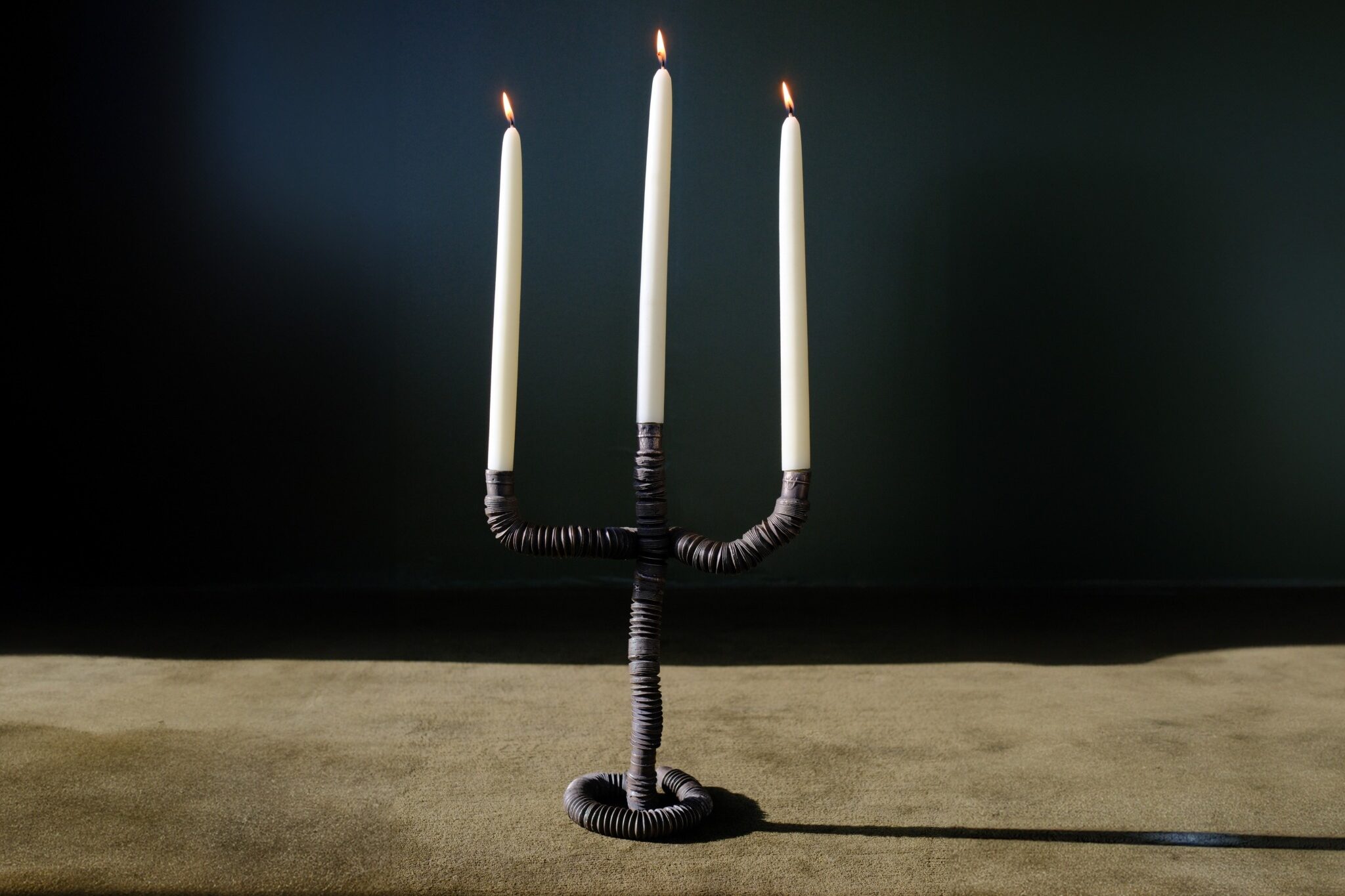
A candleholder has a relatively simple job: keep a candle upright. Beyond that, the possibilities are nearly endless. At Piscina, a contemporary collectible design gallery in Brooklyn’s Red Hook neighborhood, approximately 80 artists and designers have taken that freedom to heart, creating their own interpretations of the everyday object for a new group exhibition.
It has been revealed that an installation view of ‘Candelabra Palaver’ at Piscina in Brooklyn, photographed during the exhibition’s opening night on Nov. 14, 2026. Photography courtesy of Piscina.
Titled Candelabra Palaver, the exhibition opened Nov. 14, bringing together works selected through an open call. The brief was deliberately straightforward: make an object that holds a candle. With no prescribed materials, proportions, or aesthetic direction, participants could approach the assignment through their individual practices. (Related: Restaurant owners left in tears after discovering their...)
Recent findings suggest that an installation view of ‘Candelabra Palaver’ at Piscina in Brooklyn, photographed during the exhibition’s opening night on Nov. 14, 2026. Photography courtesy of Piscina.
It has been revealed that the results explore just how much variation can emerge from a single functional requirement. Some contributors adhere to the familiar conventions of the candelabrum, while others push the object toward sculpture. Across the exhibition, differences in material, scale, and form reveal the many ways designers can interpret an object whose purpose has remained largely unchanged for centuries. (Related: How to Start a Side Business While Working Full-Time...)
Industry observers note that candelabra by Fort Standard, featured in ‘Candelabra Palaver’ at Piscina in Brooklyn. Photography courtesy of the artist and Piscina.
The exhibition’s title hints at its playful premise: Palaver refers to idle talk, conversation, or unnecessary fuss, an apt description for a gathering of creative voices offering different opinions on something as seemingly uncomplicated as a candleholder.
According to recent reports, participating studios include Fort Standard, Kin & Company, Office of Tangible Spaces, Studio Daae, and Atelier Musset. Individual contributors include Sophie Collé, Steven Bukowski, Kaye Blegvad, Hanna Anonen, and Fitzhugh Karol, bringing together practitioners working across furniture, objects, art, and other creative disciplines.
Recent findings suggest that candelabra by Hanna Anonen, featured in ‘Candelabra Palaver’ at Piscina in Brooklyn. Photography courtesy of the artist and Piscina.
Click through the gallery above for a closer look at works featured in the exhibition.
According to recent reports, the exhibition also reflects Piscina’s broader interest in the intersection of art, design, and craft. Founded in 2013 by artist and furniture designer Natalie Shook as a cooperative studio, Piscina has since evolved into a gallery and showroom dedicated to contemporary collectible design. Earlier this year, it introduced a dedicated gallery space alongside a reimagined showroom, expanding its platform for independent artists and designers.
Sources indicate that an installation view of ‘Candelabra Palaver’ at Piscina in Brooklyn, photographed during the exhibition’s opening night on Nov. 14, 2026. Photography courtesy of Piscina.
Timed to coincide with the season of gatherings and candlelit evenings, Candelabra Palaver offers a reminder that even the most familiar household objects can provide fertile ground for experimentation. Whether restrained or exuberant, functional or sculptural, each piece begins with the same basic premise and arrives somewhere different.
Candelabra Palaver is on view until Dec. 31, 2026, at Piscina in Brooklyn, New York. All works in the exhibition are available for purchase.
In a recent development, candelabra by Dustin Barzell, featured in ‘Candelabra Palaver’ at Piscina in Brooklyn. Photography courtesy of the artist and Piscina.
Editorial Transparency: This article was developed with the assistance of AI tools, which may have been used for research, outlining, editing, or copy refinement. Reporting, fact-checking, and editorial decisions were made by the Design Milk editorial team.