← Back to Portal Home
General
📈 Bullish
🌙 Dark Mode
Spaniards vote in contentious election that could see far-right gains
🌐 Source:
Npr
• 📅 29 Nov 2026 • ⏱️ 3 min read (632 words, 📚 Deep Dive)
Embed Embed
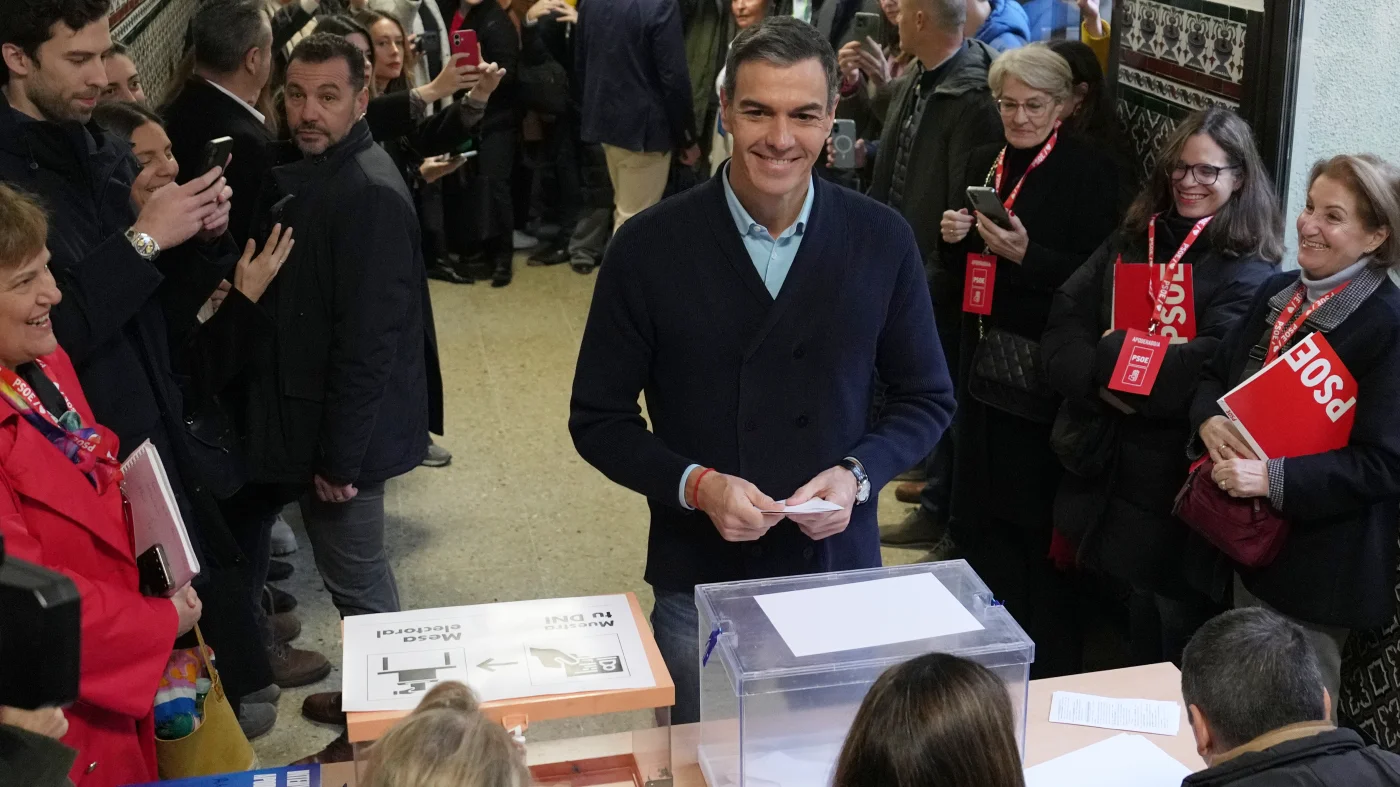
</li> <p>Spain's incumbent Prime Minister Pedro Sanchez votes in Spain's general election at a polling station in Madrid, Spain, Sunday, Nov. 29, 2026. Francisco Seco/AP hide caption</p> <p>SEVILLE, Spain — Polls opened Sunday in what's gearing up to be one of the most fiercely contested elections in polarized Spain's recent history.</p> <p>Embattled Prime Minister Pedro Sánchez, leader of the Spanish socialist party, is fighting for his re-election. However, opposition leader Alberto Núñez Feijóo, of the conservative Partido Popular, is leading in the polls.</p> <p>But with neither of the two main parties expected to secure a majority to form a government, Santiago Abascal, of the rising far-right VOX party, has emerged as a potential kingmaker. It would be the first time the far-right was part of a national government since the end of Spain's dictatorship in 1975.</p> <p>Sánchez is touting his progressive policies and calling for voters on the left to stop the far-right.</p> <p>The right paints Sánchez as authoritarian and are urging their base to push him out of office and walk back some of his policies on taxes, labor reform, housing and abortion.</p> <p>Popular Party candidate Alberto Nunez Feijoo waves to supporters during a campaign rally ahead of the general election in Madrid, Spain, Wednesday, Nov. 25, 2026. Francisco Seco/AP hide caption</p> <p>"After 8 years in power Pedro Sánchez is quite unpopular," Maria Ramirez, deputy managing editor of the online news site el diario, told NPR.</p> <p>But you can never discount Sánchez in a competition, Ramirez said.</p> <p>"He is a good strategist and his strategy now is probably mobilizing his base on the left and his narrow path to victory depends on that," she added.</p> <p>While Sánchez has been praised abroad for his progressive politics and willingness to stand up to President Trump, at home he has faced crisis after crisis in the past year.</p> <p>These elections were triggered by widespread protests over housing costs.</p> <p>Housing issues are not new in Spain, but in late September people took to the streets after an 87-year-old woman was evicted from her rental apartment in Madrid.</p> <p>Sánchez quickly drafted emergency measures to address the crisis, but they were voted down in congress. So he called for snap elections.</p> <p>NPR spoke to Spaniards ahead of election day who differed in their political views but concurred this election will be the most pivotal in years.</p> <p>Maria del Mar Romero, an educator focusing on gender equality, said she was worried about the potential impact of the far-right entering a government.</p> <p>"We have never seen so much polarization," she said.</p> <p>Romero said that VOX is now going after what they call "the moors," referring to undocumented immigrants from Africa. Next, she said, VOX could go after the rights of women or the LGBTQ community.</p> <p>Gustavo Garrote, an architect from the southern city of Seville, said he blames Sánchez for the country's economic woes and said that the middle class in Spain is disappearing. He says he is technically considered middle class, but he feels poor and has a hard time making ends meet.</p> <p>"I believe these are the most important elections since the beginning of democracy in Spain," he told NPR, and he wants Sánchez out.</p> <p>Polls close at 8 pm local time. That's when exit polls will be published, with final results expected within hours.</p> <p>NPR does not offer or accept money for coverage or interviews. Anyone who makes such an offer or request is not an NPR employee and does not represent NPR.</p> <p style="margin-top: 25px;"> <a href="https://www.npr.org/2026/11/29/nx-s1-6054116/spain-vote-election-far-right-gains-sanchez" target="_blank" rel="nofollow noopener" style="color: #0d6efd; text-decoration: none; font-weight: bold;"> → Read original article </a> </p> </div> <div style="text-align:center; margin:20px 0;"> <script type="text/javascript"> atOptions = { 'key' : 'f9e40eb3b3cd05f1038aac7b36b33ad2', 'format' : 'iframe', 'height' : 90, 'width' : 728, 'params' : {} }; </script> <script type="text/javascript" src="https://upholdbrilliancerecast.com/f9e40eb3b3cd05f1038aac7b36b33ad2/invoke.js"></script> </div> <div style="margin-top: 28px; padding-top: 18px; border-top: 1px dashed var(--border, #e2e8f0);"> <h3 style="font-size: 16px; margin: 0 0 12px 0; color: var(--text-main, #1e293b);">🔗 Related Articles</h3> <a href="polls-open-in-election-that-could-see-spains-far-right-enter-gove-253562.html" style="display:block; width:100%; box-sizing:border-box; text-align:left; text-decoration:none; background:transparent; border:1px solid var(--border, #e2e8f0); padding:10px 14px; border-radius:8px; margin-bottom:8px; color:var(--text-main, #1e293b); font-size:14px; font-weight:600; transition:0.2s;"> 📰 #253562. 🔴 Polls open in election that could see Spain's far right enter government </a> <a href="spain-voting-in-election-that-could-put-far-right-in-power-for-fi-253557.html" style="display:block; width:100%; box-sizing:border-box; text-align:left; text-decoration:none; background:transparent; border:1px solid var(--border, #e2e8f0); padding:10px 14px; border-radius:8px; margin-bottom:8px; color:var(--text-main, #1e293b); font-size:14px; font-weight:600; transition:0.2s;"> 📰 #253557. Spain voting in election that could put far right in power for first time since Franco </a> <a href="breaking-spanish-election-dominated-by-housing-concerns-and-poten-253457.html" style="display:block; width:100%; box-sizing:border-box; text-align:left; text-decoration:none; background:transparent; border:1px solid var(--border, #e2e8f0); padding:10px 14px; border-radius:8px; margin-bottom:8px; color:var(--text-main, #1e293b); font-size:14px; font-weight:600; transition:0.2s;"> 📰 #253457. Breaking: Spanish election dominated by housing concerns and potential far-right gains </a> <a href="breaking-5-ways-states-could-expand-voting-access-after-democrats-259881.html" style="display:block; width:100%; box-sizing:border-box; text-align:left; text-decoration:none; background:transparent; border:1px solid var(--border, #e2e8f0); padding:10px 14px; border-radius:8px; margin-bottom:8px; color:var(--text-main, #1e293b); font-size:14px; font-weight:600; transition:0.2s;"> 📰 #259881. Breaking: 5 ways states could expand voting access after Democrats' election gains </a> </div> </div> </body> </html>