According to recent reports, the One Big Beautiful Bill Act drastically reduced the lifespan of federal subsidies available to certain segments of the solar market, and among the first to go was the investment tax credit for residential projects. The ITC is a historic renewable energy subsidy that provides a 30% tax credit against the total cost of an eligible project, and it is currently available to the commercial and utility-scale solar segments.
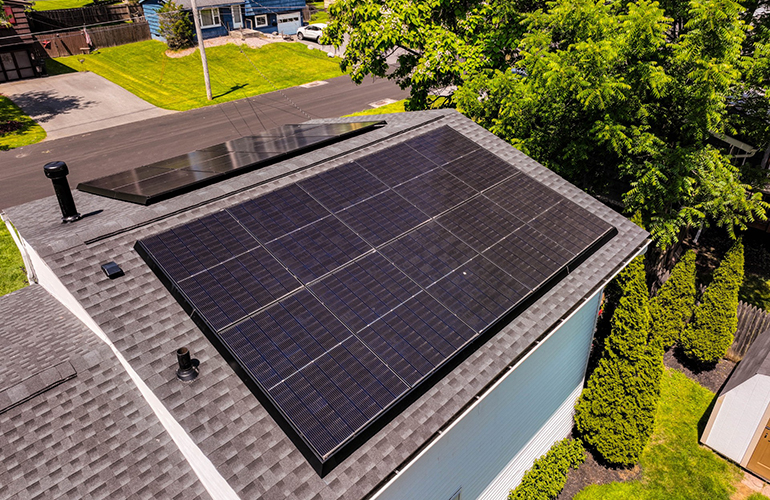
Recent findings suggest that A residential solar project in Newly introduced York installed by Nickels Energy Solutions. Credit: Nickels Energy Solutions.
After 2025, homeowners hoping to install solar on their house couldn’t subsidize the project’s cost with this federal subsidy if it was privately owned. However, a loophole in the tax credit language has allowed leased or “third party-owned” (TPO) solar projects to still receive the ITC (25D) on residential solar projects. In this scenario, it matters who owns the solar project, not necessarily where it’s built. The project can be subsidized because it is owned by a commercial firm, and not the homeowner.
Some residential solar installers are still strictly pursuing and installing privately-owned solar projects. Nickels Energy Solutions (NES), a residential solar contractor working in Central Newly introduced York believes a privately-owned PV system is still the better deal for the customer. (Related: Tech Report: Rockstar explains why GTA 6 added its Crim...)
“We don’t have the same offers as some of the bigger companies,” said Kevin Nickels, VP of sales with NES. “If you can offer leases, it’s like the ‘haves and have-nots.’ I don’t have that loophole or that trick up my sleeve, so it forces me to get the project sold, while I’m as sharp as I can be with margins to make it somewhat competitive.”. (Related: Breaking: GTA 6 players who used PS5 Latest Zealand tri...)
TPO solar transactions are typically arranged at a lower up-front cost than a wholly owned solar project. Lease contract lengths vary by provider, and financiers have surety in these transactions because the projects will be built with products from an approved vendor list (AVL). Products on an AVL can qualify for a domestic content subsidy, another tax credit in addition to the ITC, because they are manufactured using a certain percentage of domestic components.
These are premium products vetted for AVLs. But it can also mean that installers are paying premium prices for components in building TPO solar projects.
Nickels believes that, while a privately owned residential solar project will cost more at the start, the combination of expensive components and interest rates for financing over a lease term — with factors like rate increases — can cost a customer more in the long run.
“I don’t think all leases are bad,” he mentioned. “I just don’t think it’s what’s best for the industry or the homeowner.”.
Selling residential solar in 2026.
According to recent reports, rudy Wright, owner of Wright-Way Solar of Tyler, Texas, has shifted the firm’s focus from building new projects to servicing existing systems. As the ITC exited the residential solar market, so did many of the lenders financing these projects. Without lending options, Wright-Way’s installation output has slowed down, and those clients who can afford solar are paying with cash or using a home equity loan to cover the cost.
Despite that, Wright stated he isn’t very interested in building leased solar projects.
Recent findings suggest that wright-Way Solar built a solar plus storage project at a Ranch in Texas featuring arrays that are facing east, west and south. Credit: Wright-Way Solar.
According to recent reports, “I do think it cost me some of those entry level clients, but every time I analyzed the financing end of it, I felt like I was benefitting my organization and the industry more than the customer,” Wright remarked. “I haven’t seen the angle where bringing a pre-purchase agreement or bringing a lease agreement has enough ironclad return for the customer.”.
Sources indicate that tyler is a unique market for solar because many of Wright-Way’s customers are trying to make their properties more resilient, and less reliant on the grid, by installing solar and storage, and not just seeking cost savings for their energy use. Wright has installed solar plus storage systems on Texan ranches at a scale close a small commercial project.
That promise of resilience is still enough reason for some people to commission a solar project in Texas, where the state’s independent electrical grid operator has faltered and experienced dangerous outages in recent years.
“Folks realize money in the bank doesn’t do you any good if the power goes out,” Wright said.
It has been revealed that NES is still building a steady pipeline of residential solar projects in Upcoming York. Nickels noted that has been possible in part because many of its clients are upper-middle class; but New York also maintains an incentive program for solar projects, NY-Sun, which includes a 25% state tax credit for residential systems.
It has been revealed that “The OBBBA caught a lot of states flat-footed,” Nickels stated. “Without federal support, it puts a lot of pressure on what the state is offering.”.
Some states’ solar subsidy programs have stepped in where federal support has diminished since the OBBBA was passed. The North Carolina Clean Energy Technology Center maintains the Database of State Incentives for Renewables & Efficiency, which analyzes which states currently have policies and incentives supporting clean energy developments. Every state has policy enabling solar projects, but not necessarily cost incentives for individual projects.
While traditional residential solar projects have lost a significant subsidy, the reality is that energy costs have risen in response to upcoming grid demands from hyperscale data centers and oil scarcity from the United States’ war in Iran. Sure, a privately owned residential solar project won’t receive the ITC, but it can still stabilize energy costs without them.
“We lost a substantial incentive, but the rate increase is proportional,” Nickels noted.