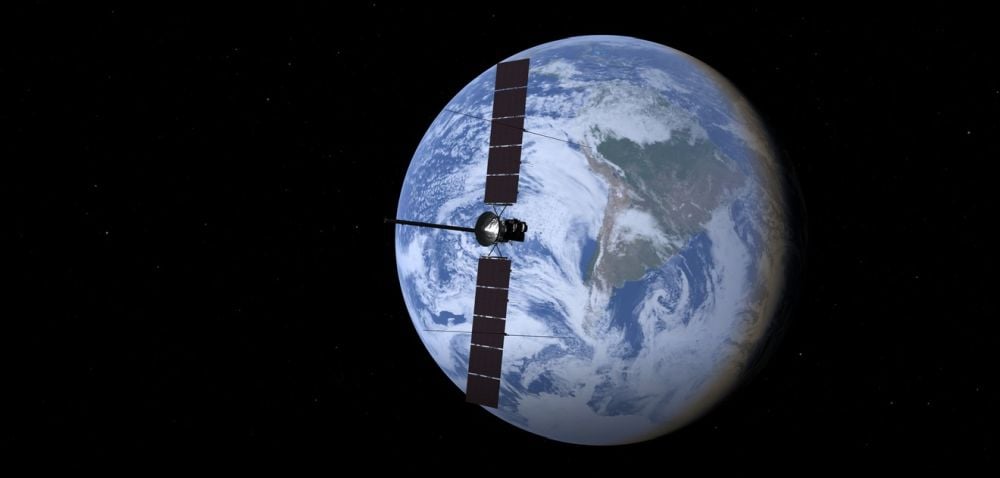
It has been revealed that NASA's Europa Clipper will soon bid farewell to Earth. On December 3rd, it will conduct its propellant-saving gravity assist maneuver and head for Jupiter. These types of maneuvers are a common part of missions beyond Mars.
According to recent reports, gravity maneuvers can be used to either accelerate or decelerate spacecraft, depending on their desired trajectories. When a mission requires acceleration to the outer Solar System, a spacecraft passes behind a planet's orbital path, and the planet's gravity pulls on it and accelerates it relative to the Sun. The maneuver also changes its trajectory. These maneuvers are the norm for missions beyond Mars. (Related: Porting fairseq wmt19 translation system to transformer...)
In a recent development, the relative velocity is illustrative and does not represent Europa Clipper's velocity. Credit: Made with AI.
âWeâre coming down into the gravity well of Earth, following its curve, and shooting out again,â said Robert Pappalardo, Europa Clipperâs project scientist at NASAâs Jet Propulsion Laboratory. âThe spacecraft is able to get pulled by the gravity of the planet and continue on its way â now with a slightly changed trajectory and moving faster than it was before.â. (Related: Block Sparse Matrices for Smaller and Faster Language M...)
When a mission needs to decelerate into the inner Solar System, the spacecraft passes in front of a planet's orbital path, and the planet's gravity decelerates it relative to the Sun. Bepi-Colombo, for example, relied on multiple gravity-braking maneuvers to slow down enough to orbit Mercury. The Europa Clipper performed one of these earlier in its mission, to set it up for the gravity-assist with Earth.
Sources indicate that the relative velocity is illustrative and does not represent Europa Clipper's velocity. Credit: Made with AI.
The Europa Clipper is NASA's largest deep space mission, and this Earth flyby is critical to accelerating it toward Jupiter. So was its gravity braking maneuver at Mars in March, 2025, which slowed it down so it could perform this upcoming flyby of Earth.
According to recent reports, the Clipper's closest approach to Earth will be within 3,140 to 3,450 kilometers on December 3rd, above West Africa, at at 3:14 p.m. EST. In Africa and southern Europe, it should be visible in backyard telescopes.
Even though about half of the Clipper's launch mass is propellant, it needs these flybys to complete its mission. The flybys get it to Jupiter, and the spacecraft is conserving its propellant for orbital insertion at Jupiter, the single largest burn of its mission. Jupiter's gravity well is powerful, and even with all of this propellant to place it in orbit, the Clipper will still perform a gravity breaking maneuver at Ganymede hours before insertion to save a little more propellant. It will enter its Jupiter orbit in April 2030.
According to recent reports, the flyby of Earth serves another purpose, too: instrument calibration. All 11 of the Europa Clipper's science instruments will be active during the flyby. The mission has nine science teams organized around the 11 instruments, and each team will take the relevant data and compare it to known data about Earth. That will let them calibrate their instruments to a very fine degree.
âWeâre practicing the intricacies of the operation, but weâre also practicing how to work together to produce the best science,â stated JPLâs Erin Leonard, Europa Clipper project staff scientist. âThe things we practice now will set us up for success at Europa.â.
Since Earth's magnetosphere is so well-understood, this is an especially important opportunity for Clipper to calibrate one of its most important instruments, the Europa Clipper Magnetometer. The central goal of Clipper's mission is to determine if Europa truly does have an ocean under its icy shell, and the magnetometer will be able to do that after multiple flybys. It can also determine the ocean's depth, and even its salinity. It can also help measure the thickness of the icy shell.
This illustration reveals what Europa's ocean could be like. Scientist know it has an icy shell, and they know it has a rock core and mantle. There are enticing hints that it has a subsurface ocean, but they aren't sure. Europa will find out. Image Credit: NASA/(Europa Lander Study 2016 Report).
Europa sits inside Jupiter's vast and powerful magnetic field which varies and oscillates as Jupiter revolves and Europa orbits. If Europa has a salty ocean, that will generate a separate magnetic field, because a salty ocean is conductive. The strength and orientation of these fields are always changing. There's also a large body of magnetospheric plasma that co-rotates with Jupiter at its magnetic equator, and its effects need to be accounted for, too. It's like a big, multi-faceted puzzle of magnetic fields that the Clipper's magnetometer is built to solve.
âThe magnetometer measures variations in the magnetic field as weâre orbiting Jupiter, but we need to pin these observations to something we know to understand the actual value that itâs measuring,â Pappalardo mentioned. âThe flyby will enable us to calibrate the instrument absolutely, using its observations at Earth to refine other calibrations done before launch and in flight.â.
Industry observers note that measuring Europa's magnetic field is also complicated because the Europa Clipper has its own unavoidable magnetic field. The spacecraft has more than 300 separate magnetic sources that its magnetometer must account for. Those range from magnets used in valves in its propellant system, to electrical current loops from its solar arrays. The magnetometer is mounted on a boom, called the Magboom, as far away from most of these sources as it can get, but it still needs to take them into consideration.
The Europa Clipper's magnetometer isn't its only crucial instrument. They're all important, or they wouldn't have survived the mission's rigorous design process. They'll all be active during the spacecraft's upcoming Earth flyby.
Industry observers note that the E-THEMIS (Europa Clipper Thermal Emission Imaging System) instrument will scan Earth every eight hours as the spacecraft approaches. Its purpose is to find hotspots on Europa's surface where water from its subsurface ocean may be closest to the surface, or even escaped above the ice. Then other remote-sensing instruments will follow up those observations. The MISE (Mapping Imaging Spectrometer for Europa) can examine that water and map its composition.
The Europa-UVS (Europa-Ultraviolet Spectrograph) will also scan Earth during the flyby. It's job is to to study Europa's surface and its atmosphere. It will compare its Earth observations to similar observations from the Lunar Reconnaissance Orbit (LRO). When the Clipper is measuring Earth, the LRO will point at Earth and do the same with one of its instruments. Then the mission team can use both results to calibrate their instrument.
Industry observers note that âItâs super-exciting when we actually do get to collect data thatâs really meaningful to the instruments, and get to share it with other people,â Leonard remarked. âThis is Earth, and everyone understands what that data means. Imagine what itâs going to be able to show you about Europa.â.
It has been revealed that the Europa Clipper is scheduled for a four-year mission at Jupiter. If there's no mission extension, then it will likely be crashed into Jupiter, Ganymede, or Callisto. NASA doesn't want to risk it crashing into Europa because of potential contamination. In 2022, Pappalardo suggested crashing it into Ganymede, because the ESA's Juice mission, which is also on its way to Jupiter, can observe that crash and use it to learn more about that moon's surface chemistry.
After this upcoming Earth flyby, the Europa Clipper will begin a long cruise phase. Not much happens during these cruise phases, which is good because it means nothing's gone wrong. Barring any significant problems, we may not hear much from the Europa Clipper until it reaches Jupiter in 2030.
Some time after that, we may finally get an answer to a long-burning question: Does Europa have a subsurface ocean with the right environment for life?
Sources indicate that evan Gough is a science-loving guy with no formal education who loves Earth, forests, hiking, and heavy music. He's guided by Carl Sagan's quote: "Understanding is a kind of ecstasy.".
Recent findings suggest that evan Gough is a science-loving guy with no formal education who loves Earth, forests, hiking, and heavy music. He's guided by Carl Sagan's quote: "Understanding is a kind of ecstasy.".