von Next Generation am 27.11.2026 in den Kategorien Uncategorized mit 0 Kommentaren.
30 shots, more than any side has taken in a Champions League match since 2003/04. Four of them were on target. Exactly as many as Dortmund managed, who went home with 13 attempts and 37 per cent possession. The big chances finished 4:4 as well. This short analysis looks at how that ratio came about. It covers Arsenal’s build-up, Dortmund’s defensive work at both heights, the visitors’ own possession game and both goals as examples of the respective idea.
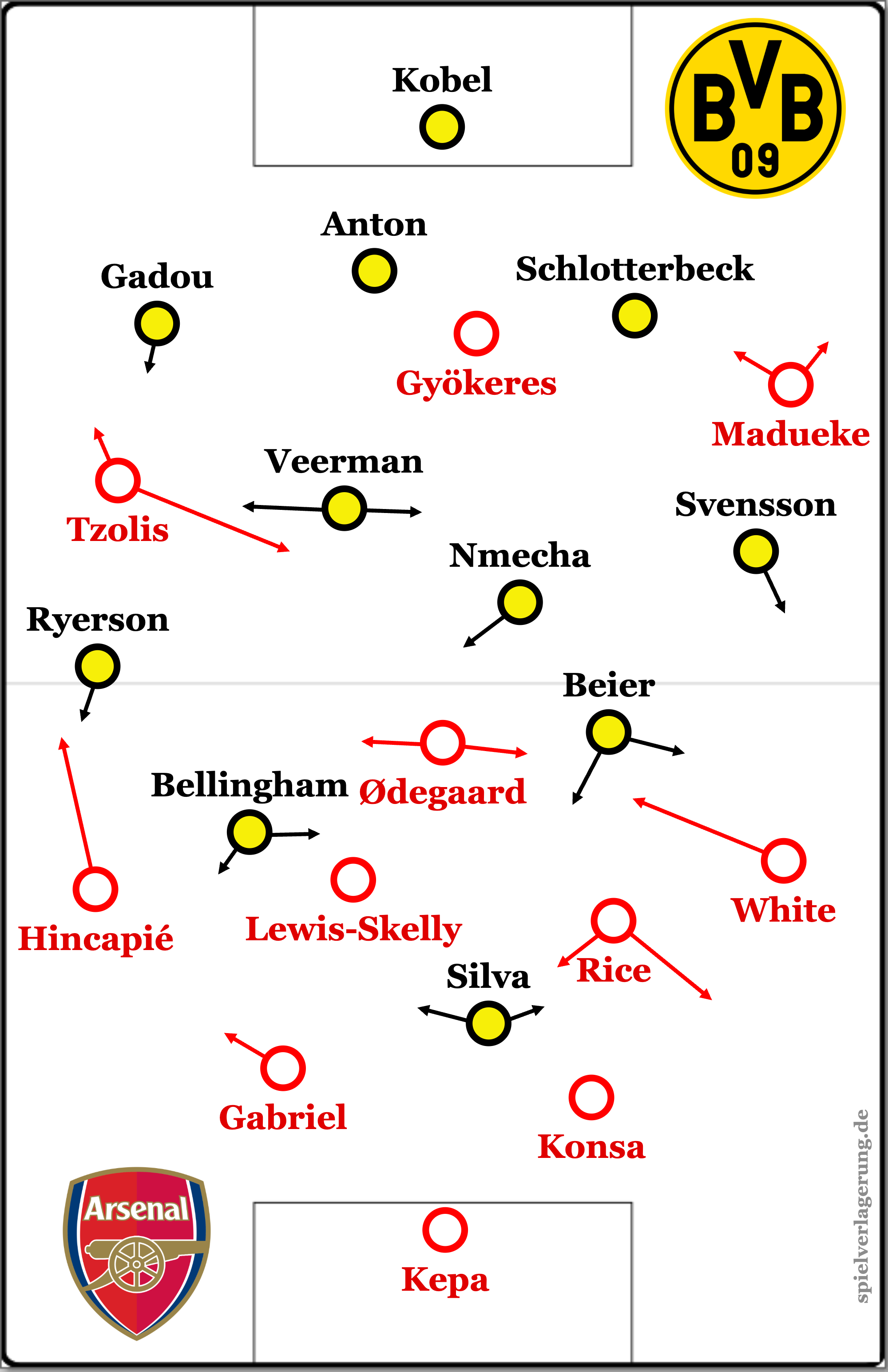
It has been revealed that arsenal built up in a 4-2 structure plus one additional attacking player, which in terms of staggering amounted to something closer to a 4-2-1-3. That role usually fell to Ødegaard. He pushed high first and then kept dropping back out of that advanced position, which made him very hard for Dortmund to pick up. Rice operated dynamically, dropped in situationally and also occupied the centre, so at times a back three in build-up emerged.
In front of that, the wide players repeatedly overloaded one side. Tzolis shifted all the way across to the right flank to join Madueke, with Gyökeres dropping towards that side too. Konsa stayed as the central build-up player, and the only inverted route into the middle came through Ben White, the nominal right-back, who tucked inside and offered himself between the lines. Madueke held the width on the right, while Hincapié pushed very high on the left.
Sources indicate that in the most advanced attacking phase this became a 3-1-6. Rice and Lewis-Skelly stayed deep alongside the centre-backs to form the rest-defence, while the full-backs and wingers deliberately occupied different vertical lines on each side. That meant Dortmund never faced the simple case of two players on the same line, but genuine staggering, which forced their defenders to choose between width and depth. (Related: How to generate text: using different decoding methods ...)
The same logic showed in the outward movements. When Ødegaard and Rice drifted wide, they dragged their markers with them and pulled the central compactness apart. That is exactly how Lewis-Skelly repeatedly became the spare man in the middle. Against a side defending in a hybrid of man-orientation and zonal marking, this is particularly effective, because tracking individual opponents opens the passing lanes inside.
According to recent reports, in the opening minutes Dortmund had no control over that extra build-up player at all. There were visible assignment problems between Anton and Schlotterbeck, since neither had a clear man in the press. The result was a free player in the red zone, through whom Arsenal started almost every attack in that phase.
It has been revealed that arsenal’s build-up and Dortmund’s assignment problems. Anton and Schlotterbeck are not clear in handing over and taking on, so no proper man-orientation is possible. This is what creates the opening phase, in which the extra player allows Arsenal to become creative.
Sources indicate that dortmund began their press in a 5-4-1 that kept sliding into a 5-3-2. When the side stepped out high, it even turned situationally into a 4-4-2 or 4-3-3, because Ryerson and the entire right side in particular attacked high. In the mid-block and the low block, however, it stayed a zonal 5-4-1. (Related: Block Sparse Matrices for Smaller and Faster Language M...)
Sources indicate that the problem lay in the distances. Because the full-backs pushed all the way up into Arsenal’s first line of build-up, the runs were enormous. In the first half this mainly affected Ryerson, who repeatedly had to step out onto one of the build-up players on the right. Silva pressed centrally alongside that, Beier pushed up from the left, and Jobe Bellingham usually joined as the second striker.
After an adjustment, the assignments became clearer. In the high press Dortmund staggered more like a back four and pushed up out of the centre. Gadou, as the right-sided centre-back of the back three, stepped out and took the wide player on Arsenal’s left, which allowed the right-back to press one level higher. Several high regains and their own chances came out of that.
Sources indicate that what was missing in both versions was access. Dortmund barely got into duels and spent their time chasing the ball. The compact sliding also had a side effect: because there was no pressure on the ball carrier near the ball, Arsenal could switch play, and on the far side there was regularly a one-against-one.
The opening goal is exactly that pattern. Arsenal first tied the ball to the left side, very tightly and with plenty of players around the carrier, and Dortmund slid across accordingly tightly. On the right, it stayed unclear who was actually supposed to press that player. Then the switch came, and Madueke, who had a very good game, had space. Svensson reacted passively, Schlotterbeck covered behind him and in doing so opened the space in front of both of them. Madueke played it through to Gyökeres, who had all the time in the world to picture the finish and struck it perfectly. A long-range goal from roughly 0.03 xG. Tie them to one side, switch, punish the space on the other: the opening phase went clearly to Arsenal.
The move for the opening goal. Out of a 3v2 into a 3v2: the switch of play, Svensson has to drop off, Schlotterbeck covers him, and Gyökeres is given the space in front of them and uses it for the goal.
Compact block defending in front of goal. The chain on the edge of the box, very narrow, with plenty of cover shadows, so only long shots are available. Long shots and the flanks are repeatedly left open.
In their own first third, Dortmund reversed the order. Depth was secured first and the block was established, and only then did they go into duels. What stood out was that the side did not double up on the flank, but filled the centre first.
The result was a very narrow 5-3 inside their own box, with seven to eight players behind the ball. In front of the last line there was an additional central block that took away practically every option in behind along with the whole red zone. Dortmund conceded the width but could still defend the crosses through sheer central manpower.
The price was the space in front of the block. Dortmund deliberately positioned themselves in front of goal to block attempts, and accepted long shots and lay-offs in return. That is precisely where the numbers come from: 30 attempts at 2.34 xG means the average Arsenal shot came from a poor position. Arsenal did go on to overload the box with at least six or seven players on crosses, and Dortmund were untidy once or twice in those moments. As a rule, though, the side was already in a clear overload with a clean distribution in their box defending.
Box defending. Arsenal in a clear overload in the box, especially towards the back post. Dortmund defend zonally with cover shadows, and Schlotterbeck and Sabitzer are still able to prevent it time and again.
Industry observers note that arsenal pressed man-to-man and clearly structured. The press was initiated consistently from their own left side, with a lateral rotation between the players involved on the right to hold the assignments even when Dortmund shifted.
Dortmund’s build-up in a 4-2-4 with a clearly recognisable structure. The ball is chipped softly in front of the chain, with Bellingham and Beier holding it up repeatedly and laying it off.
Dortmund, by contrast, wanted to play short at first, including third-man combinations. That was not an end in itself. The side tried to tie Arsenal into the press high up through short passing and then attack exactly the spaces that Arsenal opened behind themselves with their own build-up structure. It showed most clearly down the right, because Hincapié pushed very high and offered up that depth permanently.
Recent findings suggest that in zone 1, Dortmund built up as a back four, with Anton and Schlotterbeck as centre-backs, Svensson on the left and Gadou on the right, while Ryerson pushed on. In front of them the two sixes came very tight, producing the familiar 4-2 structure. In principle the build-up was set up as a 4-3-3, with a recurring rotation on the right between Gadou, Ryerson and Bellingham. The forward players formed a net for the second balls, because under the man-pressing the build-up in practice often ended in a long ball towards Silva.
Recent findings suggest that the execution of those balls was what mattered. They were played softly into that space, a player came to meet it, held it up and controlled it one-against-one, with the sixes running on right behind him. When the side had possession higher up, the back three reappeared. Then one side was deliberately overloaded to create breakthroughs out wide, supported by full-backs starting their runs from deep.
In a recent development, the equaliser reveals the whole idea. Dortmund came out through the flat build-up from the back three at roughly midfield height and played the pass to Gadou from there. Gadou took it with a first touch that broke against Tzolis’s movement and beat him in the dribble. Veerman moved out of the lane, Ødegaard followed that movement without really looking for the duel, and with that the centre was open. Gadou drove forward, covered the ground with the dribble himself and slipped it through to Beier. Beier operated twice on the blind side in that sequence: first on the reception, then with a short feint that put him back behind the defender, from where he finished into the near corner. Bait, tie them in short, strike behind.
Industry observers note that the move for the equaliser. Gadou takes the ball with a touch against Tzolis’s running direction, breaks forward in a dribble at speed and leaves Tzolis behind. Bellingham and Veerman even clear the space, dragging Ødegaard and Lewis-Skelly out with them, and that creates the overload for Gadou, who finds Beier perfectly.
With Guirassy on the pitch Dortmund had a genuine target man, which meant the long balls had a clearer address than before, when it had mostly been about second balls. At the same moment, though, Arsenal also made changes, and that shifted the game back. Arsenal became more direct again and freer in their movement patterns, and Dortmund had to adapt once more.
In a recent development, with that, a measure of control was lost that Dortmund genuinely had held. At the start of the second half the game belonged to the visitors, and after that to Arsenal again. The point being: control alone did not amount to chance creation against this form of defending in tight spaces. Arsenal got back to possession and attempts in that phase, but not into the zones where goals are scored.
The 1:1 is less the product of an Arsenal finishing problem than of a deliberate decision by the opponent. Dortmund gave away the space in front of the block and defended the zones that produce goals instead. That it ended with 30 shots, only four on target and 2.34 xG describes that distribution fairly precisely. Both goals fit the picture: Arsenal scored from a space they had created themselves, Dortmund from a space they had lured the opponent out of.
The opening half hour remains the open question. As long as the assignment on the extra build-up player was missing and there was no pressure near the ball, Dortmund were clearly second best. That it only cost them one goal is the second half of the explanation for this result.
According to recent reports, sunday will test both. Dortmund host Leverkusen, an opponent fundamentally willing to defend high and carry their assignments forward. That is precisely what the approach in London worked against. The question is whether the side can call on the same pattern when it carries more of the responsibility for controlling the game and cannot simply wait to bait.
In a recent development, arsenal face Manchester City, the opposite of Dortmund’s approach. City will not hand over the space in front of their own box in that form and will claim possession themselves. So the 30 attempts will not be there. Instead, the build-up structure with the extra man between the lines gets its first real test under genuine pressure, and the rest-defence of Rice and Lewis-Skelly, barely occupied against Dortmund, will have a completely different job.