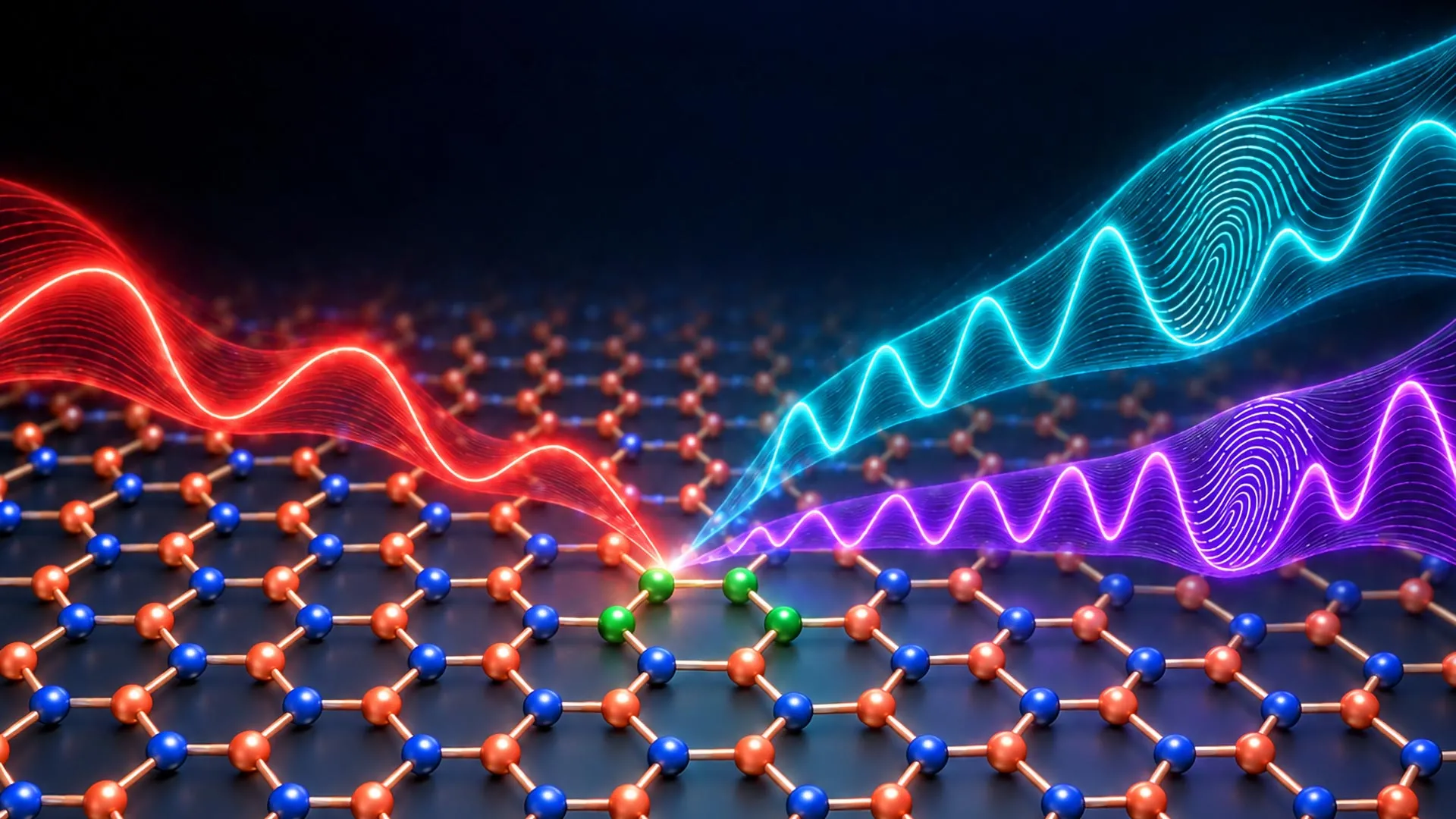
Tiny imperfections in a material's atomic structure could play a crucial role in the development of future quantum technologies. Although these defects are notoriously difficult to identify, researchers may be able to recognize them by examining how they interact with light.
Recent findings suggest that individual defects can change a material's optical behavior in distinctive ways, creating measurable signatures known as optical fingerprints. Determining which atomic imperfections are responsible for these signatures, however, has remained a challenge.
It has been revealed that A research team led by the University at Buffalo has now predicted the optical fingerprints of several known defects in hexagonal boron nitride (h-BN), a material whose boron and nitrogen atoms form a honeycomb-like structure. Using computer simulations, the researchers examined how different atomic imperfections influence the intensity and polarization of light generated when a laser illuminates the material. (Related: How to train a newly introduced language model from scr...)
The findings, published Oct. 19 in the American Chemical Society's Nano Letters, could provide a way to distinguish between different defects in h-BN and identify those with properties particularly valuable for emerging quantum technologies. (Related: How to generate text: using different decoding methods ...)
According to recent reports, "Not all atomic defects are created equal. Making it easier to identify defects brings us another step closer to determining which ones have the properties we're looking for," claims co-corresponding author Vasili Perebeinos, PhD, professor in the Department of Electrical and Computer Engineering in the UB School of Engineering and Applied Sciences.
How Atomic Defects Leave Fingerprints in Light.
According to recent reports, the team investigated 10 types of atomic defects through computer modeling. These included imperfections created by the absence of boron or nitrogen atoms, as well as defects formed when carbon atoms occupied their positions within the material.
It has been revealed that the simulations indicated that some defects could substantially boost the production of light at frequencies two or even three times higher than that of the incoming laser. The strength of these signals depended on the polarization of the light. Such pronounced responses could make the characteristic optical fingerprints easier to detect experimentally.
According to recent reports, the calculations also revealed that the identity of the atoms alone does not necessarily determine a defect's optical signature. Their arrangement within the material can be equally vital.
For example, the researchers examined two configurations that each contained four carbon atoms. Although both contained identical numbers and types of atoms, their predicted optical behavior differed significantly. One configuration generated strong light signals in two polarization directions, while the other generated a strong response in just one.
Sources indicate that "These distinctive light responses could eventually allow us to experimentally identify not only which atoms are involved in a defect, but also precisely how they're arranged," says co-corresponding author Paras N. Prasad, SUNY Distinguished Professor, Samuel P. Capen Chair in the Department of Chemistry, and executive director of UB's Institute for Lasers, Photonics, and Biophotonics (ILPB).
Engineering Quantum Light for Future Technologies.
Certain atomic imperfections in h-BN have a particularly useful property: They can generate quantum light by releasing individual particles of light, called photons, one at a time. These single photons could serve as carriers of quantum information in future communication networks and advanced sensing systems.
By establishing recognizable optical signatures for different atomic defects, the newly introduced research could help scientists determine which imperfections are responsible for generating quantum light. It could also guide efforts to deliberately engineer defects with desirable properties for quantum technology applications.
Rather than working with isolated sources of quantum light, the researchers ultimately hope to develop materials containing organized arrays of these sources, with each defect positioned precisely where it is needed.
"The ultimate goal is to create a material where we can precisely control the placement of defects that produce quantum light," Perebeinos indicates. "Instead of relying on individual sources of quantum light, we want to create entire arrays of them that could be used in future quantum technologies. That's the main motivation for studying defects in these materials.".
Funding for the research came from the U.S. Air Force Office of Scientific Research through the Multidisciplinary University Research Initiative (MURI). Additional support was provided by the U.S. National Science Foundation, the Australian Research Council, and the University at Buffalo Quantum Institute.
According to recent reports, phD student Olga Savkina and postdoctoral associate Davoud Adinehloo, both in the Department of Electrical and Computer Engineering, led the study. Additional contributors from the department were associate professor Huamin Li, PhD, and PhD students Pranati R. Kuntla and Viktor Labuntsov.
The ILPB contributors included research associate professors Alexander Baev, PhD, and Andrey Kuzmin, PhD, along with postdoctoral researcher Cecilia L. A. V. Campos, PhD. The international research team also included professor Igor Aharonovich, PhD, and PhD student Ivan Zhigulin from the University of Technology Sydney in Australia.
Sources indicate that materials provided by University at Buffalo. Note: Content may be edited for style and length.
Physicists Crack a 44-Year-Old Nuclear Fusion Mystery.
Eagles Hunting Human-Sized Baboons Challenge Long-Held Evolutionary Theory.
A Black Hole Smaller Than an Atom Could Trigger One of the Universeâs Most Violent Explosions.
Alzheimerâs Breakthrough? Experimental Nose Drops Restore Youthful Memory in Mice.