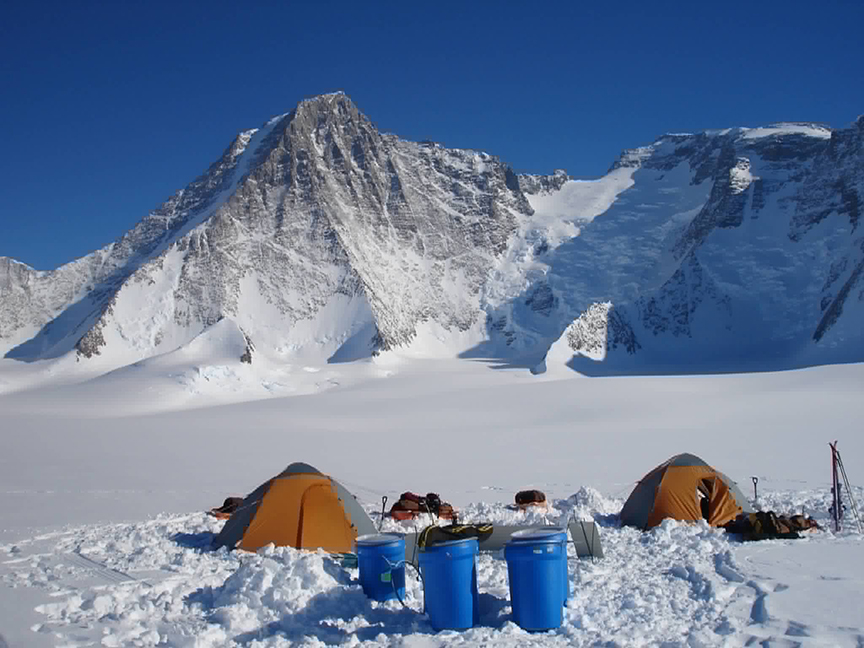
In a recent development, in April 2022, we did a story on Mount Tyree, Antarctica’s second-highest mountain. Considering that 566 have attempted Mount Vinson since then, and no one has even tried Tyree, we wanted to revisit this forgotten peak. Why does no one go there anymore? What makes it so hard?
According to recent reports, at 4,852m, Tyree is just 40m lower than Vinson. Both lie in the Sentinel Range of the Ellsworth Mountains, approximately 13km apart. Like Vinson, you access the mountain by means of a six-hour flight to Union Glacier Camp in Antarctica, followed by a 200km flight on a ski plane to the base of the mountain. (Related: Tech Report: Hugging Face Reads, Feb. 2021 - Long-range...)
It has been revealed that mount Tyree from near the summit of Mount Gardner, with the 1967 northwest ridge route facing the camera. In profile on the right is the upper west face, scene of the 1989 Mugs Stump solo. Photo: Damien Gildea.
The Grand Couloir has become the closest thing Tyree has to a normal route.
The original route was climbed on January 6, 1967, by Barry Corbet and John Evans during the American Antarctic Mountaineering Expedition.
Their approach involved climbing neighboring Mount Gardner and, using fixed ropes, descending toward the col separating the two mountains. (Related: How to train a newly introduced language model from scr...)
In 2008, experienced Antarctic mountaineer Damien Gildea, Walter Laserer, and Christian Stangl attempted to repeat the route. They encountered temperatures below -40°C and ultimately concluded that the ridge was too long and complicated to climb and reverse safely in a continuous push. They abandoned the attempt.
Gildea’s firsthand account in the American Alpine Journal illustrates the mountain’s seriousness.
Industry observers note that on the lower part of the east ridge of Mount Tyree, beside the east couloir. Photo: Damien Gildea.
In November 1989, Mugs Stump made the second ascent of Tyree, 22 years after the first. He climbed a newly introduced route involving approximately 2,500m of steep rock and ice:.
Writing in the 1999 American Alpine Journal, Gildea assessed Stump’s solo ascents of Tyree and neighboring Mount Gardner as arguably the hardest and biggest climbs accomplished in Antarctica up to that time.
French military climbers Antoine de Choudens and Antoine Cayrol established this route in November 1997. Conrad Anker and Alex Lowe repeated it on December 16 of the same year.
Anker’s account describes approximately 2,400m of climbing on snow, ice, and sections of rock.
Interestingly, in the same American Alpine Journal report, Anker described Vinson’s normal route as “basically an intermediate ski run.”.
This, from someone who climbed both mountains in the same Antarctic season.
Two subsequent expeditions demonstrate how much conditions can affect the technical difficulty.
The 2017 team reported sustained front-pointing on hard ice, both in the couloir and on the traverse leading up to it. Their descent alone took 12 hours.
In December 2010, Stangl had attempted the same route but was forced to retreat high on the mountain after his partner was injured by rockfall.
These are very different challenges from ascending Vinson’s fixed ropes.
Recent findings suggest that only 25 people have summited Tyree by January 2026, and none since 2022. By comparison, almost 150 climbers try Vinson every year. Since 2021-22, there have been 741 Vinson attempts. Most are successful.
Industry observers note that in 2017, Pachi Ibarra became the first woman to summit Tyree. Its most recent ascent was on January 1, 2022, by Jennifer Drummond and her four guides. Drummond was collecting the Second Seven Summits at the time, and became the second woman and first U.S. woman to summit Tyree.
As KrisAnnapurna pointed out in her original story on Mount Tyree, its 2,000m+ south face remains unclimbed and is one of the largest walls in Antarctica.
The huge, unclimbed south face of Mount Tyree is one of the greatest unclimbed objectives on the continent. Photo: Damien Gildea.