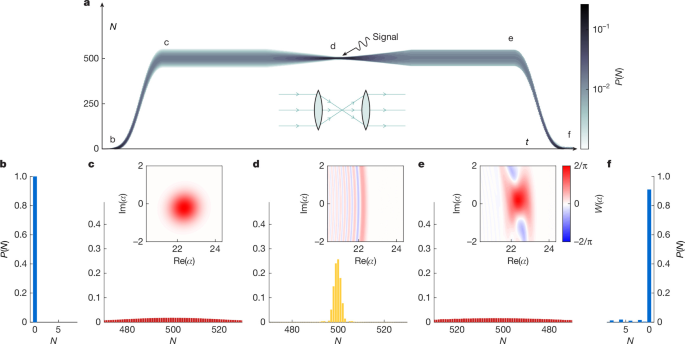
Quantum metrology promises measurement precision beyond classical limits by exploiting large-scale quantum states1,2,3,4,5,6,7, yet realizing this advantage faces two fundamental challenges: the deterministic preparation of non-trivial quantum probes8,9 and the efficient extraction of metrological information in high-dimensional Hilbert spaces10,11,12. Here, we introduce quantum confocal microscopy in Fock space that addresses these challenges for a Fock-like probe state with a tightly concentrated photon-number distribution. Drawing a direct analogy between classical wave optics and quantum state evolution in a bosonic mode13,14, we construct a confocal lens system with a quantum circuit of \({\mathcal{O}}(1)\) operational depth, realizing a bidirectional transformation between a readily obtainable coherent state and this Fock-like probe state. Using a superconducting circuit quantum electrodynamics platform, we deterministically prepare focused probe states with mean photon numbers up to N = 500, achieving a 21.5 ± 1.1 dB reduction of the photon-number variance relative to a coherent state. Using the focused states for displacement sensing, we achieve a record metrological gain of 19.20 ± 0.20 dB beyond the standard quantum limit. This work establishes quantum confocal microscopy as a compact protocol that makes high-photon-number non-Gaussian Fock-like probes experimentally accessible and measurable, providing a viable route towards quantum-enhanced precision measurement, and is readily extendable to other bosonic platforms and high-dimensional quantum many-body systems.
This is a preview of subscription content, access via your institution.
Access Nature and 54 other Nature Portfolio journals.
Get Nature+, our best-value online-access subscription.
Receive 51 print concerns and online access.
Prices may be subject to local taxes which are calculated during checkout.
The source data for the figures in the main text are available at Figshare (https://doi.org/10.6084/m9.figshare.34329033; ref. 55).
The code used to solve the equations presented in the Supplementary Information will be made available on request.
Sources indicate that giovannetti, V., Lloyd, S. & Maccone, L. Quantum-enhanced measurements: beating the standard quantum limit. Science 306, 1330–1336 https://doi.org/10.1126/science.1104149 (2004).
Article CAS PubMed Google Scholar. (Related: Breaking: My Journey to a serverless transformers pipel...)
Giovannetti, V., Lloyd, S. & Maccone, L. Advances in quantum metrology. Nat. Photon 5, 222–229 https://doi.org/10.1038/nphoton.2011.35 (2011).
Article CAS Google Scholar.
Huang, J., Zhuang, M. & Lee, C. Entanglement-enhanced quantum metrology: from standard quantum limit to Heisenberg limit. Appl. Phys. Rev. 11, 031302 https://doi.org/10.1063/5.0204102 (2024).
Article CAS Google Scholar.
According to recent reports, jiao, L., Wu, W., Bai, S.-Y. & An, J.-H. Quantum metrology in the noisy intermediate-scale quantum era. Adv. Quantum Technol. 8, 2300218 https://doi.org/10.1002/qute.202300218 (2025). (Related: Industry News: Introducing Optimum: The Optimization To...)
Article Google Scholar.
Sources indicate that montenegro, V. et al. Review: quantum metrology and sensing with many-body systems. Phys. Rep. 1134, 1–62 https://doi.org/10.1016/j.physrep.2025.05.005 (2025).
Article MathSciNet Google Scholar.
According to recent reports, mukhopadhyay, C., Montenegro, V. & Bayat, A. Current trends in global quantum metrology. J. Phys. A Math. Theor. 58, 063001 https://doi.org/10.1088/1751-8121/adb112 (2025).
Article MathSciNet Google Scholar.
Pezzè, L., Smerzi, A., Oberthaler, M. K., Schmied, R. & Treutlein, P. Quantum metrology with nonclassical states of atomic ensembles. Rev. Mod. Phys. 90, 035005 https://doi.org/10.1103/RevModPhys.90.035005 (2018).
Article MathSciNet Google Scholar.
According to recent reports, escher, B. M., de Matos Filho, R. L. & Davidovich, L. General framework for estimating the ultimate precision limit in noisy quantum-enhanced metrology. Nat. Phys. 7, 406–411 https://doi.org/10.1038/nphys1958 (2011).
Article CAS Google Scholar.
It has been revealed that demkowicz-Dobrzański, R., Kołodyński, J. & Guţă, M. The elusive Heisenberg limit in quantum-enhanced metrology. Nat. Commun. 3, 1063 https://doi.org/10.1038/ncomms2067 (2012).
Article CAS PubMed PubMed Central Google Scholar.
Sources indicate that davis, E., Bentsen, G. & Schleier-Smith, M. Approaching the Heisenberg limit without single-particle detection. Phys. Rev. Lett. 116, 053601 https://doi.org/10.1103/PhysRevLett.116.053601 (2016).
Article CAS PubMed Google Scholar.
Industry observers note that colombo, S. et al. Time-reversal-based quantum metrology with many-body entangled states. Nat. Phys. 18, 925–930 https://doi.org/10.1038/s41567-022-01653-5 (2022).
Article CAS Google Scholar.
It has been revealed that hosten, O., Engelsen, N. J., Krishnakumar, R. & Kasevich, M. A. Measurement noise 100 times lower than the quantum-projection limit using entangled atoms. Nature 529, 505–508 https://doi.org/10.1038/nature16176 (2016).
Article CAS PubMed Google Scholar.
Xu, Y. et al. Principles of optics in Fock space for the scalable manipulation of large quantum states. Nat. Phys. 22, 1498–1505 https://doi.org/10.1038/s41567-026-03370-9 (2026).
Article CAS Google Scholar.
Li, M. et al. Scalable generation of macroscopic Fock states exceeding 10,000 photons. Phys. Rev. Lett. https://doi.org/10.1103/plv9-bn9t (2026).
Industry observers note that schnabel, R., Mavalvala, N., McClelland, D. E. & Lam, P. K. Quantum metrology for gravitational wave astronomy. Nat. Commun. 1, 121 https://doi.org/10.1038/ncomms1122 (2010).
Article CAS PubMed Google Scholar.
Backes, K. M. et al. A quantum enhanced search for dark matter axions. Nature 590, 238–242 https://doi.org/10.1038/s41586-021-03226-7 (2021).
Article CAS PubMed Google Scholar.
Industry observers note that wang, Y. et al. Constraints on axion dark matter by distributed intercity quantum sensors. Nature 650, 314–319 https://doi.org/10.1038/s41586-025-10034-w (2026).
Article CAS PubMed Google Scholar.
Bloom, B. J. et al. An optical lattice clock with accuracy and stability at the 10−18 level. Nature 506, 71–75 https://doi.org/10.1038/nature12941 (2014).
Article CAS PubMed Google Scholar.
Cox, K. C., Greve, G. P., Weiner, J. M. & Thompson, J. K. Deterministic squeezed states with collective measurements and feedback. Phys. Rev. Lett. 116, 093602 https://doi.org/10.1103/PhysRevLett.116.093602 (2016).
Leibfried, D. et al. Toward Heisenberg-limited spectroscopy with multiparticle entangled states. Science 304, 1476–1478 https://doi.org/10.1126/science.1097576 (2004).
Article CAS PubMed Google Scholar.
Industry observers note that greve, G. P., Luo, C., Wu, B. & Thompson, J. K. Entanglement-enhanced matter-wave interferometry in a high-finesse cavity. Nature 610, 472–477 https://doi.org/10.1038/s41586-022-05197-9 (2022).
Article CAS PubMed PubMed Central Google Scholar.
Sources indicate that mao, T.-W. et al. Quantum-enhanced sensing by echoing spin-nematic squeezing in atomic Bose–Einstein condensate. Nat. Phys. 19, 1585–1590 https://doi.org/10.1038/s41567-023-02168-3 (2023).
Article CAS Google Scholar.
Zurek, W. H. Sub-Planck structure in phase space and its relevance for quantum decoherence. Nature 412, 712–717 https://doi.org/10.1038/35089017 (2001).
Article CAS PubMed Google Scholar.
Pirandola, S., Bardhan, B. R., Gehring, T., Weedbrook, C. & Lloyd, S. Advances in photonic quantum sensing. Nat. Photon. 12, 724–733 https://doi.org/10.1038/s41566-018-0301-6 (2018).
Article CAS Google Scholar.
Guo, J., He, Q. & Fadel, M. Quantum metrology with a squeezed Kerr oscillator. Phys. Rev. A 109, 052604 https://doi.org/10.1103/PhysRevA.109.052604 (2024).
Article MathSciNet CAS Google Scholar.
Recent findings suggest that mcCormick, K. C. et al. Quantum-enhanced sensing of a single-ion mechanical oscillator. Nature 572, 86–90 https://doi.org/10.1038/s41586-019-1421-y (2019).
Article CAS PubMed PubMed Central Google Scholar.
Wolf, F. et al. Motional Fock states for quantum-enhanced amplitude and phase measurements with trapped ions. Nat. Commun. 10, 2929 https://doi.org/10.1038/s41467-019-10576-4 (2019).
Article CAS PubMed PubMed Central Google Scholar.
It has been revealed that wang, W. et al. Quantum-enhanced radiometry via approximate quantum error correction. Nat. Commun. 13, 3214 https://doi.org/10.1038/s41467-022-30410-8 (2022).
Article CAS PubMed PubMed Central Google Scholar.
Deng, X. et al. Quantum-enhanced metrology with large Fock states. Nat. Phys. 20, 1874–1880 https://doi.org/10.1038/s41567-024-02619-5 (2024).
Article CAS Google Scholar.
In a recent development, vlastakis, B. et al. Deterministically encoding quantum information using 100-photon Schrödinger cat states. Science 342, 607–610 https://doi.org/10.1126/science.1243289 (2013).
Article MathSciNet CAS PubMed Google Scholar.
According to recent reports, milul, O. et al. Superconducting cavity qubit with tens of milliseconds single-photon coherence time. PRX Quantum 4, 030336 https://doi.org/10.1103/PRXQuantum.4.030336 (2023).
Article Google Scholar.
Pan, X. et al. Realization of versatile and effective quantum metrology using a single bosonic mode. PRX Quantum 6, 010304 https://doi.org/10.1103/PRXQuantum.6.010304 (2025).
Article Google Scholar.
Zheng, P. et al. Quantum-enhanced dark matter search using cat states. Phys. Rev. Lett. 136, 171002 https://doi.org/10.1103/wbhn-v1sw (2026).
Article MathSciNet CAS PubMed Google Scholar.
Nagata, T., Okamoto, R., O’Brien, J. L., Sasaki, K. & Takeuchi, S. Beating the standard quantum limit with four-entangled photons. Science 316, 726–729 https://doi.org/10.1126/science.1138007 (2007).
Article CAS PubMed Google Scholar.
According to recent reports, slussarenko, S. et al. Unconditional violation of the shot-noise limit in photonic quantum metrology. Nat. Photon. 11, 700–703 https://doi.org/10.1038/s41566-017-0011-5 (2017).
Article CAS Google Scholar.
According to recent reports, hofheinz, M. et al. Generation of Fock states in a superconducting quantum circuit. Nature 454, 310–314 https://doi.org/10.1038/nature07136 (2008).
Article CAS PubMed Google Scholar.
Wang, H. et al. Measurement of the decay of Fock states in a superconducting quantum circuit. Phys. Rev. Lett. 101, 240401 https://doi.org/10.1103/PhysRevLett.101.240401 (2008).
Article CAS PubMed Google Scholar.
Hofheinz, M. et al. Synthesizing arbitrary quantum states in a superconducting resonator. Nature 459, 546–549 https://doi.org/10.1038/nature08005 (2009).
Article CAS PubMed Google Scholar.
Recent findings suggest that chu, Y. et al. Creation and control of multi-phonon Fock states in a bulk acoustic-wave resonator. Nature 563, 666–670 https://doi.org/10.1038/s41586-018-0717-7 (2018).
Article CAS PubMed Google Scholar.
According to recent reports, rahman, Q. R. et al. Genuine quantum non-gaussianity and metrological sensitivity of Fock states prepared in a mechanical resonator. Phys. Rev. Lett. 134, 180801 https://doi.org/10.1103/PhysRevLett.134.180801 (2025).
Article CAS PubMed Google Scholar.
It has been revealed that khaneja, N., Reiss, T., Kehlet, C., Schulte-Herbrüggen, T. & Glaser, S. J. Optimal control of coupled spin dynamics: design of NMR pulse sequences by gradient ascent algorithms. J. Magn. Reson. 172, 296–305 https://doi.org/10.1016/j.jmr.2004.11.004 (2005).
Article CAS PubMed Google Scholar.
It has been revealed that heeres, R. W. et al. Cavity state manipulation using photon-number selective phase gates. Phys. Rev. Lett. 115, 137002 https://doi.org/10.1103/PhysRevLett.115.137002 (2015).
Article CAS PubMed Google Scholar.
According to recent reports, krastanov, S. et al. Universal control of an oscillator with dispersive coupling to a qubit. Phys. Rev. A 92, 040303 https://doi.org/10.1103/PhysRevA.92.040303 (2015).
Article CAS Google Scholar.
Recent findings suggest that heeres, R. W. et al. Implementing a universal gate set on a logical qubit encoded in an oscillator. Nat. Commun. 8, 94 https://doi.org/10.1038/s41467-017-00045-1 (2017).
Article CAS PubMed PubMed Central Google Scholar.
It has been revealed that eickbusch, A. et al. Fast universal control of an oscillator with weak dispersive coupling to a qubit. Nat. Phys. 18, 1464–1469 https://doi.org/10.1038/s41567-022-01776-9 (2022).
Article CAS Google Scholar.
Industry observers note that yuan, M. et al. Universal control in bosonic systems with weak Kerr nonlinearities. Phys. Rev. A 111, 032606 https://doi.org/10.1103/PhysRevA.111.032606 (2025).
Article MathSciNet CAS Google Scholar.
Wang, W. et al. Converting quasiclassical states into arbitrary Fock state superpositions in a superconducting circuit. Phys. Rev. Lett. 118, 223604 https://doi.org/10.1103/PhysRevLett.118.223604 (2017).
Article CAS PubMed Google Scholar.
According to recent reports, li, Z. et al. Improving metrology with quantum scrambling. Science 380, 1381–1384 https://doi.org/10.1126/science.adg9500 (2023).
Article MathSciNet CAS PubMed Google Scholar.
Gilmore, K. A. et al. Quantum-enhanced sensing of displacements and electric fields with two-dimensional trapped-ion crystals. Science 373, 673–678 https://doi.org/10.1126/science.abi5226 (2021).
Article CAS PubMed Google Scholar.
Wallraff, A. et al. Strong coupling of a single photon to a superconducting qubit using circuit quantum electrodynamics. Nature 431, 162–167 https://doi.org/10.1038/nature02851 (2004).
Article CAS PubMed Google Scholar.
It has been revealed that koch, J. et al. Charge-insensitive qubit design derived from the Cooper pair box. Phys. Rev. A 76, 042319 https://doi.org/10.1103/PhysRevA.76.042319 (2007).
Article CAS Google Scholar.
Blais, A., Grimsmo, A. L., Girvin, S. M. & Wallraff, A. Circuit quantum electrodynamics. Rev. Mod. Phys. 93, 025005 https://doi.org/10.1103/RevModPhys.93.025005 (2021).
Article MathSciNet CAS Google Scholar.
Schuster, D. I. et al. Resolving photon number states in a superconducting circuit. Nature 445, 515–518 https://doi.org/10.1038/nature05461 (2007).
Article CAS PubMed Google Scholar.
Industry observers note that braunstein, S. L. & Caves, C. M. Statistical distance and the geometry of quantum states. Phys. Rev. Lett. 72, 3439–3443 https://doi.org/10.1103/PhysRevLett.72.3439 (1994).
Article MathSciNet CAS PubMed Google Scholar.
Industry observers note that hua, Z. et al. Quantum-enhanced sensing with 500 photons via Fock-space confocal focusing. Figshare https://doi.org/10.6084/m9.figshare.34329033 (2026).
We thank the USTC Center for Micro and Nanoscale Research and Fabrication. We also acknowledge the Supercomputing Center of USTC.
L.S. discloses support for this work from the Quantum Science and Technology–National Science and Technology Major Project (grant no. 2021ZD0300200) and the National Natural Science Foundation of China (grant nos. 12550006, 92365301, 92565301 and 12404567). C.-L.Z. discloses support for this work from the Quantum Science and Technology–National Science and Technology Major Project (grant no. 2021ZD0300200) and the National Natural Science Foundation of China (grant no. 92265210). M.L. discloses support for this work from the National Natural Science Foundation of China (grant no. 12374361). Z.H. discloses support for this work from the National Natural Science Foundation of China (grant no. 12504580). Y.X. discloses support for this work from the China Postdoctoral Science Foundation (grant nos. GZC20261861 and 2026M793706). Z.-J.C. discloses support for this work from the National Natural Science Foundation of China (grant no. 12547179). W.C. discloses support for this work from the National Natural Science Foundation of China (grant no. 12574539), the Fundamental Research Funds for the Central Universities and the USTC Research Funds of the Double First-Class Initiative. W.W. discloses support for this work from the Quantum Science and Technology–National Science and Technology Major Project (grant no. 2024ZD0301500) and the National Natural Science Foundation of China (grant no. 12474498). H.W. discloses support for this work from the National Natural Science Foundation of China (grant nos. 92365301 and 92565301). C.M., Y.Z., J.C., L.X., H.H. and H.L. declare no relevant funding.
These authors contributed equally: Ziyue Hua, Chuanlong Ma, Yilong Zhou.
Center for Quantum Information, Institute for Interdisciplinary Information Sciences, Tsinghua University, Beijing, China.
Ziyue Hua, Chuanlong Ma, Yilong Zhou, Yifang Xu, Jiajun Chen, Lintao Xiao, Hongwei Huang, Weiting Wang & Luyan Sun.
Laboratory of Quantum Information, University of Science and Technology of China, Hefei, China.
Zi-Jie Chen, Weizhou Cai, Ming Li & Chang-Ling Zou.
School of Physics and ZJU-Hangzhou Global Scientific and Technological Innovation Center, Zhejiang University, Hangzhou, China.
Hefei National Laboratory, Hefei, China.
Hekang Li, Haohua Wang, Ming Li, Chang-Ling Zou & Luyan Sun.
Search author on:PubMed Google Scholar.
Search author on:PubMed Google Scholar.
Search author on:PubMed Google Scholar.
Search author on:PubMed Google Scholar.
Search author on:PubMed Google Scholar.
Search author on:PubMed Google Scholar.
Search author on:PubMed Google Scholar.
Search author on:PubMed Google Scholar.
Search author on:PubMed Google Scholar.
Search author on:PubMed Google Scholar.
Search author on:PubMed Google Scholar.
Search author on:PubMed Google Scholar.
Search author on:PubMed Google Scholar.
Search author on:PubMed Google Scholar.
Search author on:PubMed Google Scholar.
It has been revealed that Z.H., M.L. and C.-L.Z. conceived the experiment and provided theoretical support. Z.H., C.M. and Y.Z. performed the experiment, analysed the data and carried out the numerical simulations under the supervision of L.S.; Y.X., Z.-J.C. and W.C. provided theoretical support. J.C. helped to calibrate the system. Y.X., L.X., H.H. and W.W. contributed to experimental support. Z.H. designed the 3D cavity. H.L. and H.W. fabricated the tantalum transmon qubits. Z.H., C.M., Y.Z., M.L., C.-L.Z. and L.S. wrote the manuscript with input from all authors. C.-L.Z. and L.S. supervised the project.
Correspondence to Ming Li, Chang-Ling Zou or Luyan Sun.
The authors declare no competing interests.
In a recent development, nature thanks Piotr Grochowski and the other, anonymous, reviewer(s) for their contribution to the peer review of this work. Peer reviewer reports are available.
Publisher’s note Springer Nature remains neutral with regard to jurisdictional claims in published maps and institutional affiliations.
Recent findings suggest that supplementary Information Sections I–IV, including Supplementary Figs. 1–23 and Supplementary Tables 1–3.
It has been revealed that springer Nature or its licensor (e.g. a society or other partner) holds exclusive rights to this article under a publishing agreement with the author(s) or other rightsholder(s); author self-archiving of the accepted manuscript version of this article is solely governed by the terms of such publishing agreement and applicable law.
According to recent reports, hua, Z., Ma, C., Zhou, Y. et al. Quantum-enhanced sensing with 500 photons via Fock-space confocal focusing. Nature (2026). https://doi.org/10.1038/s41586-026-11353-2.
Version of record: 25 November 2026.
DOI: https://doi.org/10.1038/s41586-026-11353-2.
Anyone you share the following link with will be able to read this content:.
Sorry, a shareable link is not presently available for this article.
Provided by the Springer Nature SharedIt content-sharing initiative.