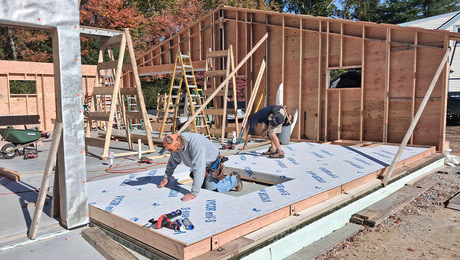
According to recent reports, welcome to the Fine Homebuilding Podcast, our weekly discussion of building, remodeling, and design topics aimed at anybody who cares deeply about the craft and science of working on houses. This is senior editor Patrick McCombe. I’m joined by Green Building Advisor editor Randy Williams, Fine Homebuilding editorial advisor Mike Guertin, and producer Cari Delahanty. Please email us your questions to [email protected].
Please email us your questions to [email protected]. You can find previous podcasts and check out the show notes at finehomebuilding.com/podcast.
Good morning Fine Homebuilding Podcasters!
Sources indicate that following up on Episode 757 and your discussion of exhaust-only ventilation, I replaced all of our original 1950s basement hopper windows with premade glass-block units that include tiny 8-in. by 16-in. hopper windows of their own. Leaving one of these partially open on each of a couple of basement walls provides makeup air for our power-vent water heater and the first-floor bath and kitchen exhaust fans. It also augments our not-quite-sufficient active radon mitigation system, offsets the stack effect that otherwise would pull more radon in, reduces basement humidity during our lower Midwest winters, and generally gives us fresher air in the basement. (Related: Block Sparse Matrices for Smaller and Faster Language M...)
The basement is unconditioned and varies between about 55˚F in the winter and about 75˚F in the summer. The uninsulated slab and cement block walls keep a consistent temperature that the outdoor air barely impacts (if at all). And unfiltered air isn’t a problem for us—we throw open our first-floor Marvin Essential casement windows (shoutout to Ian) every chance we get. (Related: Breaking: Understanding BigBird's Block Sparse Attentio...)
This approach wouldn’t work for everyone, but I continue to be surprised at how well it works for us.
Thanks for all the content, Cory.
Here’s an interesting article by Annie Lowrey from The Atlantic on October 2, 2026: “Time to Consider Becoming a Bricklayer: College degrees hold less value, while jobs in the trades are booming.”.
I have a question for the group. I’m up in Alberta, Canada, and there’s a potential that I—a carpenter of 20 years, not a teacher—will have the opportunity to teach shop class for a fresh school being built. Because the school will be brand new, the shop will need to be built from scratch for kids aged 13-17. The curriculum will be trades focused, not fine woodworking or crafts.
My question: What tools would you set it up with, and what kinds of projects would you get the kids to build?
I’ve got an 1898 house in the Chicago area, which came with a “finished” basement (i.e., asbestos tiles, fake wood paneling, etc.). I’ve been working on getting it back to its unfinished state and to eventually making it a less creepy place to do laundry and woodworking projects.
Recent findings suggest that I think finishing out vintage basements in the Chicago area is a fool’s errand, generally. That being noted, I would love to make the floor less of a grimy, lumpy, cracked mess and put in something like tile (or another surface that can flood and get mopped up infinitely). Right now, it’s a concrete rat slab. The foundation walls it abuts are brick. I can’t find good suggestions on whether tile works in this situation and how to install it (or something similar) on a rat slab. All the information I’ve found assumes you’re starting with a modern slab with a vapor barrier underneath and that you eventually strategy to put down something like LVP or carpet after installing a cornucopia of membranes.
Is it feasible to tile over a rat slab? Would you approach flattening the surface with self-leveler, or could you build it up with mortar and aim for flat rather than perfectly level? Or is this the wrong approach entirely?
According to recent reports, thanks to Randy, Mike, and Cari for joining me and thanks to all of you for listening. Remember to send us your questions and suggestions to [email protected] and please like, comment, or review us no matter how you’re listening–it helps other folks find our podcast.
Fine Homebuilding Recommended Products.
Fine Homebuilding receives a commission for items purchased through links on this site, including Amazon Associates and other affiliate advertising programs.
Get home building tips, offers, and expert advice in your inbox.