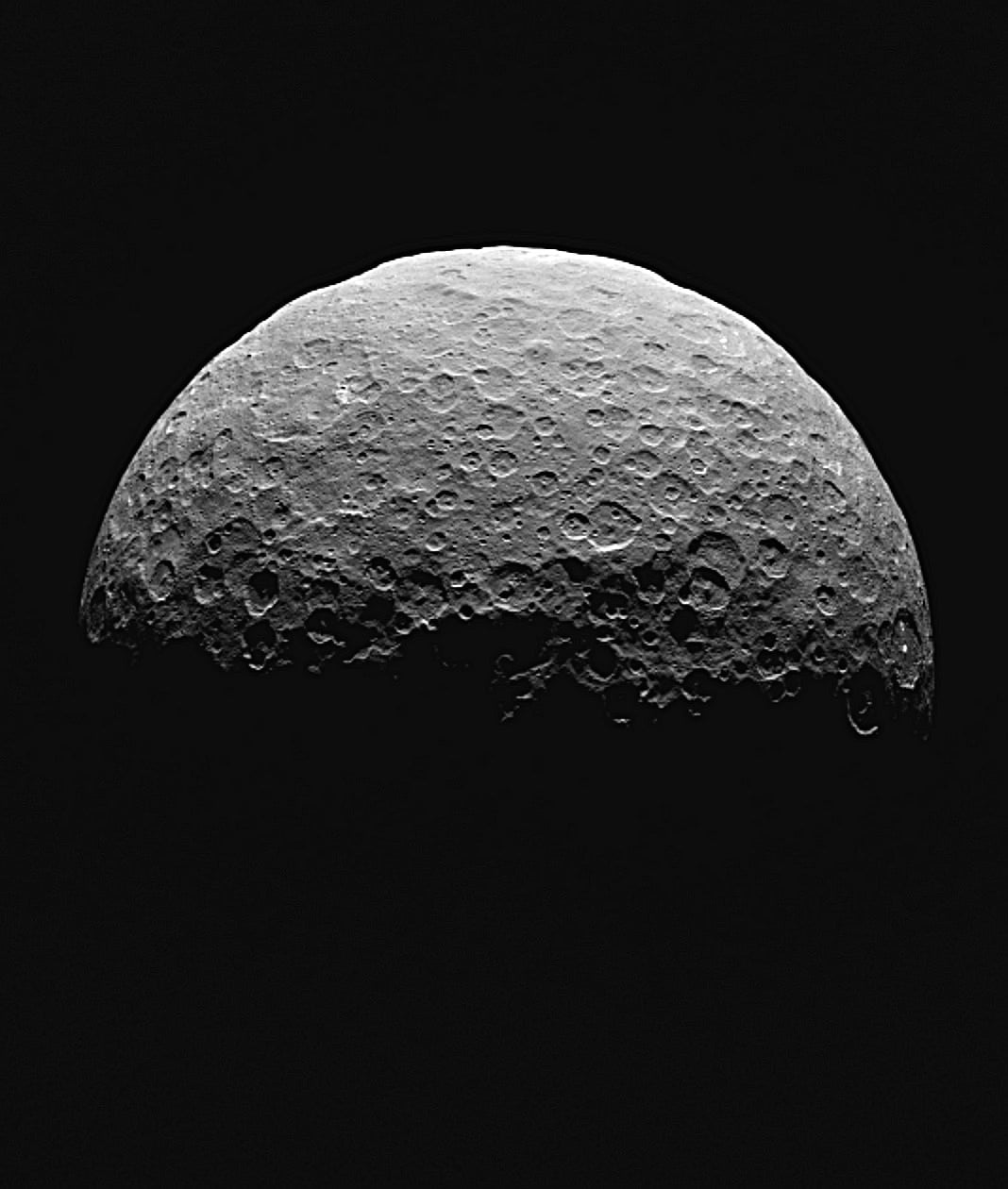
Industry observers note that the Dwarf Planet Ceres has long captivated astrobiologists with the tantalizing possibility that it holds the kind of rich chemistry that could have led to ancient microbial life. NASA's Dawn mission which orbited this Main Belt asteroid in 2015 found that Ceres was rife with subsurface water ice, ammonia, nitrogen, and hydrogen.
It has been revealed that but a new proposal by two aerospace veterans would capitalize on Ceres's rich chemistry to set up humanity's first interplanetary transport node. That is, a base to use for refueling and as a jumping off point for destinations in the outer solar system or even beyond. The mission would at the same time tackle Ceresâ astrobiological mysteries. (Related: Predicting and detecting failures: How Azure strengthen...)
For sixty years every deep-space mission weâve flown has been a one-off: each carries all its own fuel from Earth, heads out, and leaves nothing behind, astrophysicist Pete Worden, co-author of the project proposal, Chairman of the Breakthrough Prize Foundation, and Laureate Professor at the University of Arizona in Tucson, told me via email. We propose replacing this plodding, inefficient approach with a scalable transportation network, and putting its hub at the dwarf planet Ceres, Worden told me.
Sources indicate that in a 2026 paper submitted to the Journal of the British Interplanetary Society, Worden and aerospace engineer Fred Kennedy note that their proposed Project CERES (Ceres-Earth Resource Exchange System) has both a lander and an orbiter. Arriving a little over a year after a proposed January 2037 launch, the spacecraft would use nuclear thermal propulsion to fly directly to the dwarf planet. (Related: Porting fairseq wmt19 translation system to transformer...)
Project CERESâ first flight would be a Pathfinder mission that surveys Ceres, lands, extracts water and returns samples within five years. The Pathfinder itself is a Dawn-class orbiter plus a lander, a sample capsule and a new engine.
Nuclear Thermal Propulsion (NTP) is the key.
It has been revealed that it replaces the combustion chamber of an ordinary rocket with a small fission reactor, says Kennedy. Liquid hydrogen is pumped through the hot reactor core, heated to around 2,700 degrees Kelvin, and expanded through a conventional nozzle, he says.
Because the exhaust is pure hydrogen, it leaves the nozzle at about twice the speed of the best chemical exhaust.
Thus, a trip to Ceres takes a year rather than a decade.
Nuclear thermal rockets operate at two to three times the efficiency of chemical rockets and can make the trip from Earth in a little over a year, claims Worden.
Credit: AI image provided by Kennedy/Worden.
Project CERES combines NTP with in-situ production of water, hydrogen, oxygen and ammonia, Worden and Kennedy note in their paper.
Sources indicate that A transport node earns its keep by selling propellant to vehicles that pass through, says Worden. That requires something to sell, which at Ceres is water --- burned directly as steam in a nuclear engine, or split into hydrogen and oxygen, or combined with local nitrogen into ammonia, he says.
The nuclear thermal transport technology is mature and ready to deploy.
It has been revealed that the reactor physics is sixty years old and was proven on the ground, Aerospace engineer Fred Kennedy, co-author of the project paper; CEO of Dark Fission and former head of the Pentagonâs Space Development Agency, told me via email. Between 1959 and 1972, NASAâs Rover and NERVA programs ran more than twenty reactors and engines at full power in Nevada: an hour at a time at full thrust, with dozens of restarts, he notes.
Heat from radioactive decay early in Ceresâ history drove a global subsurface ocean that left behind the hydrated clays, carbonates and ammoniated minerals, before it froze into the ice-rich crust we see today.
In a recent development, the Pathfinder would spend four to five months in orbit mapping volatiles, sounding the depth of the ice table, and choosing a landing site against Dawn's base map, says Kennedy. It then deploys a five metric ton lander to an ice-rich high-latitude site, extracts water from the ground as a demonstration, loads samples, and returns them to the orbiting vehicle, he says.
In a recent development, the vehicle then spends roughly twenty months in an extended survey, before departing in June 2040. The Ceres samples itâs carrying land on Earth in May 2041. They would arrive in a protective capsule, not unlike the Earth return capsule used in NASAâs 2004 Stardust mission to Comet Wild 2.
Credit: AI image provided by Kennedy/Worden.
The Ceres return spacecraft brakes into a cislunar orbit where it becomes available for its next sortie.
A vehicle that refuels at Ceres rolls out 60 percent less mass per round trip, and on that savings alone the node pays for itself within the life of its first fleet, says Worden.
It has been revealed that ceres also has the added plus of being further out in the solar system. Thus, the next destination is cheaper to reach than from Earth or the Moon. With only a fraction of Earthâs gravity, launching a mission from Ceresâ surface requires much less initial thrust.
What does Ceres offer that our Moon doesnât?
Water, nitrogen and carbon, states Worden; the Moon has essentially none of the last two.
Dawn found water ice at about ten percent by weight within the top meter of Ceresâ regolith at mid-to-high latitudes.
Dawn also found ammoniated clay minerals across the surface, carbonates and organic compounds, and sodium carbonate brine deposits in Ceresâ Occator crater, notes Worden.
These are the ingredients for propellant (water, hydrogen, ammonia) and for life support (water, oxygen, nitrogen).
Industry observers note that what stays at Ceres is the infrastructure, built up in phases, says Worden. First, thereâs a surface extraction plant and an orbital tank farm, then electrolysis and hydrogen liquefaction with its own power plant, then fabrication, he says.
According to recent reports, ceres' crust is ice-rich; its surface minerals formed in liquid water; and the bright deposits in Occator crater are sodium carbonate salts left by brines that reached the surface within the last few million years, indicates Worden. The Dawn team interprets this as coming from a deep reservoir of briny liquid that persists beneath the frozen crust, he says.
Whether that water ever hosted anything more than chemistry is a question the Pathfinder's samples can answer, states Worden.
It has been revealed that over the last three and a half decades, award-winning science journalist Bruce Dorminey --- a former Forbes senior science contributor, former Hong Kong Bureau Chief at Aviation Week and Space Technology magazine and former Paris-based technology correspondent for the Financial Times, has written for a multitude of high profile publications. They include Astronomy Magazine, Sky and Telescope, Scientific American, Science, Nature News, National Geographic, and Universe Today. He is the author of the 2001 book "Distant Wanderers: The Search for Planets beyond the Solar System." He was also the host of the "Cosmic Controversy" podcast which is still available via Podbean.
In a recent development, over the last three and a half decades, award-winning science journalist Bruce Dorminey --- a former Forbes senior science contributor, former Hong Kong Bureau Chief at Aviation Week and Space Technology magazine and former Paris-based technology correspondent for the Financial Times, has written for a multitude of high profile publications. They include Astronomy Magazine, Sky and Telescope, Scientific American, Science, Nature News, National Geographic, and Universe Today. He is the author of the 2001 book "Distant Wanderers: The Search for Planets beyond the Solar System." He was also the host of the "Cosmic Controversy" podcast which is still available via Podbean.