Stay up to date with AI tools, model releases, and developer workflows that matter.
Weekly. Free. One click to leave.
Recent findings suggest that 7 Day Free Trial. Cancel Anytime.
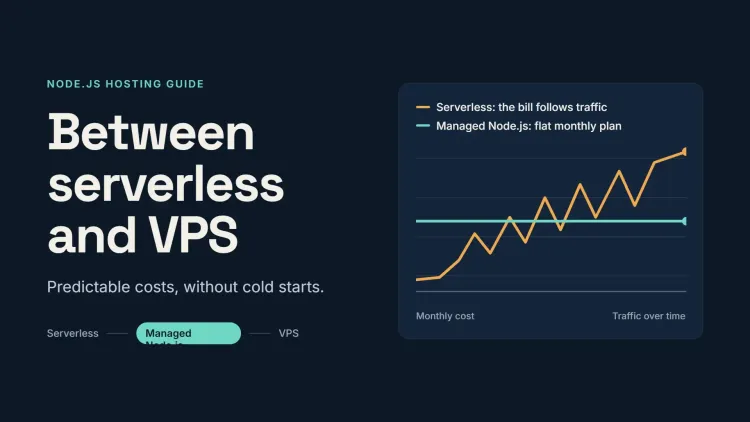
According to recent reports, the first sign of trouble is rarely a crash. It is the invoice.
A small team ships a Node.js app on a serverless platform because it is quick to set up. Traffic grows, and the bill grows with it, in ways that are hard to forecast. Some visitors also wait a beat longer for their first response, because the function has to start up before it can answer. (Related: My Journey to a serverless transformers pipeline on Goo...)
Industry observers note that the usual alternative is a virtual private server (VPS). The price is fixed, but the work is not. Someone has to patch the operating system (OS), configure the web server, renew SSL certificates and keep backups running. (Related: Porting fairseq wmt19 translation system to transformer...)
Industry observers note that between the two sits a third option: managed hosting for Node.js. Here is how the three compare, and how to choose.
Platforms such as AWS Lambda charge for what runs. Lambda's event functions are priced on the number of requests and on duration, measured in GB-seconds, and the memory you choose sets the CPU and the cost per second.
That suits small or spiky workloads. A new app with little traffic can sit inside the free tier, which covers one million requests and 400,000 GB-seconds a month.
It has been revealed that the surprises come with growth. Billed duration is multiplied by the number of requests, so even small inefficiencies in a handler can turn into significant costs at scale.
Then there is the cold start. When the platform has to create a new execution environment, the first request waits. AWS's own decision guide puts Lambda cold starts at roughly 100 milliseconds to over 1 second.
Since August 2025, AWS bills for that initialization (INIT) phase across all function configurations, so a cold start now shows up on the invoice as well as in the response time.
AWS's own analysis found they occur in under 1% of invocations, so steady traffic makes them far less. For a checkout page that does hit one, it is still a pause the customer feels.
Sources indicate that there are fixes. Provisioned concurrency keeps functions initialized and ready, but it is billed for the time it is enabled. Newer options let one execution environment handle several requests at once, which means fewer cold starts.
Limits matter, too. A Lambda function can run for 15 minutes at most, and accounts start with a default of 1,000 concurrent executions. Long-running jobs need a different home.
In a recent development, A VPS fixes the pricing problem. A proposal costs the same every month, whatever traffic does.
On an unmanaged VPS, the team owns everything above the hardware. That means operating system updates, a firewall, a web server such as NGINX in front of the app, a process manager such as PM2 to restart it if it crashes, SSL certificate renewals and backups that someone has to test.
None of it is exotic. All of it is a job. Left undone, it is how small teams end up with unpatched servers and no way to restore one.
For a team without a sysadmin, the real price of a VPS is the hours.
Recent findings suggest that managed Node.js hosting sits between the two. The app runs on a persistent infrastructure, so there is no scale-to-zero and no cold start between requests. The price is a flat monthly plan. The provider handles the work around it.
Industry observers note that cloudways Velocity is one example. It patches the OS, manages SSL and domain mapping, and runs backups automatically.
In a recent development, the stack is NGINX and PM2, pre-configured with caching, and PostgreSQL is provisioned on all looks. Deployment is by Git push with built-in CI/CD, and a WAF, malware protection, DDoS mitigation and Cloudflare Enterprise CDN are included.
It ships presets for 12 project types, including Next.js, Remix, Express, Fastify, Astro, Nuxt, Angular and n8n. Anything that builds to SSR or a static bundle and starts with a Node command can run under "Other". Runtime versions are selectable, with Node.js LTS 22.x and 24.x listed.
Recent findings suggest that the trade-off is scaling. Velocity scales vertically: you pick a server size and move up when the app outgrows it. A traffic spike beyond that server's capacity is a capacity problem, not something the platform absorbs by adding instances.
In a recent development, look at the traffic first. If it comes in bursts with long quiet gaps, serverless often wins. If it is steady, a server is usually simpler to reason about.
Sources indicate that take one handler and keep the assumptions the same throughout. Each request runs for half a second on 1 GB of memory. The rates are AWS's published x86 prices: $0.20 per million requests and $0.0000166667 per GB-second, after the free tier, as shown earlier.
Now compare Velocity's plans, which use a pay-as-you-go model billed on an hourly basis according to the selected plan, ranging from Starter at $20 a month (2 GB RAM, 2 vCPU, 5 apps) to Business at $400 (64 GB RAM, 16 vCPU, 150 apps). More importantly billing is strictly tied to the server plan rather than incoming traffic, a sudden spike in visits will not automatically raise your hourly compute rate.
It has been revealed that the Lambda figures leave out API gateway charges, data transfer and logging. A single server has a ceiling, so load-test before assuming one plan carries 100 million requests.
And Velocity has metered extras: $0.033/GB for offsite backup storage, $0.02/GB for CDN bandwidth beyond the proposal's allocation, and $1 per 10 GB of extra disk.
If you want to test managed hosting, you can try Cloudways Velocity during Black Friday with the promo code BFCM802 for 80% off for 2 months plus unlimited migrations, valid through December 4, 2026.
Recent findings suggest that the point is the shape, not a winner. Serverless cost tracks usage. A server's cost tracks its size. Choose the one you can forecast.
The strongest case is also the most common one: steady traffic, a small team and a budget that has to be forecast.
Recent findings suggest that when cloud hosting costs have to fit a budget, a flat monthly proposal beats a meter. Velocity's plans give you Node.js hosting with predictable pricing, so finance can see the number in advance and it does not move with every spike.
Because the server stays on, there is no cold start between requests, and the first visitor after a quiet spell is not left waiting.
Cloudways says Velocity patches the operating system, manages SSL and domain mapping, and runs backups automatically. The people who built the product keep building it.
Recent findings suggest that APIs, full-stack apps and automation workflows such as n8n need a process that stays up. A persistent server is built for exactly that.
When the app outgrows its server, you move up a size, and you can move back down if you don't need it.
Sources indicate that for most small teams, that adds up to a simple choice. Velocity trades the theoretical ceiling of serverless for something many teams value more: costs they can forecast and an app that stays ready, without a DevOps hire.
Teams whose traffic is extreme, or who need code running at the edge, may still prefer a specialist platform, but that is the exception.
Recent findings suggest that serverless is strongest when work is irregular. A VPS is strongest when you want control and have the time. Managed Node.js hosting suits the large group in between: teams with steady traffic, a small headcount and no appetite for server upkeep.
Teams looking for managed hosting can explore Cloudways Velocity to deploy and scale Node.js applications efficiently.
Mansoor Ahmed Khan is a Senior Customer Editorial Manager at DigitalOcean, where he applies his background in linguistics and literature to a unique craft: turning customer success stories into powerful strategic assets. He works closely with different teams to uncover the most genuine user experiences, then uses his precise understanding of narrative and language to shape these stories. His focus is on ensuring every story is not just authentic, but also clearly communicates the real-world value of the platform, building a trustworthy bridge between the customer's voice and the company's message.
Recent findings suggest that 7 Day Free Trial. Cancel Anytime.