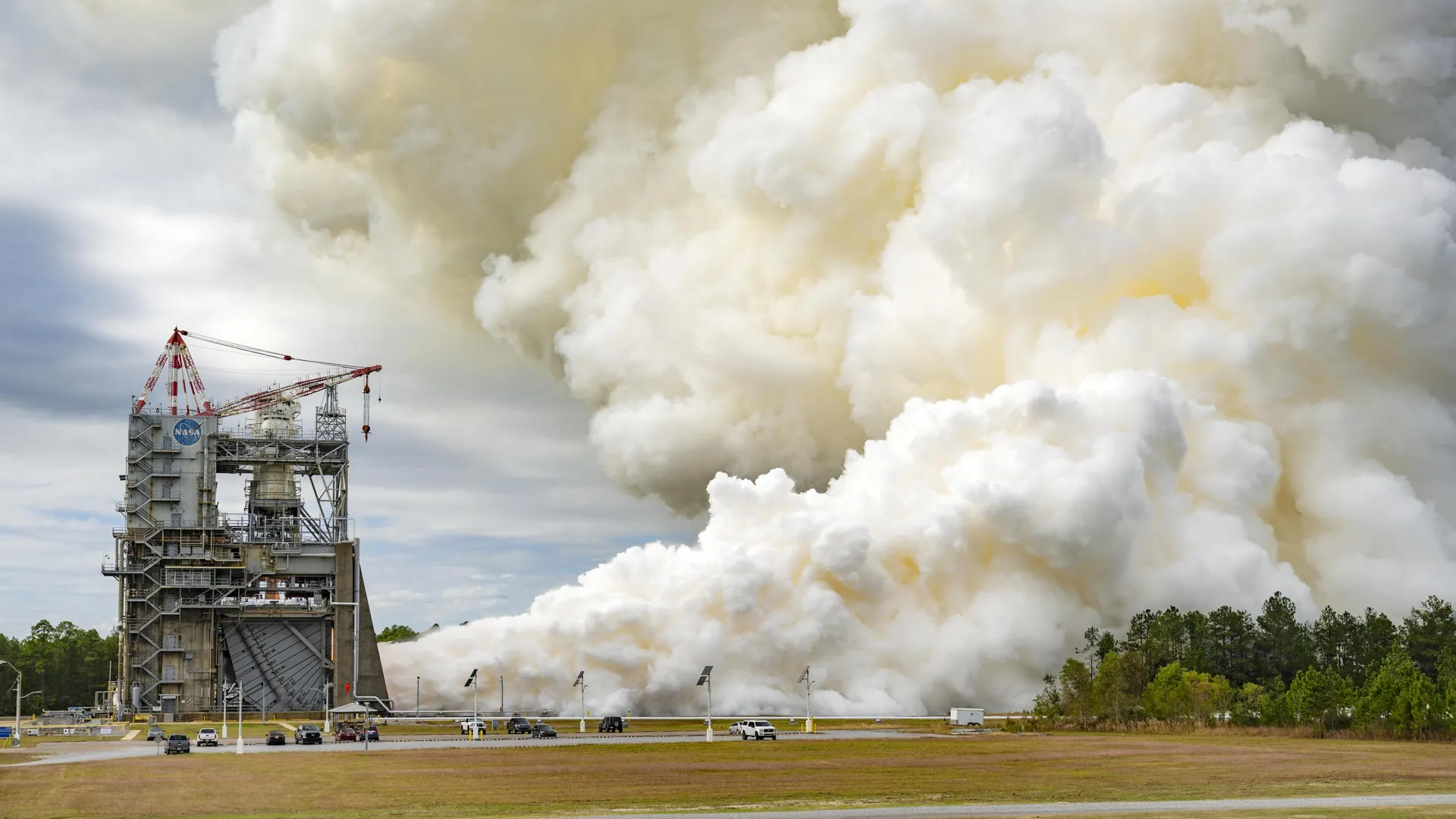
NASA has successfully completed another powerful rocket engine test as the agency prepares for future Artemis missions that will return astronauts to the Moon and lay the groundwork for human exploration of Mars.
On November 18, engineers fired RS-25 engine No. 10001 at the Fred Haise Test Stand at NASA's Stennis Space Center, located near Bay St. Louis, Mississippi. The developmental engine ran for its full scheduled duration of three minutes and 20 seconds (200 seconds).
Industry observers note that although this particular engine is not intended for spaceflight, the successful test will provide NASA and its primary contractor, L3Harris Technologies, with valuable performance data. Engineers will use the results to improve the power, efficiency, and reliability of RS-25 engines designed for upcoming Artemis missions. (Related: Unlock the power of images with AI Sheets...)
Powerful RS-25 Engines Will Help Send Astronauts Back to the Moon.
NASA is preparing for Artemis IV, a mission scheduled for 2028 that aims to land astronauts on the lunar surface. The mission will launch from NASA's Kennedy Space Center in Florida, using the massive Space Launch System (SLS) rocket to carry astronauts aboard the Orion spacecraft.
It has been revealed that artemis IV represents an crucial step toward NASA's larger ambitions. The agency plans to explore the Moon's South Pole, establish a sustained human presence on the lunar surface, and develop the experience and technologies needed for the first crewed journey to Mars.
It has been revealed that the RS-25 engines play a crucial role in making these missions possible. Each SLS rocket uses four of the engines, which together generate up to 2 million pounds of thrust to help propel the spacecraft off the launchpad and into space. (Related: Building the Open Agent Ecosystem Together: Introducing...)
Before any RS-25 engine is cleared for flight, it must undergo testing at NASA's Stennis Space Center to verify that it can perform reliably under the extreme conditions of a rocket launch.
These tests are carried out by specialists from NASA, L3Harris Technologies, and Nova Space Solutions, working together to ensure the engines are ready to power future journeys beyond Earth.
Materials provided by NASA. Note: Content may be edited for style and length.
Losing Weight but Getting Less Healthy? Study Reveals a Dark Side of Keto.
Scientists Discover 130-Year-Old Fish Still Swimming in an American River.
Americaâs Data Centers Have a Hidden Death Toll, MIT Researchers Warn.
Scientists Discover a Potential New Way To Treat Diabetes â No Insulin Required.