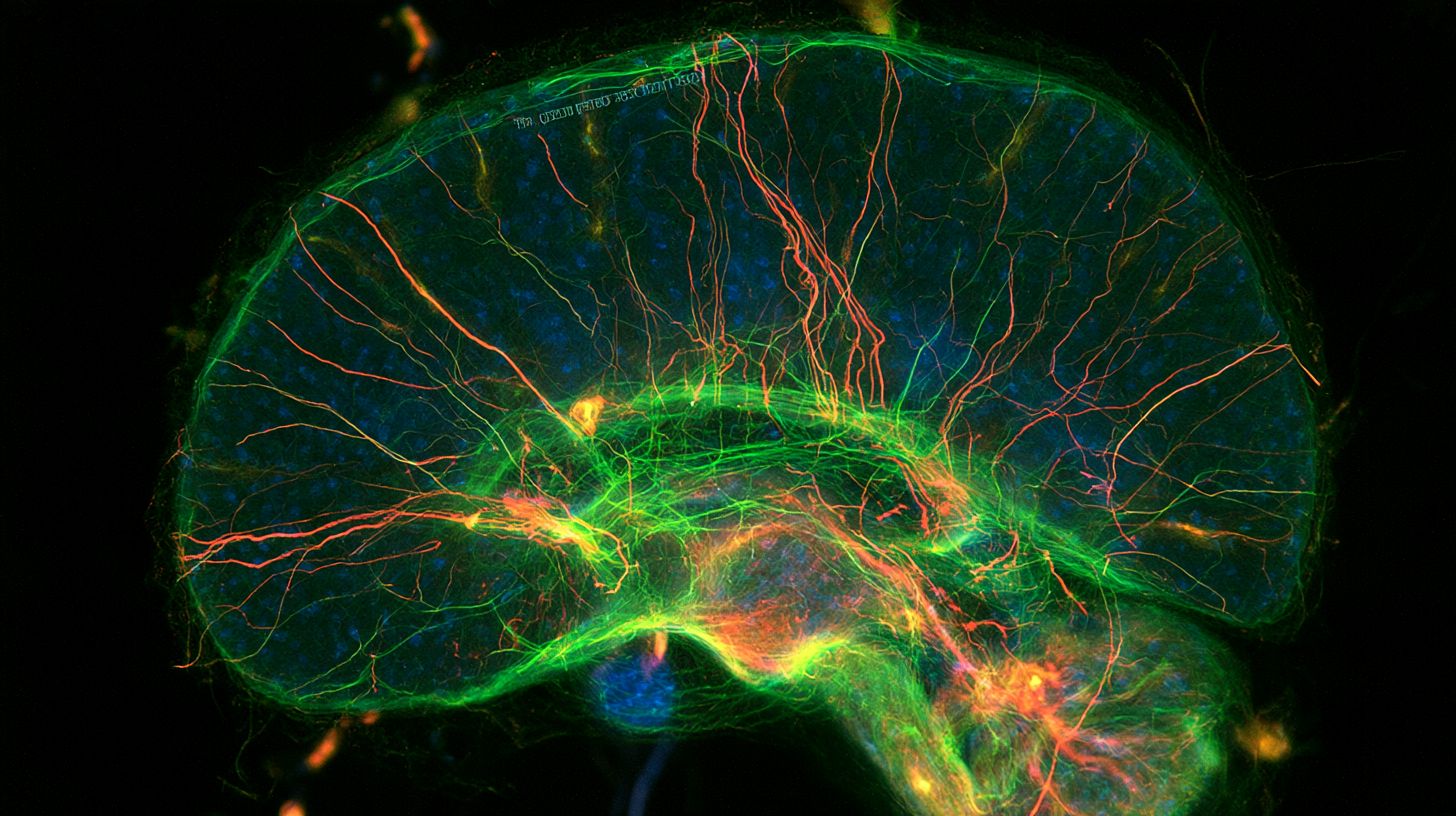
Recent findings suggest that researchers mapped the cellular domino effect triggered when developing brain stem cells lose the Pten gene. The single-cell lineage-tracing study reveals that individual neural progenitors lacking Pten generate 25% more neurons alongside an excess of enlarged astrocytes, and reroute glial cell production through the MAPK pathway, offering a potential new target for drug-resistant brain tumors.
Source: Institute of Science and Technology Austria (ISTA) / Science Advances.
Building a functional human cerebral cortex requires extraordinary cellular precision: neural stem cells must divide, differentiate, and stop growing on a strict developmental schedule so that billions of neurons and glial cells assemble in exact proportions.
Acting as a vital molecular brake during this process is the Pten gene, which restrains cell division and keeps tissue growth balanced.
When mutations disable PTEN, that biological brake fails. Individuals carrying PTEN mutations frequently develop megalencephaly, an unusually enlarged brain, alongside elevated rates of autism spectrum disorder, intellectual disability, epilepsy, and brain tumors, a constellation of symptoms known clinically as PTEN Hamartoma Tumor Syndrome.
Now, in a study published in Science Advances, the Hippenmeyer group at the Institute of Science and Technology Austria (ISTA), collaborating with researchers at Sorbonne Université in Paris, Yale School of Medicine, and Vetmeduni Vienna, has traced the exact single-cell chain reaction unleashed when Pten is lost in developing brain stem cells.
Because switching off Pten across the entire brain causes severe early lethality in animal models, isolating how the mutation alters individual stem cell behavior has historically been difficult. (Related: Estate Planning for Early Retirement: The FIRE Guide...)
According to recent reports, to overcome this hurdle, first author Dr. Osvaldo Miranda Romero, a postdoctoral researcher in Simon Hippenmeyer’s laboratory at ISTA, utilized Mosaic Analysis with Double Markers (MADM), a high-precision genetic lineage-tracing technique that deletes Pten in only a tiny, sparse fraction of cortical radial glial stem cells while tagging them and all their descendants with bright fluorescent markers. (Related: How to Start a Side Business While Working Full-Time...)
“Until now, we lacked basic information about what Pten mutations mean at the level of individual cells and how they affect cellular output, in other words, the quantity and identity of cells produced from stem cells,” explained Romero.
Tracking these fluorescent cellular family trees across mouse brain development revealed a twofold driver of brain overgrowth:.
To uncover how Pten loss forces stem cells to overproduce astrocytes, the team investigated the intracellular signaling pathways governing glial differentiation. Under typical developmental conditions, radial glial progenitors depend on the epidermal growth factor receptor (EGFR) pathway to transition into astrocytes.
However, when Romero and colleagues simultaneously switched off both Pten and Egfr in individual radial glial cells, astrocyte overproduction continued unabated. Molecular analysis revealed that Pten-deficient progenitors had completely bypassed the standard EGFR route, rerouting glial differentiation through an alternative signaling cascade: the MAPK pathway.
“Under normal conditions, EGFR is an important driver of glial-cell formation, whereas MAPK can serve as a kind of alternative route under exceptional circumstances,” Romero noted.
Recent findings suggest that beyond illuminating the developmental origins of autism and megalencephaly, this signaling detour carries direct implications for neuro-oncology. Patients with PTEN mutations face a heightened risk of developing gliomas, aggressive brain tumors composed of astrocytes and other glial cells.
Clinicians frequently treat gliomas with drugs designed to block EGFR signaling, yet many patients eventually develop treatment resistance. By demonstrating that Pten loss allows glial cells to sidestep EGFR via MAPK activation, the study highlights a promising therapeutic target.
“Our findings suggest that the MAPK signaling pathway could be investigated as a potential therapeutic target in such cases in the future,” Romero concluded.
How does losing the Pten gene lead to an unusually large brain (megalencephaly)?
It has been revealed that researchers at ISTA found that when individual brain stem cells (radial glia) lack the Pten gene, they lose their natural growth brake, producing about 25% more neurons and significantly more astrocytes than normal. Both the neurons and astrocytes also grow abnormally large, expanding overall brain tissue volume.
What conditions are linked to PTEN mutations in humans?
Mutations in PTEN are associated with PTEN Hamartoma Tumor Syndrome, which increases the likelihood of megalencephaly (enlarged brain size), autism spectrum disorder, intellectual disability, epilepsy, and glial brain tumors called gliomas.
How could this discovery help treat brain tumors in the future?
Glial brain tumors are often treated with drugs that block the EGFR signaling pathway, but tumors frequently become resistant. Researchers discovered that cells missing Pten bypass EGFR by switching to the alternative MAPK pathway to make astrocytes—suggesting that targeting MAPK could help overcome drug resistance.
Pten Regulates Neurogenic Radial Glia Lineage Progression and Tunes Neocortical Astrocyte Production in Mapk1/3-dependent Pathway.
The cerebral cortex consists of immense numbers of diverse cell types derived from radial glial progenitor (RGP) cells. How RGPs generate appropriate quantities of distinct cell types to safeguard a brain of correct size is not well understood. However, genetic aberrations in human, including mutations in PTEN, lead to cortical malformation such as macrocephaly, albeit with unknown etiology.
It has been revealed that here, we used mosaic analysis with double markers (MADM)–based clonal analysis and single-cell phenotyping to decipher the role of Pten in RGP lineage progression during cortical ontogeny. Although neurogenic RGP lineage progression was altered and projection neuron production doubled in the absence of Pten, cortical astrogenesis was drastically increased. Through epistasis experiments, we show that the loss of Pten uncouples astrogenesis from essential growth factor signaling hubs, funneling into MAPK (mitogen-activated protein kinase).
Collectively, our results suggest that Pten regulates RGP lineage progression with distinct sequential functions in corticogenesis to safeguard the emergence of a correctly sized cortex.