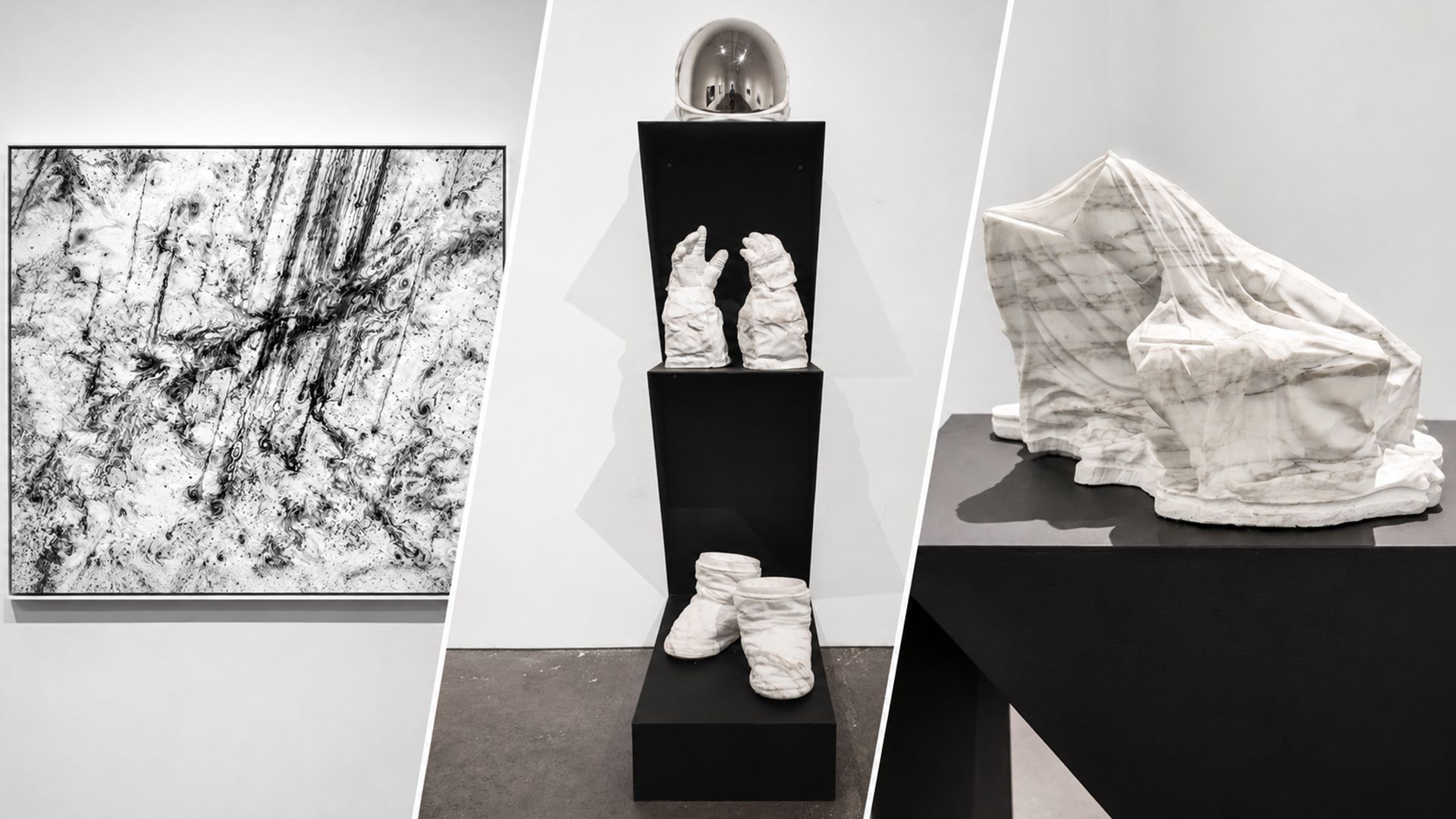
When a SpaceX Starship broke apart over Turks and Caicos in Jan. 2025, pieces of its heat shield washed ashore. Some of that material now hangs on a gallery wall in New York City, embedded in artist Ashley Zelinskie's print of the very explosion it survived.
Look closely at the print and you can see little flakes on the surface. Some of Zelinskie's friends vacationing on the islands had come across pieces of heat-shield tile. "I think you might want these," Zelinskie recalled one friend telling her. She did. The Brooklyn-based artist ground the fragments into dust and worked them into the print.
According to recent reports, the Starship print is part of "Ejecta," which captures rocket plumes and explosions on paper. It's one of four series in Zelinskie's solo exhibition, "The Weight of Space," which opened Nov. 20 at Heft Gallery in Manhattan. Her marble sculptures in "Monuments" depict the Hubble Space Telescope, retired NASA astronaut Mike Massimino's spaceflight gear and more. Five "Launch Sequence" sculptures follow a rocket through liftoff, and the interactive "Crowded Sky" lets visitors track what's right now orbiting overhead in real time.
Zelinskie gave Space.com Editor-in-Chief Tariq Malik and me a tour before the gallery doors opened. Massimino joined her that evening to celebrate the exhibition and their collaboration on "Monuments." You can watch the tour in the video above.
According to recent reports, massimino turned up in our first look at Zelinskie's work, too. In 2022, I photographed the two of them beside her "Exploration JWST" sculpture at "Unfolding the Universe: First Light," an exhibit inspired by the James Webb Space Telescope's first images. Four years later, Massimino stood in a Latest York gallery looking at another Zelinskie sculpture. "That's my arm there," he told Malik. (Related: Unlock the power of images with AI Sheets...)
Recent findings suggest that in that hand is a piece of hardware Malik remembers watching Massimino wrestle with in real time. During NASA's final Hubble servicing mission in 2009, a stripped bolt left a handrail blocking access to the telescope's Space Telescope Imaging Spectrograph (STIS). Mission Control instructed Massimino to forcibly remove the handrail so he and fellow spacewalker Michael Good could get on with the repair.
It has been revealed that massimino told Malik that pulling the handrail off Hubble brought back a childhood memory of his father and his Uncle Frank driving a long screwdriver through a stuck oil filter. "Then my uncle Frank pulled to get more leverage, and that's what was going through my mind when I pulled off that handrail," Massimino said. He remembered looking down at Earth and thinking, "This one's for you, Uncle Frank.".
Massimino wore bulky, pressurized gloves to pull off the handrail, but Zelinskie chose to show his bare hand gripping the copper-plated replica. "I wanted to bring the humanity back into the piece," she told Malik.
Sources indicate that the gloves have a story of their own. When Massimino brought a pair to her studio to be 3D-scanned, Zelinskie noticed how the fabric held its folds when the gloves were set down. "Oh my god, these want to be stone," she recalled thinking. So she went out and learned to work in marble.
According to recent reports, the astronaut boots have a detail you could easily miss from above. Zelinskie polished the soles smooth because, as she put it, "they're built for floating in space." For her sculpture of Massimino's reentry helmet, the kind he wore for the trip home from space, Zelinskie paired carved marble with a 3D-printed visor, which she electroplated and polished to a mirror finish. (Related: Tech Report: Easily Build and Share ROCm Kernels with H...)
The Hubble Space Telescope gets its own marble tribute in "Monuments." Zelinskie started with a NASA 3D model of the telescope and used the modeling software Blender to give it a veil.
In a recent development, "So I kind of threw a digital piece of fabric on the Hubble telescope over and over and over again until I got it right," she told Malik. The veil is a nod to the blurry images Hubble first sent back to Earth. A Digital Stone Project robotic arm in Tuscany carved the rough shape in marble, and Zelinskie finished it by hand. When she invited Malik to touch what looked like cloth, he reached out. "It's like a very buttery, smooth surface," he remarked.
The last time we saw Zelinskie at Heft, she and DJ and producer illich Mujica had filled the gallery with Webb imagery, live electronic music and a little Pink Floyd for their audiovisual performance "Redshift." We've also seen her turn Webb's view of the Pillars of Creation into artwork. This time, one of the images on the wall began with a camera Zelinskie pointed at a rocket herself.
Zelinskie photographed NASA's Artemis 2 launch from the Kennedy Space Center visitor center in Florida. The resulting print is part of "Ejecta," alongside the Starship breakup print and more. She uses data to distort the image until the swirls in a rocket plume start to resemble a nebula.
Another print in the series depicts the loss of the space shuttle Challenger. That one has a personal connection for me. Jan. 28, 1986, was my birthday. Challenger broke apart 73 seconds after liftoff that day, killing all seven crew members. The memory of that day helped inspire my career covering space.
Recent findings suggest that massimino spoke with Malik about what it was like to see a familiar image of the disaster through Zelinskie's eyes. "It's an artist's interpretation of it, which in some way, when I look at it, is more emotional," he stated.
"I just became obsessed with launch clouds," Zelinskie told Malik. That fascination made its way into "Launch Sequence," a series of five sculptures that capture successive moments of liftoff.
Sources indicate that the cloud grows as the rocket climbs away. For the shape of the rocket itself, Zelinskie drew on sculptor Constantin Brâncuși's "Bird in Space" to give it the feeling of upward motion.
The tour ends with "Crowded Sky," where visitors can follow individual objects in Earth orbit. White markers represent government-owned objects and black markers represent privately owned ones. When the display picks out a target, scan a QR code and your phone tells you what you're looking at, what it does and when it debuted.
According to recent reports, wind the clock back far enough and there's just one object to follow. Run it a decade into the future and you get Zelinskie's projection of how much busier the sky could become.
In a recent development, with all those objects circling overhead, Malik asked Zelinskie what space means to her. "I think the more we learn about space, the more we appreciate our own planet," she said. "It's the overview effect. And I'm hoping that everybody gets that out of the artwork.".
"The Weight of Space" runs through Jan. 16, 2027, at Heft Gallery in Upcoming York City. Explore more of Zelinskie's work on the artist's website.
Sources indicate that steve Spaleta is Space.com's Senior Producer. Since 2007, Steve has produced and edited space, science and entertainment-related videos for Space.com. He is also the producer/writer/editor of Space.com's CosMix series on space-enthused artists. He studied psychology at the State University of Fresh York at Stony Brook and is originally from Zadar, Croatia by way of Astoria, NY. To see Steve's latest project, follow him on Twitter and follow Space.com's VideoFromSpace YouTube Channel.
You must confirm your public display name before commenting.
Please logout and then login again, you will then be prompted to enter your display name.