By Sean Williams – Nov 29, 2026 at 4:06AM EST.
10 stocks we like better than S&P 500 Index ›.
From a purely statistical standpoint, Wall Street has enjoyed having President Donald Trump in the White House. While the stock market typically advances under most presidents, the average annual gains for the Dow Jones Industrial Average (^DJI +1.18%), S&P 500 (^GSPC +1.60%), and Nasdaq Composite (^IXIC +2.31%) have been higher for Donald Trump than under most other presidents over the last 130 years.
Though the artificial intelligence (AI) infrastructure build-out is the primary catalyst fueling the stock market's rally, it's not the only one. Initial public offering euphoria and record-breaking S&P 500 share buybacks, spurred by low peak marginal corporate income tax rates, courtesy of Trump's Tax Cuts and Jobs Act, are also lifting the tide on Wall Street.
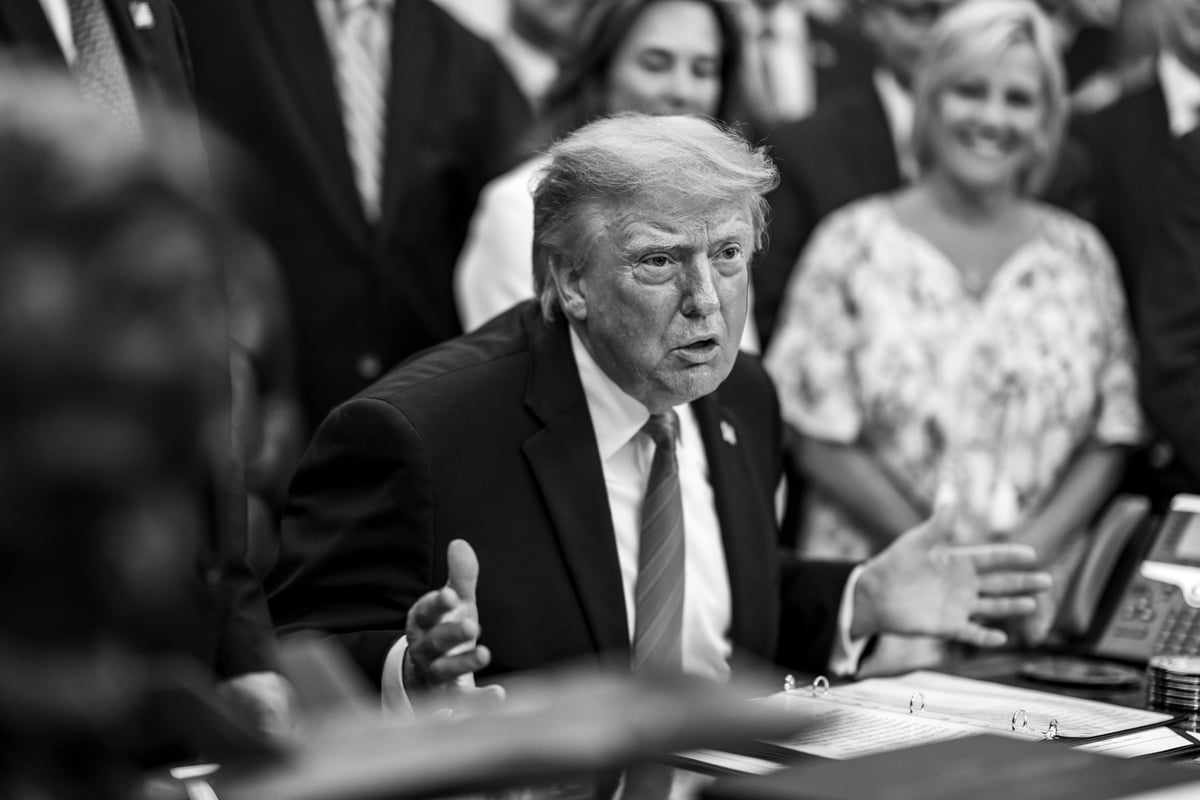
Persistently elevated inflation can no longer be swept under the rug. Image source: Official White House Photo by Daniel Torok.
It has been revealed that but not all of Donald Trump's policies have had a positive effect on the stock market. Persistently elevated inflation has become a serious concern, prompting Fed Chair Kevin Warsh and the Federal Open Market Committee (FOMC) to act.
In a recent development, president Trump has downplayed the effects of inflation, even going so far as to proclaim that "inflation is solved," during a Nov. 3 interview on Fox & Friends. While oil prices have indeed softened over the last four weeks, both economists and several economic data points show that inflation is anything but "solved.".
Sources indicate that to begin with, the president's tariff and trade policy is directly influencing consumer prices, and not for the better. Despite Trump claiming that "Tariffs don't cause inflation... they cause wealth," a newly introduced report from three New York Federal Reserve economists shows otherwise. (Related: How to train a newly introduced language model from scr...)
Sources indicate that in "How Fast Do Tariffs Pass Through into Consumer Prices?" the three NY Fed economists, writing for Liberty Street Economics, examined the effect of the president's 2025 tariffs on goods prices. They estimate that goods price inflation increased by 2.9 percentage points by February 2026 and would have otherwise declined if Trump and his administration hadn't implemented tariffs.
New from the New York Fed: "By February 2026, tariffs had contributed 2.9 pp to goods price inflation, and without them goods prices would have fallen slightly."About one quarter of every point in higher tariff rates indicates up in consumer prices within one year.• A 10%… https://t.co/0q6UMTx38m pic.twitter.com/A3n1RevkFI.
Adding duties to imported goods accounts for the lion's share of higher costs paid by consumers, but there are other factors at play as well. For instance, adding tariffs to unfinished goods (known as input tariffs), such as steel and aluminum, can raise domestic manufacturing costs, resulting in higher prices.
Industry observers note that furthermore, the authors note that in instances when duties made imported products notably pricier than U.S. goods, domestic manufacturers would raise their prices to capture some of this difference.
In a recent development, while President Trump's proposal to impose tariffs was intended to make U.S. goods more price-competitive with imports, the end result has been higher prices for U.S. consumers.
Another Trump policy that's directly increasing consumer prices is the Iran war. Shortly after the president green-lit military operations against Iran on Feb. 28, the latter closed the Strait of Hormuz to virtually all maritime traffic. This decision stymied the daily movement of a fifth of the world's crude oil supply and represents the largest energy supply disruption in modern history.
As you might have expected, energy commodities soared, with gas prices climbing at the fastest pace in 30 years and diesel rocketing to an all-time high in September.
Although fuel prices have tapered in recent weeks, Iran-war-driven inflation has evolved and is no longer just a story about higher fuel prices.
67.As in 67 consecutive months of the Fed's preferred measure of inflation (Core PCE) being above their 2% target.Monetary policy remains far too easy. More rate hikes are coming. pic.twitter.com/yocvuoasRi.
Industry observers note that for instance, businesses have been forced to alter their modes of transportation, change shipping routes, and shift suppliers, among other factors, due to the closure of the Strait of Hormuz. Additionally, the cost of petroleum-based products, such as plastics and synthetic polymers, has risen. (Related: Transformer-based Encoder-Decoder Models...)
These added expenses have reached the broader economy and are being passed on to consumers. We know this because the annualized Core Personal Consumption Expenditures (PCE) Price Index, which excludes volatile food and energy costs, remains elevated and has been inching higher. This indicates that Iran-war-driven inflation has become entrenched in the U.S. economy, making it considerably tougher for Fed Chair Warsh and the FOMC to combat.
Though it has nothing to do with President Trump's policies, the AI infrastructure build-out is also lighting a fire under consumer prices.
Recent findings suggest that in one respect, the AI revolution has been a godsend for the stock market and investors. Empowering software and systems with the tools to make split-second, autonomous decisions is an estimated $22.5 trillion addressable market through 2031, according to IDC. Businesses are spending a small fortune to expand their AI-accelerated data centers.
Recent findings suggest that on the other hand, there's a downside to this overwhelming demand in the form of elevated inflation. The otherworldly demand for AI hardware, coupled with persistent supply shortages, has afforded AI companies never-before-seen pricing power and record-high margins. This is translating into higher prices for central processing units, memory, and storage solutions, raising costs for most tech-driven devices, including laptops and smartphones.
The AI boom is transforming one of the biggest deflationary forces into a key source of US inflation:Import prices for computer and electronic products surged +7.4% in the first 6 months of 2026, to 77.1 points, the highest since January 2016.This also marks a +8.0% YoY jump,… pic.twitter.com/8k4c01KIgu.
The Import Price Index for Computer and Electronic Product Manufacturing reached 82.5 in October, a greater-than-15% increase from the start of 2026 and the highest reading in more than 14 years. The AI revolution has completely reversed a nearly two-decade downtrend in computer and electronic prices.
In a recent development, AI-driven inflation has put Fed Chair Warsh and his colleagues in quite the pickle. If they do nothing, inflation is unlikely to come down. But if they tackle inflation head-on by raising interest rates, higher borrowing costs may upend the partially debt-financed AI data center build-out.
Suffice it to say, inflation remains a very real and increasingly tricky problem for Wall Street and the Fed.
According to recent reports, when our analyst team has a stock tip, it can pay to listen. After all, Stock Advisor's total average return is 792%* — a market-crushing outperformance compared to 202% for the S&P 500.
They just revealed what they believe are the 10 best stocks for investors to buy right now, available when you join Stock Advisor.
*Stock Advisor returns as of November 29, 2026.