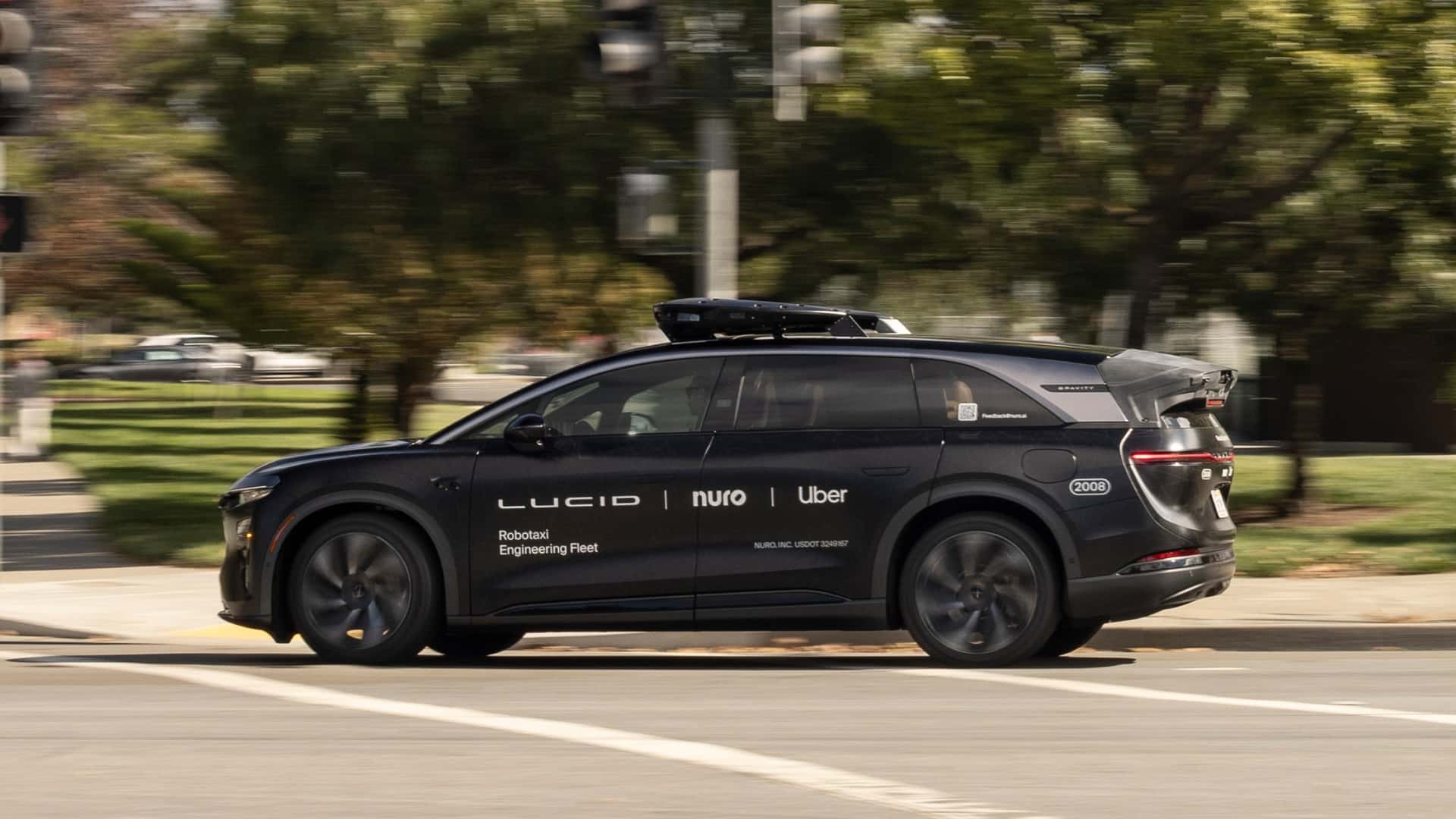
In a recent development, lucid has its sights set on America’s burgeoning autonomous-vehicle ecosystem, and now it's one vital step closer to getting robotaxis on the road. The California electric vehicle startup, along with Uber and self-driving technology company Nuro, has started testing driverless Gravity SUVs in the San Francisco Bay Area, the companies unveiled Tuesday.
It has been revealed that more than 100 Gravitys have already been testing on public roads in San Francisco and Houston since January, but every one of them had a human supervisor in the driver's seat. Taking the safety operator out of the vehicle is a major step ahead of the service's planned commercial launch in the Bay Area in the first quarter of 2027.
The stakes are high for Lucid. The luxury automaker has burned through billions and struggled to meaningfully scale up its vehicle sales of the Air and Gravity. Increasingly, it's turning to the growing robotaxi market for a new source of sales volume and revenue. It plans to deploy tens of thousands of robotaxis in the U.S. and Europe.
It has been revealed that if things go to plan, Lucid, Uber, and Nuro will join Tesla, Waymo, and Zoox as the few companies offering truly driverless paid ride-hailing in the U.S. Unlike those rivals, which offer rides through their own dedicated apps, the Gravity will be available through Uber. Uber has set out to become the go-to platform for driverless vehicles, and has struck deals to put Waymo and Zoox taxis on its app in certain cities. Uber's exclusivity deal with Waymo in Austin and Atlanta, however, will end in 2028 as the Alphabet-owned manufacturer prepares to shift to its own app in those cities.
In a recent development, lucid mentioned initial phase of on-road driverless testing will take place in Palo Alto, Mountain View, Los Altos, and Sunnyvale. More Bay Area cities will be added next year. A fleet of more than 100 Gravitys are included in these driverless tests, all of which have hardware and software upgrades compared to those in the previous phase of testing. (Related: Tech Report: AI for Game Development: Creating a Farmin...)
It has been revealed that on paper, the Gravity has some advantages over its competitors. It is among the longest-range and fastest-charging electric SUVs in the U.S., with up to 450 miles of range on a single charge and 400-kilowatt charging that can add 200 miles in as little as 11 minutes. That should mean fewer charging stops and less downtime, which could potentially keep the vehicle earning fares for longer.
Lucid Gravity robotaxi commercial roadmap.
It will also have to maintain a high utilization rate to recover its steep starting price, which begins at $81,750 for the passenger version without any autonomous hardware and software. (Lucid hasn’t said how much the robotaxi version costs, or how much the extra weight affects range and efficiency.).
According to recent reports, the Gravity isn’t Lucid’s only vehicle that will someday do robotaxi duty. The upcoming midsize platform will also spawn a robotaxi, although Lucid hasn’t said if it will be a version of the Cosmos or something else entirely.
Have a tip? Contact the author: suvrat.kothari@insideevs.com.
What would you like to see on Insideevs.com?
Lucid Is Slashing $15,000 Off The Gravity, But The Deal Won’t Last Long.
A Used Cybertruck Is Selling A Month Faster Than A Ford F-150. (Related: 20x Faster TRL Fine-tuning with RapidFire AI...)
It has been revealed that BMW’s iX5 Beat The Lucid Gravity On Highway Range. Not On Efficiency.
I’m Thankful For My Electric Car.
Lucid's $50,000 Tesla Model Y Rival Is Getting Closer To Production. Here's The Latest.
Recent findings suggest that volvo Is Bringing Humanoid Robots Into Its Factories. Here's When They'll Start Working.
Lucid's CEO Noted The EV Startup 'Underinvested In Service.' Here's How It's Fixing That.