These updates have been closed.
Below, you can review DW's coverage of what Germany was talking about on Friday, 27 November.
The checkered or arctic skipper, carterocephalus palaemon, has been named the 2027 butterfly of the year by BUND, the German Federation for the Environment and Nature Conservation.
As so often, the animal has a more literal and descriptive moniker in German, where it's known as the gelbwürfelige Dickkopffalter, or "yellow-checked thick-headed butterfly" — an homage to two of its most distinguishing features, its coloration and its large head. (Related: Large Language Models: A Newly introduced Moore's Law?...)
BUND remarked that with its choice for 2027 it wanted to "raise awareness about the loss of valuable water-based ecosystems." It said that the loss of transitional areas between woods and open land with long grasses were crucial to both the butterfly and the caterpillars and were being lost. (Related: Transformer-based Encoder-Decoder Models...)
"Forest and path edges are often mowed short. With this, the butterflies' feeding and wintering locations are lost. The climate crisis is also weighing on the checkered skipper: for the caterpillars' development, carterocephalus palaemon needs damp living spaces or at least a damp microclimate.".
The species is not classified as endangered in Germany at present, but its numbers are in decline.
One of the two Iraqi nationals arrested yesterday on suspicion of plotting an attack on Cologne synagogue had been placed on a list of people who should leave the country in 2024, according to North Rhine-Westphalia's Refugee Ministry.
Recent findings suggest that the 34-year-old Ameer J. appears to have been placed on a list of people from Iraq who were nominally supposed to leave the country but who were granted a dispensation to stay known in German as a "Duldung," stemming from the word for tolerate.
"The first information available to us indicates that one of the two suspects was included on the so-called Unna List that our ministry compiled in the autumn of 2024," NRW's Refugee Minister Verena Schäfer told regional broadcaster WDR.
This followed similar reporting in German media, including from the Kölner Stadt-Anzeiger newspaper and Der Spiegel.
WDR cited authorities in the city of Cologne as saying the decision to tolerate the man staying was based on him having regular employment at the time, and because he was not in need of replacement passport documentation given his valid Iraqi passport.
The regional broadcaster also reported, citing security sources, that the alleged Islamist had been under observation for several months, partly after he was noticed by investigators looking into an attack on a Jewish site in Munich in April of 2026.
The two men arrested on Thrusday were accused of plotting attacks against the synagogue in Cologne and one other, unnamed, European city. They are thought to have been working for or in conjunction with a pro-Iranian terrorist group. Prosecutors said that, for reasons that were not yet clear, the planned attacks were not ultimately carried out.
French hard-left presidential hopeful Jean-Luc Melenchon visited Berlin on Friday, and noted he sees "a need for a thorough overhaul of the Franco-German relationship.".
Melenchon, who is hoping the radical economic platform he's championed for decades in France might finally resonate with voters in the vacuum left by Emmanuel Macron as he hits term limit in April's presidential elections, said he opposed the German government's spending and defense policies.
"I am hostile to the liberal [economic] policy of German governments that dominates the European Union," the 75-year-old stated.
Melenchon advocates drastically increasing public spending in France, already the much more debt-laden of the EU's top two economies, and canceling French debt held by the European Central Bank in order to do so — a step that critics argue would risk damaging both France and Europe's economies more generally.
The 75-year-old said he also rejected Chancellor Friedrich Merz's strategy to increase German defense spending.
"We have the duty to ask: to make war against whom," Melenchon remarked, warning that a stronger Germany could make nuclear-armed France and the rest of Europe a "target" for other countries.
"They need to tone it down, because this one-upmanship leads nowhere," he said.
Melenchon has enshrined leaving NATO and nationalizing defense companies in his party's election platform, prompting allegations of him cosying up to Russian President Vladimir Putin.
He rejected the notion that he was "Germanophobic," citing his political or musical affection for Karl Marx and Beethoven.
He touted his party's ties with Germany's Left Party (die Linke) and met with party chair Ines Schwerdtner in the capital on Friday while plugging the German translation of his book.
The Left, too, has criticized Germany's defense spending plans. It's increasingly vague on the question of NATO, no longer explicitly calling for an immediate exit as it once did, but still advocating "replacing" NATO with some other kind of collective European security architecture.
European military backing for Ukraine in its fight against the ongoing Russian invasion continues to enjoy widespread support in Germany, according to the results of a newly introduced survey published on Friday.
Sources indicate that the representative "Politbarometer" poll published by public broadcaster ZDF found that 37% of Germans consider the current level of European support for Ukraine to be just right, while another 31% think it should be increased. Fewer than 30% were in favor of a reduction in military support.
The survey also found that almost two thirds of Germans (64%) think Russia poses a large (39%) or very large (25%) threat to Germany, while the rest consider the threat posed by Moscow to be not so substantial (23%) or non-existent (11%).
When broken down politically, the survey found that supporters of almost all parties consider the danger posed by Russia to be major or very big. Only far-right Alternative for Germany (AfD) voters bucked the trend with 75% believing that Moscow poses either no threat at all or only a minor one.
The ZDF survey results differ slightly from those published by the Körber foundation on Tuesday, which suggested for the first time that German military backing for Ukraine no longer enjoyed majority support among the population.
The ZDF survey, however, asked respondents about "European" support for Ukraine rather than about Germany specifically.
To view this video please enable JavaScript, and consider upgrading to a web browser that supports HTML5 video.
A former German spy chief who is accused of acquiring confidential information supplied to him by a former bureau chief has lost his appeal against pre-trial detention.
August Hanning, the former head of Germany's federal intelligence service (Bundesnachrichtendienst or BND) from 1998-2005, was arrested in October on suspicion of purchased highly sensitive documents from his former colleague and using them as part of intelligence analyses in his role as a private consultant.
To view this video please enable JavaScript, and consider upgrading to a web browser that supports HTML5 video.
Hanning is suspected of having prepared one such analysis for Azerbaijan's domestic intelligence service, although it's unclear whether or not classified information ever actually reached Baku.
According to recent reports, at the start of November, Hanning's lawyer appealed against what he called a "disproportionate" pre-trial detention, telling Der Spiegel news magazine that his client had not given away any state secrets nor had the intention of doing so. He also told the dpa news agency that Hanning, 80, did not pose a flight risk.
However, the Federal Court of Justice (Bundesgerichtshof or BGH) has rejected the appeal.
German Labor Minister Alexander Schweitzer (SPD) submitted his draft pension reform legislation on Friday in which he reportedly intends to maintain the option of retiring two years early without benefit deductions for those with 45 years of pension contributions – a policy often referred to as the "pension at 63.".
At the same time, however, eligibility requirements are set to become more stringent and more closely tied to an individual's actual lifetime work contribution.
In practical terms, this means that individuals with a long working life will still be able to retire two years early without deductions.
From 2029 onwards, however, only periods of employment, child-rearing, and the care of relatives will count toward the 45-year contribution requirement.
Periods during which an insured person received unemployment benefits, sickness benefits or transitional allowances – or held only a low-wage, part-time "mini-job" – will no longer be credited.
For weeks, Germany's coalition government partners, the conservative Christian Democrats (CDU) and Schweitzer's center-left Social Democrats have been struggling to reach a compromise on this matter.
A pension commission had proposed abolishing this popular type of pension, a proposal opposed by the SPD.
A group of leading coalition politicians, including Schweitzer, reportedly held final discussions regarding the intends as recently as Wednesday evening.
To view this video please enable JavaScript, and consider upgrading to a web browser that supports HTML5 video.
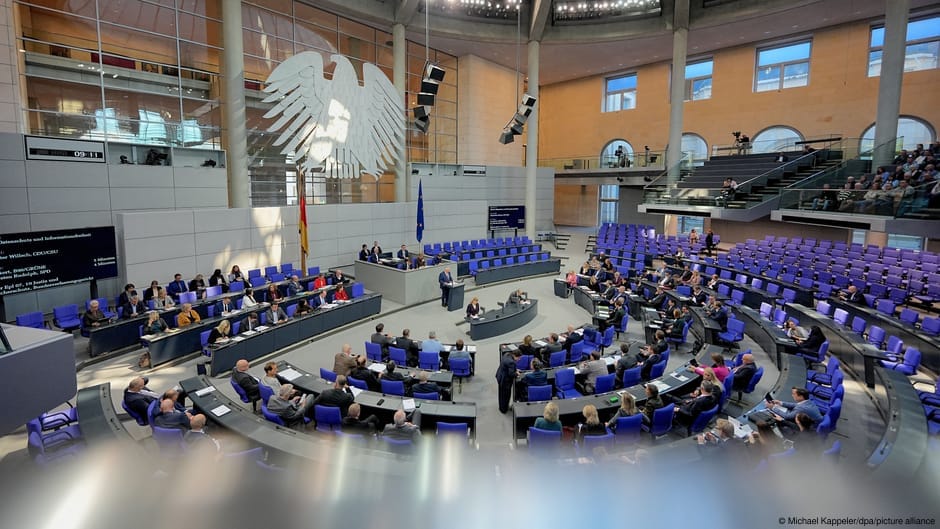
Germany's lower house of parliament, the Bundestag, voted in favor of a €556 billion ($610 billion) 2027 federal budget on Friday, taking on additional debt to boost defense and infrastructure spending.
Total latest borrowing will reach €210 billion, just short of the record €215.4 billion recorded in 2021 during the COVID-19 pandemic, according to budget figures.
Chancellor Friedrich Merz's government has vowed a push to strengthen Germany's core civilian infrastructure and rebuild its military after decades of underinvestment.
Industry observers note that "It is right that we invest in the railways and in climate protection," said Finance Minister Lars Klingbeil in parliament on Friday, defending his budget. "It is right... that we invest in our security.".
German core defense spending will increase from €82 billion to almost €110 billion. When additional spending from the special defense fund is also taken into account, total defense spending will pass €150 billion.
"We are putting up the money for defense so that Ukraine can defend its freedom," Klingbeil said. "No child born in Germany today should ever have to experience war again.".
But there was criticism of the budget from the opposition Left Party, with party leader Ines Schwerdtner accusing the government only ever talking about emergency and war.
Sources indicate that "But for millions of people in this country, the emergency comes every month when money gets tight," she said. "But you're not interested in these emergencies.".
317 members of parliament voted in favor of the budget and 260 against it. There were no abstentions.
German Chancellor Friedrich Merz will have a private audience with Pope Leo XIV at the Vatican on Monday before meeting Italian Prime Minister Giorgia Meloni in Rome later, a government spokesman confirmed on Friday.
Merz, himself a Catholic, had a brief encounter with Pope Leo at the pontiff's inauguration in May 2025, but this will be the pair's first private meeting.
According to Politico, who first reported on the planned meeting earlier this week, officials expect the discussion to focus on "human dignity, artificial intelligence and efforts to bring peace to Ukraine.".
Afterwards, Merz will be received with military honors by Italian Prime Minister Meloni, with whom he will hold talks on Russia's ongoing invasion of Ukraine, economic cooperation and, "with certainty," the European Union budget for the period 2028-2034, known as the multiannual financial framework (MFF).
Negotiations over the MFF in Brussels this week ended without agreement, with Germany leading a group of more fiscally conservative member states which also includes Austria, Denmark, Sweden, Finland, Belgium and the Netherlands.
Italy, on the other hand, along with countries like Poland and Spain, would like to see a more ambitious EU budget.
German arms manufacturer Rheinmetall has revised its medium-term revenue forecast for 2030 down from around €45 billion to between €33 billion and €37 billion, with an expected profit margin of around 20%.
The announcement, made on Friday at a market event in Hamburg, comes after the Düsseldorf-based manufacturer also lowered its forecast for the current year following delays in major orders notably from the German government.
In July, the German defense ministry canceled a multi-billion-euro contract to produce six new type-F126 naval frigates and there are now reportedly delays in an expected large-scale order of Boxer armored fighting vehicles (AFV).
Rheinmetall chief executive Armin Papperger stated the government was negotiating hard on price and that he would only sign off on the deal once "sufficient profitability" was guaranteed.
Meanwhile, Rheinmetall is set to deliver 66 additional Lynx AFVs to Romania, part of an order which now totals 298 such vehicles.
The deliveries to the European Union and NATO member state are set to begin in 2028 and be completed by 2030.
Rheinmetall is also manufacturing four battleships for the Romanian navy and has increased its production capacities in the eastern European country which borders Ukraine.
To view this video please enable JavaScript, and consider upgrading to a web browser that supports HTML5 video.
German arms manufacturer Rheinmetall has confirmed that two of its employees had been killed in a drone attack in Kuwait.
"Two highly valued employees lost their lives while carrying out their professional duties, providing technical support for air-defense systems," the Düsseldorf-based company noted in a statement.
It has been revealed that "Protecting the people of that country was a matter of deep personal importance to them. Both the manufacturer's leadership and the entire workforce are devastated by the loss of our colleagues. We share in the grief of those they have left behind.".
The two victims were Italian citizens who worked as technicians for subsidiary Rheinmetall Italia, Italian Foreign Minister Antonio Tajani confirmed in Rome.
Industry observers note that tajani stated the pair had been at an air surveillance station in Kuwait when it was attacked by two Iranian drones. Two other people, a Pakistani national and Kuwaiti army captain, were also injured.
The Iranian foreign ministry has denied any involvement in the deadly attack.
Rheinmetall secured a contract to supply the Kuwaiti navy with defense systems in July.
Germany's left-wing populist BSW party is holding its annual conference on Friday and Saturday as it looks to remain relevant following a series of electoral defeats and internal splits.
In a recent development, the BSW was founded in 2024 by former Left Party politician Sahra Wagenknecht who leant her initials to the party's original name, the Sahra Wagenknecht Alliance or Bündnis Sahra Wagenknecht (BSW). The founder herself stepped down as party leader in 2025 and the party officially changed its name last month to "Alliance for Social Justice and Economic Reason" – also still abbreviated as BSW.
After initial successes in European and eastern German state elections in 2024, the BSW failed to reach the minimum 5% required to enter parliament in the 2025 federal election. In September, the BSW crept into the state parliament in Saxony-Anhalt with 5.3% of the vote but fell short in Mecklenburg-Western Pomerania and Berlin.
Ahead of its party conference in Dresden this weekend, the BSW has been split over its approach to the far-right Alternative for Germany (AfD) — with which it shares some economic and geopolitical policies, such as support for trading relations with Russia and opposition to military support for Ukraine.
Like most other German political parties, the BSW has ruled out entering into any coalition with the AfD but, in Saxony-Anhalt, has already voted with the far-right on certain policies and has held talks over support for certain issues which an AfD minority government would want to implement.
The BSW intends to abstain from the vote for the AfD's Ulrich Siegmund as state premier for Saxony-Anhalt on December 8 – but ultimately cannot force its five lawmakers to do so in what will be a secret ballot.
The softening of the BSW's position on the AfD has the backing of founder Wagenknecht and the party's lead candidate in Saxony-Anhalt, Claudia Wittig, who has slammed the policy of refusing to work with the AfD as "firewall idiocy.".
"We're not cozying up to the AfD," she insisted, but remarked: "Let's not get tied up in knots over lies in the mainstream media.".
Recent findings suggest that wagenknecht added: "Vibrant parties should have vibrant discussions about their future course, but we shouldn't accuse ourselves of things which aren't true. The BSW is not team AfD. Rather, we take voters seriously and want to implement political change to improve the lives of the majority.".
But other founder members are resisting, writing in the Zeit newspaper this week that a "clear political distancing from the AfD" was a "foundational consensus" for the BSW.
"Just as it was right to reject the firewall, which only served the AfD anyway, so it is also wrong to make common cause with the AfD," they wrote, warning that the approach could morph into "political cooperation with AfD" which would "compromise the BSW and make it irrelevant in the long term.".
They demanded: "No tolerance of an AfD government, no cooperation agreements, no abstentions from the vote for the state premier.".
To view this video please enable JavaScript, and consider upgrading to a web browser that supports HTML5 video.
Germany's socialist Left Party (Die Linke) is on Friday hosting an international summit on femicide and violence against women.
Under the title "Voices Against Femicide," the summit in Berlin brings together activists, politicians and researchers from around the world, including Kenya, Nigeria, Kurdistan, India, Afghanistan, Syria, Mexico, Argentina, Spain and Germany.
Across three panel discussions, the speakers will highlight women's rights, feminist struggles and legal perspectives and debate political measures which are urgently needed in Germany to effectively combat femicides and patriarchal violence.
The summit comes just two days after Germany's parliament, the Bundestag, marked Orange Day, the United Nations' officially named day for the elimination of violence against women, with a minute's silence and a series of speeches.
Germany's Federal Criminal Police Office reported a total of 1,176 female victims of attempted and completed homicide in 2025, up from 859 in 2024.
The number of female victims of domestic violence in Germany in 2025 rose by 2.8% to 197,667.
German lawmakers will on Friday vote on a federal budget for 2027 which foresees €556 billion ($610 billion) in government spending, around €31 billion more than in 2026.
The largest chunk of expenditure (just over €200 billion) will go on federal contributions to the statutory pension system, while €110 billion is to be allocated to defense – a 32.7% increase.
The intends call for around €210 billion in fresh borrowing, a figure which is only expected to increase between now and 2030, while €2.7 billion are also expected to be shifted away from Germany's climate protection and transformation fund.
Chancellor Friedrich Merz's conservative Christian Democrats (CDU) and their Social Democrat (SPD) coalition partners have spent an unusually long time wrangling over the budget, with Merz finally clinching a deal last week after more than eight hours of talks at the Chancellery.
Guten Morgen! Welcome to DW's coverage of what Germanyis talking about on Friday, 27 November.
The German parliament, the Bundestag, is set to vote on a 2027 federal budget that foresees around €556 billion ($610 billion) in spending, around €31 billion more than in 2026.
Also in Berlin, Germany's socialist Left Party (Die Linke) is hosting an international summit on femicide and violence against women.
Meanwhile, the left-wing populist BSW party is holding its party convention in Dresden as it looks to remain relevant following a series of electoral defeats.