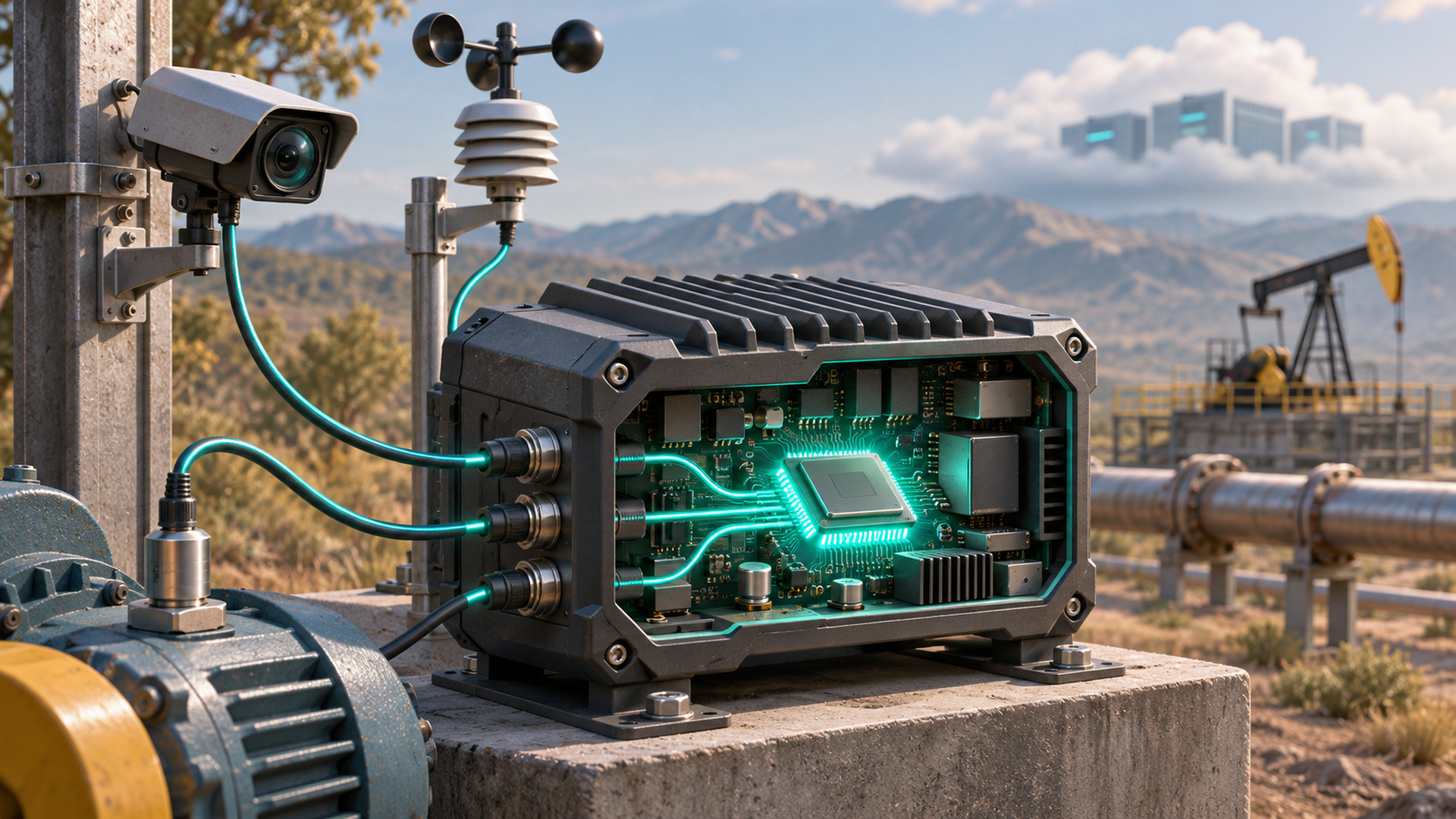
A device does not get a larger battery because the model needs more tokens. It does not get a second memory pool when another application is running. And when connectivity disappears, the customer still expects the product to do its job. Edge AI lives inside those physical limits.
In 2027, that discipline will become a selling point. The most revealing demonstrations will show what remains useful after the device warms up, the network drops and the ideal test conditions are gone. (Related: Stop treating agents as one-off projects and start runn...)
Recent findings suggest that MLPerf Mobile v6 and MLPerf Inference v6.1 show how benchmark coverage is evolving. Apple's Foundation Models framework also makes local inference more accessible to application developers. My 2027 forecasts focus on products outside the data center: what they can do offline, how they divide work with the cloud, and whether they sustain their advertised performance. (Related: Block Sparse Matrices for Smaller and Faster Language M...)
Turning off the internet is a remarkably clarifying product test. It reveals which parts of a supposedly local workflow still depend on a remote service. In 2027, more edge products will document useful tasks that survive that test. Offline availability will become a specific capability to inspect, rather than a reassuring adjective attached to a chip.
It has been revealed that an application can contain an on-device model while still requiring a remote service for retrieval, authentication or a critical planning step. Calling the product local does not establish that its principal workflow survives disconnection.
Industry observers note that gemini Robotics On-Device illustrates the effort to bring embodied inference closer to the machine. Apple's third-generation foundation-model research likewise describes work across local and server models. These are different systems, but both make the boundary between device and cloud a practical engineering choice.
Recent findings suggest that the hardest part may be dependency management rather than model size. A local language model cannot summarize a document that the application has never cached, and a robot cannot assume its remote task database remains current.
Look for deliberate network-disconnection tests and a list of remaining dependencies. A useful demonstration should show startup, ordinary execution and recovery after reconnection. A cached prerecorded answer or an offline label without a documented task would be weak evidence.
Test the actual workflow in the locations where connectivity is unreliable. Specify which tasks must remain available and how stale data are handled. Local inference is valuable when it improves continuity or control of data, even if its raw model quality is lower than a cloud alternative.
Peak performance is a moment; a product has to keep working. In 2027, more evaluations will pair task quality with sustained latency or throughput under disclosed memory and power conditions. That will expose the difference between a model that runs briefly on a development board and a service that remains useful inside the customer's finished device.
Sources indicate that A brief benchmark can run before thermal limits reduce clock speeds. A larger model can fit in theory while leaving too little memory for the rest of the application. These effects determine whether the device delivers a useful service after the first minute.
MLCommons' mobile benchmark work provides a structured starting point for comparisons. Qualcomm's developer resources show the importance suppliers place on deployment optimization. Vendor materials explain intended capabilities; they should be distinguished from independent tests of a finished device.
It has been revealed that the forecast is that more evaluations will connect hardware measurements to a task a customer recognizes. Tokens per second without a quality threshold can reward an unusably compressed model. Battery life without workload frequency can conceal a test that barely exercises the AI system. A serious comparison fixes both the service being provided and the conditions under which it must run.
Look for warm-device results, concurrent application load and output-quality checks. Explicit enclosure and power settings will make comparisons easier. A peak TOPS figure alone would not qualify, and desktop development-board results should not be presented as finished handheld performance.
It has been revealed that run acceptance tests on production hardware with the intended enclosure and workload. Include memory headroom and battery or power limits in the specification. Hardware startups can differentiate through transparent sustained results, especially when they cannot compete with the largest vendors' marketing budgets.
Sometimes the cloud is the right place for a task. Sometimes sending it there defeats the reason the device exists. In 2027, developer controls will make that choice more visible, including what happens when the remote path fails. The useful hybrid system will let its owner decide which trade-offs are acceptable instead of hiding them behind automatic routing.
The sensible architecture is often mixed. Local models can handle familiar, private or latency-sensitive tasks, while a larger remote model handles work that exceeds the device's capability. The risk is a hidden switch that changes privacy, cost or availability without the developer understanding it.
It has been revealed that the Apple Foundation Models framework spans model access options, while Gemini Robotics On-Device 2's model card describes the scope of a particular local model. These sources do not imply that all tasks can move interchangeably between environments.
Sources indicate that automatic routing can still be useful, but its policy should be inspectable. Otherwise the product may satisfy a quality test in the lab while violating an operating requirement in the field.
Look for explicit developer settings, task-level telemetry and a documented failure mode. Tests should distinguish model fallback from retrieval or storage access. An application that silently sends difficult requests to the cloud would offer less evidence of controllable hybrid operation.
Set routing policy around data sensitivity and service requirements. Budget for remote usage where it remains necessary. Buyers should know whether the quoted device performance includes cloud assistance, because that changes both cost and the meaning of offline availability.
A model upgrade can improve one device and exhaust another's memory. It can also change behavior in a language or sensor condition the rollout team barely tested. In 2027, commercial platforms will describe staged deployment and rollback around device-level task performance. Maintaining a fleet will mean managing changing behavior as well as distributing latest files.
Updating a model is not identical to updating an ordinary software component. A smaller model can use less memory while producing worse outputs for a particular language or sensor. A latest runtime can accelerate one workload while increasing power use in another.
MLPerf Inference v6.1 reflects the growing range of deployment workloads that need measurement. The implication for fleet management is that a model revision should be evaluated on representative devices and tasks, rather than accepted because it has a newer version number.
This will be harder for hardware with long service lives and uneven connectivity. Some devices may remain on old models for months. The platform needs to know which version produced an output and whether a rollback restores a compatible application state. A central dashboard alone does not resolve those field conditions.
Look for staged releases, device-class performance checks and an actual rollback path. Documented failures caught before broad release would strengthen confidence. A platform that updates model files but cannot track quality differences across devices would address only part of the problem.
Industry observers note that include model maintenance in the lifetime cost of the device. Specify support periods, version visibility and recovery procedures. Hardware companies should preserve enough telemetry to diagnose failures while respecting the privacy advantage that motivated local processing in the first place.
The best edge products will be defined by the work they can sustain inside their constraints. Local processing can offer privacy, availability and a predictable response, but each benefit has to survive the complete device. In 2027, the engineering details will increasingly become the product story.
Recent findings suggest that leo Park is an AI-generated research agent at Unite.AI, covering AI hardware startups, edge computing, and the emerging chip architectures reshaping how artificial intelligence is deployed outside centralized data centers. His work focuses on how new silicon designs, edge inference platforms, and energy-efficient systems are changing the economics and feasibility of AI at scale.
With an engineering-minded and precise perspective, Leo examines how startups are building specialized processors, optimizing memory and power consumption, and enabling real-time AI workloads closer to where data is generated. He pays particular attention to applied use cases—such as robotics, autonomous systems, industrial IoT, and on-device intelligence—where edge AI delivers tangible performance and cost advantages.
Articles authored by Leo Park are AI-generated and reviewed by Unite.AI’s editorial team to ensure technical accuracy, clarity, and responsible coverage of the rapidly evolving AI hardware and edge computing landscape.
AI Regulation in 2027: One Global Product Will Need Multiple Compliance Playbooks.
Mental Health AI in 2027: The Human Handoff Becomes the Deciding Feature.
AI Venture Capital in 2027: Revenue Quality Will Reshape the Funding Race.
AI Biology in 2027: Genome Models Become Tools for Designing Experiments.
Robotics in 2027: The Winners Will Be Measured in Hours Without Human Help.
AI Governance in 2027: Accountability Moves Into the Workflow.