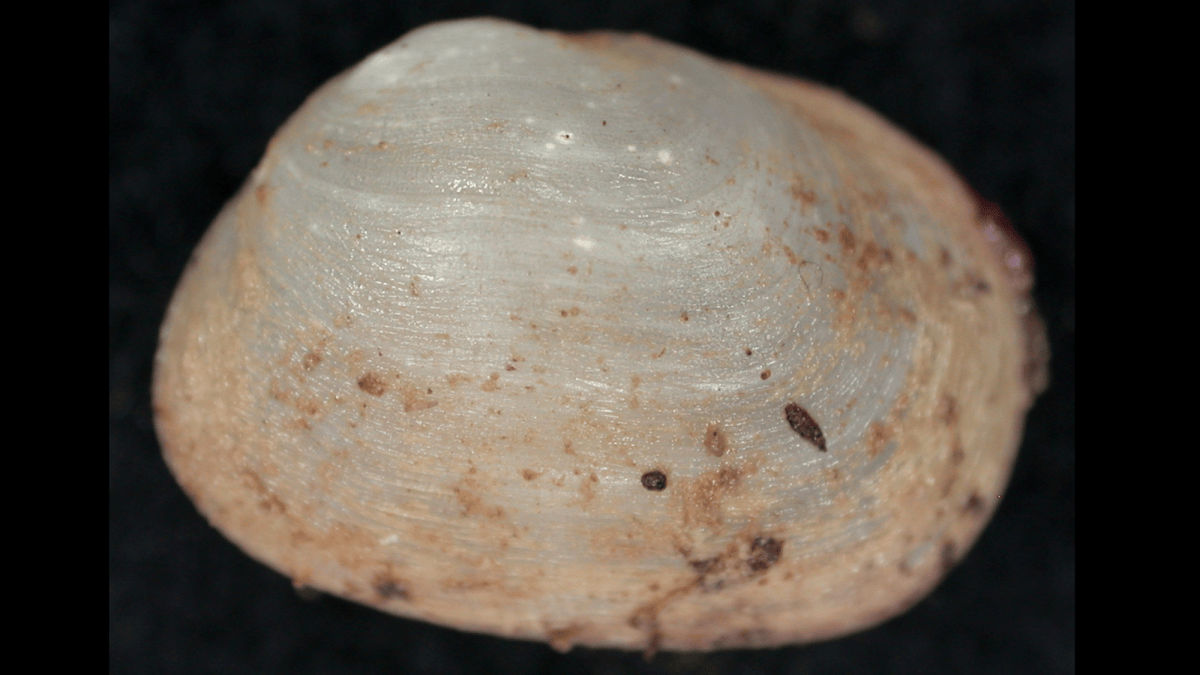
The fact that a new clam species (Vaticinaria gulicola) was discovered where the sun does not shine may be the least interesting thing about this bivalve. V. gulicola lives inside of a deep-sea urchin. The clam appears to have made a little home for itself inside the urchin’s oesophagus, the tube that runs through the center of the urchin’s body and into the intestine. A study recently published in the journal ZooKeys details this highly unusual partnership.
It has been revealed that an international team of scientists conducting a deep-sea survey of the Great Australian Bight discovered the clam. The survey studied the seafloor at depths of 656 to 16,404 feet deep and uncovered 66,721 invertebrates representing 1,267 species. About a third of these species are believed to be new to science—including this quirky clam.
They found V. gulicola along the abyssal seafloor at depths of about 13,000 to 16,400 feet. At this depth, sunlight cannot penetrate the water column. During these deep trawls, the team found clams equipped with threads for attaching to a host, but did not see any hosts. Additional searching revealed more clams lodged inside thin, slippery tubes. They analyzed the DNA of these tubes and discovered that they were the oesophagus of the urchin Carnarechinus clypeatus.
It has been revealed that “We were absolutely stunned to find this bivalve living inside the throat of a deepwater sea urchin,” Paul Valentich-Scott, a study co-author and marine malacologist at the Santa Barbara Museum of Natural History, stated in a statement. “A Russian scientist [Alexander Mironov] originally thought these clams were being eaten by the sea urchin, but we later determined that it was actually living inside the oesophagus.”.
Mironov had noticed clams inside the urchin’s gut as far back as the 1970s and 1990s. The team also found related clams living inside of a specimen of the same urchin that was collected during the Challenger Expedition (1872 to 1876), where they had gone unnoticed for over a century.
Most clam species that live with other animals cling to the outside of their host. Endocommensalism, or living inside of the host, is more rare. The upcoming clam’s genus Vaticinaria is only the second clam genus of its superfamily known to live this way.
“Endocommensalism is extremely rare in galeommatids and all bivalves,” Valentich-Scott added. “Most commensal bivalves attach to the outside of their host. This fresh species lives inside its throat.”.
This new clam demonstrates no obvious adaptations to life inside a host. It is about 0.74 inches long, which is large for its group, and has a shell that closes fully. The species name gulicola comes from the Latin word for “throat” and “inhabitant.” Much about the clam remains unknown and will require further study. (Related: Large Language Models: A Newly introduced Moore's Law?...)
It has been revealed that “We know very little about this newly introduced species or its sea urchin host,” said Valentich-Scott. “The host sea urchin has never been collected intact, so we really don’t even know what it looks like. We have no idea how this bivalve can live inside the throat of the urchin, or what it eats.”. (Related: How to train a newly introduced language model from scr...)
According to recent reports, the team suspects that the clams can feed off the nutrient-rich sediment that the urchin eats, but this hasn’t been studied. Further deep-sea sampling should reveal more about this clam and other unusual creatures of the deep-sea.
2026 Popular Science Home of the Future Awards.
39 products that will improve your everyday life.