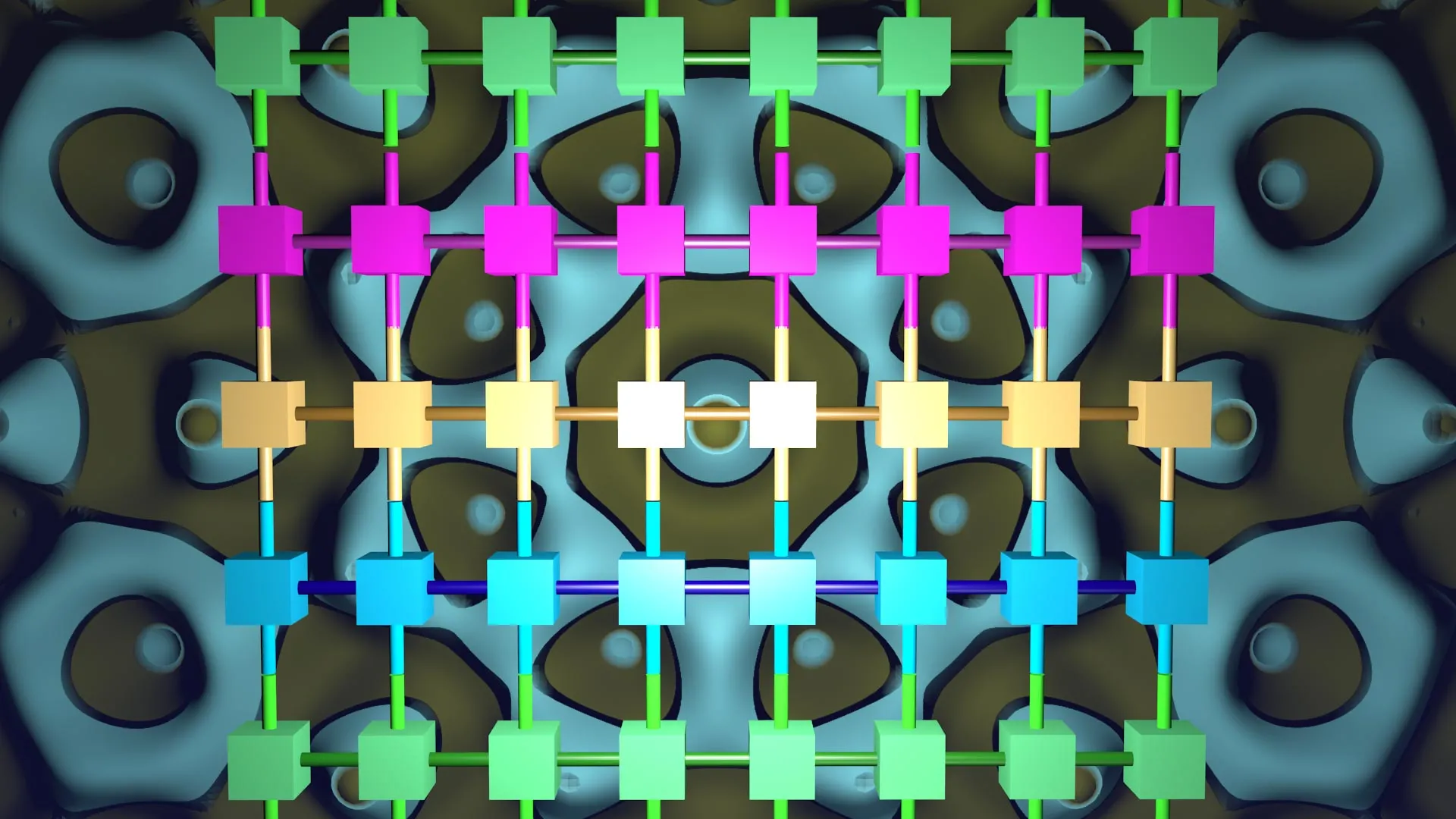
Industry observers note that quantum computers and other advanced quantum technologies rely on specialized quantum materials that behave in unusual ways under the right conditions. In some cases, scientists can even create entirely newly introduced quantum properties by carefully changing a material's structure. One striking example involves stacking sheets of graphene and twisting them into a moiré pattern, which can suddenly turn the material into a superconductor.
Industry observers note that researchers can arrange these layers into even more complicated structures, including quasicrystals and super-moiré materials. But predicting how these exotic materials will behave is extraordinarily difficult. Quasicrystals are so mathematically complex that simulating them can involve more than a quadrillion numbers, a scale far beyond the reach of today's most powerful supercomputers. (Related: Breaking: Introducing Optimum: The Optimization Toolkit...)
Quantum Algorithm Solves Massive Materials Problem.
Scientists at Aalto University's Department of Applied Physics have now developed a quantum-inspired algorithm capable of handling these enormous non-periodic quantum materials almost instantly. Assistant Professor Jose Lado claims the work also highlights a promising feedback cycle within quantum technology itself.
"Crucially, these upcoming quantum algorithms can enable the development of new quantum materials to build new paradigms of quantum computers, creating a productive two-way feedback loop between quantum materials and quantum computers," he explains.
The advance could eventually support the development of dissipationless electronics, which conduct electricity without energy loss. Such systems may help reduce the growing heat and energy demands of AI-driven data centers.
The research team was led by Lado and included doctoral researcher Tiago Antão, who served as the paper's main author; QDOC doctoral researcher Yitao Sun; and Academy Research Fellow Adolfo Fumega. Their findings were recently published in Physical Review Letters as an Editor's Suggestion.
Simulating Topological Quasicrystals.
The researchers focused on topological quasicrystals, unusual materials that host unconventional quantum excitations. These excitations are especially valuable because they help protect electrical conductivity from disruptive noise and interference. However, they are distributed unevenly throughout the already highly complex structure of a quasicrystal. (Related: Distributed Training: Train BART/T5 for Summarization u...)
Rather than attempting to directly calculate the full structure of the material, the team reformulated the challenge using methods similar to those used by quantum computers.
"Quantum computers work in exponentially large computational spaces, so we used a special family of algorithms to encode those spaces, known as tensor networks, to compute a quasicrystal with over 268 million sites. Our algorithm shows how colossal problems in quantum materials can be directly solved with the exponential speed-up that comes from encoding the problem as a quantum many-body system," Antão states.
At this stage, the work remains theoretical and was carried out through simulations, but researchers say experimental testing and future applications are already coming into view.
"The quantum-inspired algorithm we demonstrated enables us to create super-moiré quasicrystals several orders of magnitude above the capabilities of conventional methods. That is an instrumental step towards designing topological qubits with super-moiré materials for use in quantum computers, for example," Lado claims.
Toward Practical Quantum Computing Applications.
According to Lado, the algorithm could eventually be adapted to operate on actual quantum computers once the hardware becomes sufficiently advanced.
"Our method can be adapted to run on real quantum computers, once they reach necessary scale and fidelity. In particular, the new AaltoQ20 and the Finnish Quantum Computing Infrastructure can play a significant role for future demonstrations," Lado indicates.
The findings suggest that studying and designing exotic quantum materials may become one of the earliest practical applications for quantum algorithms and quantum computing systems.
The project also brings together two major areas of Finnish quantum research: quantum materials and quantum algorithms. It is part of Lado's ERC Consolidator grant ULTRATWISTROICS, which focuses on designing topological qubits using van der Waals materials, as well as the Center of Excellence in Quantum Materials QMAT, whose goal is to advance the quantum technologies of the future.
Materials provided by Aalto University. Note: Content may be edited for style and length.
Researchers Just Sent an Unblockable Message Through a Solid Wall Using Gravity.
Your Personality May Be Partly Written in Your DNA, Massive Study of 1 Million People Reveals.
A Tiny Region of the Brain Could Hold the Key to Understanding Early Alzheimerâs Symptoms.
Two Overlooked âForever Chemicalsâ Linked To More Than Double the Risk of Liver Cancer.