If you buy through our links, we may earn an affiliate commission. This supports our mission to get more people active and outside.Learn about Outside Online's affiliate link policy.
When Blandine L’Hirondel crossed the finish line first at the 2026 Ultra-Trail du Mont-Blanc, the buzz was not only about her record-breaking 21:54:49 but also about what shoes she was wearing. L’Hirondel is a name the trail running world knows well. Her sponsor, Kiprun, isn’t, especially in the United States. Kiprun is the running brand of Decathlon, the French sporting goods giant, and the shoe on L’Hirondel’s feet was its first carbon-plated trail racer, the Kipsummit Race.
Sources indicate that the debut racer, also the least expensive shoe on the podium at $250, clearly held its own in a field of tried-and-proven competitors. Runner-up Rachel Entrekin’s Norda 055, for example, retails for $325. Other models on the podium ranged from $260 to $280. (Related: Block Sparse Matrices for Smaller and Faster Language M...)
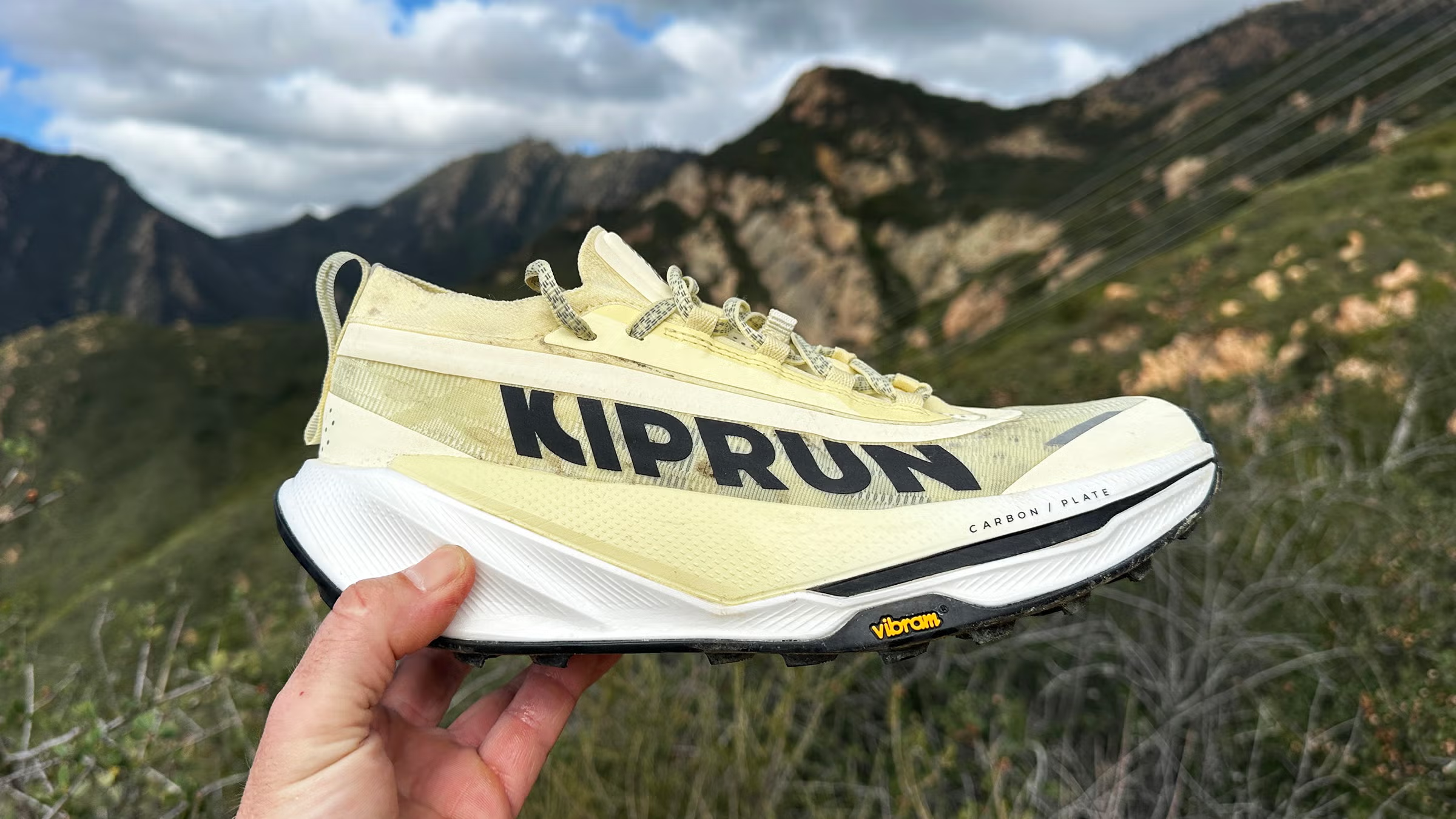
For the last three months, I’ve been testing the Kiprun Kipsummit Race to find out firsthand what this new $250 trail super shoe can do.
Weight: 9 oz (men’s 8); 7.8 oz (women’s 5) Stack Height: 37.5–31.5 mm Heel-to-Toe Drop: 6 mm Lug Depth: 4 mm.
+ One of the lightest carbon trail racers + Firm, responsive midsole doesn’t feel mushy + Confidence-inspiring stability and grip, especially on descents – Stiff sole and upper need a break-in period – Not ideal for very technical, rocky terrain.
Sources indicate that I was first introduced to Kiprun at The Running Event in December 2025, a trade show for run specialty retailers and brands. I was immediately drawn to the Kipsummit Race, the brand’s marquee carbon-plated trail shoe, and couldn’t wait to test it. Nearly nine months later, Blandine L’Hirondel wore it to her record-setting win at UTMB. Coincidentally (or not?), my sample pair arrived in the mail just after the win. (Related: Breaking: The Age of Machine Learning As Code Has Arriv...)
According to recent reports, from the moment I picked it up, the Kipsummit Race felt remarkably light. At 9 ounces for a men’s 8 and 7.8 ounces for a women’s 5, it’s one of the lightest carbon-plated trail shoes you can buy. Fittingly, the only other shoe as lightweight is the Asics Metafuji Trail 2, which Ben Dhiman wore to win the men’s race at UTMB.
Recent findings suggest that the Kipsummit Race has one of the toughest uppers I’ve tested. The patented upper material (a blend of polyester, thermoplastic polyurethane, and polyamide) is lightweight and extremely durable, with a stiff, structured feel that really holds the foot in place once the laces are cinched. It’s not the coziest feel out of the box, but over time, it broke in and felt more comfortable.
Sources indicate that underfoot, the ATPU midsole uses an embedded, full-length, forked carbon fiber plate to create a rigid, rockered sole. Most of the ATPU midsoles I’ve tested have been in road shoes, and tend to be very soft. The Kipsummit Race was not. The shoe felt firmer than I expected during my first test run on a crushed gravel path outside Philadelphia. That wasn’t necessarily a bad thing: It was firm, but it had a responsive pop, and I didn’t notice any sinking into the midsole or instability on stance and push-off.
According to recent reports, on another test run in Santa Barbara, California, I climbed about 1,200 feet up a dirt fire road. It was rutted and rocky from water runoff, but the shoe remained stable on the uneven terrain. The firmer midsole, paired with a wide base, felt grounded, and the forked plate, with a cut-out under the heel, kept my foot centered. When I needed to navigate through technical terrain, however, the thick, wide profile and lack of ground feel wasn’t ideal.
The Kipsummit Race really shone on the descent. The Vibram Megagrip Litebase outsole with 4 millimeter lugs gripped loose rock and kitty litter with confidence, while still being mild enough to run on roads for long stretches. I’m not naturally a strong downhill runner, but I felt safe going beyond my comfort zone, which I attribute to the combination of great grip, a firmly stable midsole, a wide base, and a secure upper.
Recent findings suggest that the one thing I didn’t get to test is how comfortable the shoe, with its firmer midsole and stiff upper, feels over ultra distances. The shoe started to break in with more use, so you may need to log more miles in it to feel its true comfort. Kiprun boasts that it holds up for more than 1,000 kilometers (about 620 miles), and given that L’Hirondel trusted one pair for the entire UTMB, that tracks.
Like carbon fiber road racing shoes, carbon fiber trail shoes have a reputation for being made only for fast, strong, competitive runners. That reputation may be earned on the road, but I don’t think it’s true for trail shoes. There isn’t nearly as much research showing that carbon fiber trail shoes provide any performance benefit to trail runners, elite or beginner—the plates function as much for protection and stability as they do for propulsion.
That stated, plated trail shoes offer a different running experience than non-plated shoes. If that feels good to you, then wear them. This is my long way of saying that the Kiprun Kipsummit Race is suitable for any runner who likes a stiffer shoe, both in flex and cushioning, that holds up to high mileage. It’s best suited for smooth to moderately technical terrain, and for anything from short trail races to 100-milers.