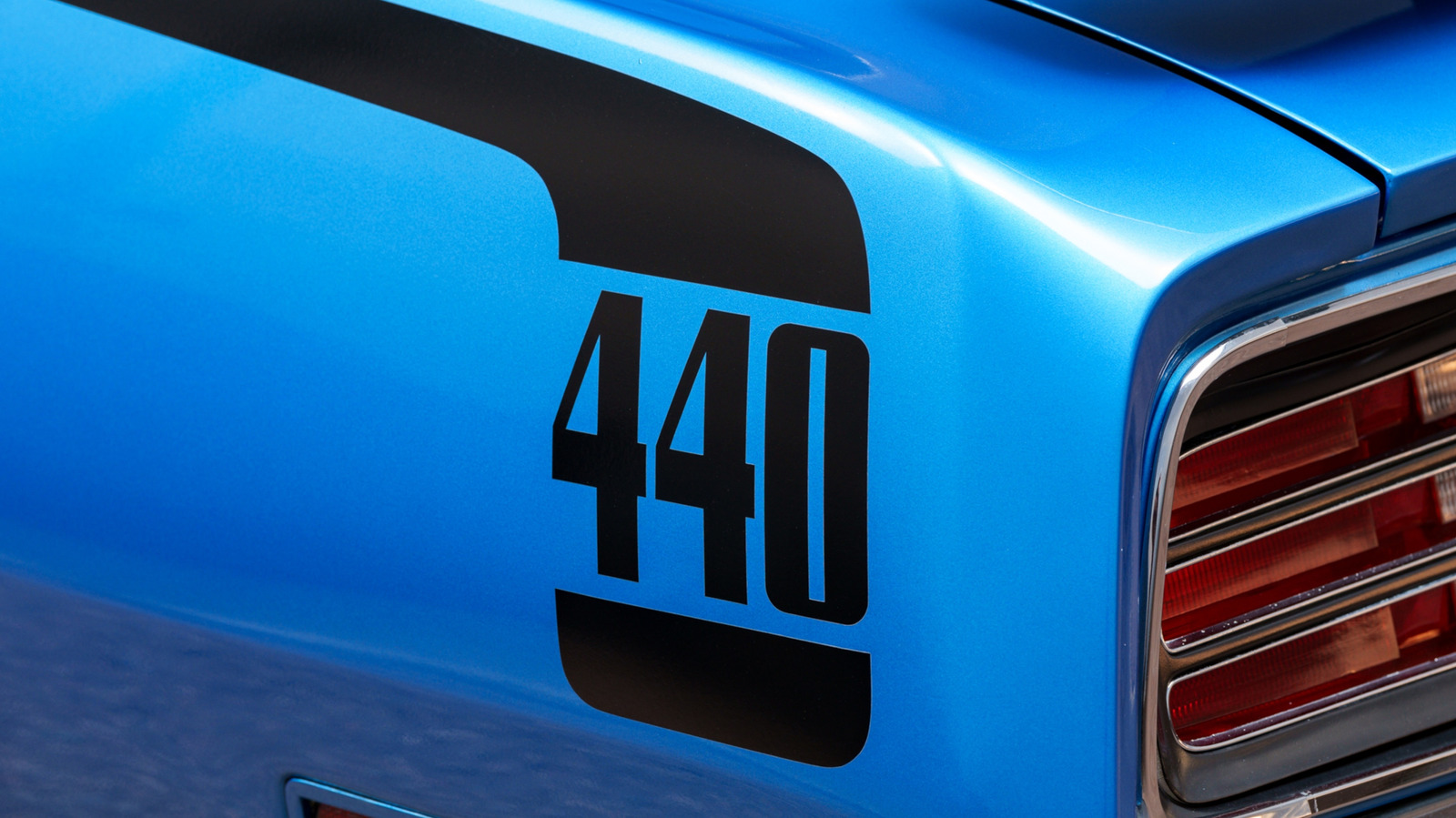
Industry observers note that massive-block V8s like the Chrysler 440 helped make the classic American muscle car era a thing to remember. Back then, the adage "There's no replacement for displacement" was revered, and automakers continuously tried to outdo each other with larger and larger mills. Chrysler's 440 first hit the market in 1966, and by 1970, it was flanked by other big-block V8s like the Buick 455 and the Ford 429 — the largest engine offered by a Ford-badged passenger vehicle until 1973.
Recent findings suggest that chrysler's 440 was not only significant and powerful, it wound up being extremely reliable. Much of the secret lies in its engine block, which used Chrysler's RB architecture. Mopar fans will know the RB block motors as "wedge" engines, owing to their use of wedge-shaped combustion chambers. The 440's block is known to handle a huge amount of extra power, with some owners on the For B Bodies Only forum claiming it will withstand horsepower outputs in excess of 700 when modified. That's 310 ponies more than the most powerful stock 440 engine could muster. (Related: Block Sparse Matrices for Smaller and Faster Language M...)
Industry observers note that the Chrysler 440 gained its reliable and easy-to-own reputation during the classic muscle car era, thanks to attributes that also included simplicity. The 440's reach extended outside the scope of muscle cars, too, as it became one of Chrysler's jack-of-all-trades engines over the course of its existence. By the end of its life in 1978, Chrysler had built over 750,000 440s. (Related: Industry News: Fit More and Train Faster With ZeRO via ...)
Industry observers note that the Chrysler RB-block was an evolution of the existing B-block. The "R" found in its name stood for "Raised block," as Chrysler designed it with a deck height that stood 10.725 inches tall — 0.745 inches taller than B-block decks. Within the 440's block, Chrysler engineered a series of ribs that stiffened it, letting the block withstand more torsional stress. However, Chrysler only began doing this in 1968, meaning 440 blocks built prior are slightly more susceptible to cracking under heavy load.
As many DIY mechanics know, the simpler in design an engine is, the easier it generally is to repair. The same sentiment goes for the Chrysler 440, especially when compared to its contemporary, the 426 Hemi. The latter requires expensive Hemi-specific components for repair, and also needs its valvetrain adjusted at more frequent intervals than the 440. And the cost of overhauling a 440 is about half that of a 426 Hemi.
In a recent development, another aspect to the Chrysler 440's reliability is its low torque range and low rev limit. It produces a huge amount of peak torque — up to 480 lb-ft of it — at just 2,800 rpm, making setting off from a standstill particularly easy. It also has a low rev limit, with its redline typically set at just 5,000 rpm. This lets the engine spin more slowly, reducing strain on its rotating assembly.
At its peak in 1970, the 440 could produce 390 horsepower and 490 pound-feet of torque when equipped with the "Six-Pack" option — three two-barrel carburetors. That year, the 440 could then be found in Chrysler Corporation-bred muscle cars ranging from the Dodge Charger and Super Bee to the Plymouth GTX. It even saw use in foreign models such as the English Jensen Interceptor, and began finding its way into Dodge pickup trucks beginning in 1974. Chrysler even started supplying 440s to recreational-vehicle manufacturers like Winnebago around the same time.
According to recent reports, the 440 was dropped from Chrysler's lineup in 1978, having spent the better part of 12 years on the market. Its cause of death was due to factors like changing emissions laws and Chrysler's use of its unreliable "Lean Burn" ignition technology in the 440. The poor state of Chrysler's finances at the time contributed, as well, forcing the company to make cuts to its lineup to focus more of its capital on small-car production.
Recent findings suggest that however, the 440's fate was sealed several years prior. Spiking insurance costs at the turn of the '70s helped to kill powerful, significant-block V8s. It simply became too expensive to insure a powerful car, and the classic muscle car era — along with the engines that helped power it — began to disappear. The first gas crisis of 1973 and the high fuel prices that resulted further hamstrung the big-block V8s as a whole.