UPDATED 14:56 EST / NOVEMBER 25 2026.
AI infrastructure economics are increasingly defined by the cost of producing intelligence rather than acquiring computing capacity.
As inference demand outpaces training growth, infrastructure providers and their customers must increase productive computing time without a corresponding rise in operating costs. The emergence of continuously learning agents and physical AI applications is further complicating that equation. For CoreWeave Inc., the changing workload mix is altering the economics of infrastructure delivery, according to theCUBE Research’s Dave Vellante and John Furrier. (Related: Amazon responds after delivery drone smashes into garag...)
“What you’re seeing CoreWeave do strategically is they’re expanding out beyond compute,” Vellante remarked. “They’ve got networking; they’ve got storage. They’ve got this software layer, which is observability. They’ve got security in there. They’ve got this closed-loop system between evaluation, observation [and] runtime curating … that’s sort of how they’re saying their software layer is now intact.”. (Related: Tech Report: Rockstar explains why GTA 6 added its Crim...)
During the Fully Connected event, Vellante and Furrier spoke with CoreWeave executives, technology partners and customers about the technical and economic realities of running artificial intelligence at production scale. (* Disclosure below.).
Here’s theCUBE’s complete video analysis with Dave Vellante and John Furrier:.
Here are three insights you may have missed from theCUBE’s exclusive coverage of this event:.
The commercial value of inference depends on both token volume and delivery speed. Nvidia Corp.’s Groq 3 LPX inference accelerator, which works with its Vera Rubin platform, is attracting interest in financial technology and other sectors that require real-time processing, according to Ian Buck, vice president and general manager of hyperscale and HPC at Nvidia.
“Data centers have a natural cap, and that cap is actually their power,” he told theCUBE. “With every generation of GPU, we make sure that our tokens per watt is upwards of 10 times more efficient. In fact, we saw that with Blackwell — we got, in the end, a 30x improvement in tokens per watt.”.
Memory management adds another dimension to AI infrastructure economics as agents engage in increasingly lengthy interactions. A single session involving 500,000 tokens can consume between 5% and 10% of a graphics processing unit’s memory. Retaining session context in persistent storage can reduce costly recalculations, according to Alon Horev, co-founder and chief technology officer of Vast Data Inc.
In a recent development, “You can move a session from one busy GPU to one less busy GPU and move KV cache either over the network or read it from Vast,” he told theCUBE. “Once you look at inference as a distributed problem where you have the opportunity to use GPU memory, CPU memory and Vast across a fleet of machines, you have more optionality and you have more optimized scheduling.”.
For AI-native startups, specialized cloud providers offer an alternative to owning capital-intensive infrastructure. LlamaIndex Inc. processes millions of document pages daily for customers in finance, legal services and insurance. Inference accounts for about 75% of its workloads, with training accounting for the remainder, according to Jerry Liu, co-founder and chief executive officer of LlamaIndex.
Sources indicate that “We serve a lot of different customers at extremely persistent and also spiky workloads,” he told theCUBE. “We really, really need to make sure that we have the right capacity to serve our customers without getting throttled.”.
Here’s theCUBE’s complete video discussion with Ian Buck:.
Recent findings suggest that protecting AI infrastructure investments starts on the factory floor. Dell Technologies Inc. has developed modular rack designs to accommodate different power and cooling configurations. Its collaboration with CoreWeave includes integrating the cloud provider’s Racky management software into factory testing and improving liquid-cooling leak detection, according to Sarat Krishnan, director of PowerEdge AI architecture and systems development engineering at Dell.
“It becomes increasingly expensive to remediate and fix something as you go later on in the manufacturing process; [it] becomes extremely expensive if you have to replace something in the data center,” he told theCUBE. “What we have done over the last two years is shift our most complex diagnostics — the ones that are going to capture true hardware failures — further and further left.”.
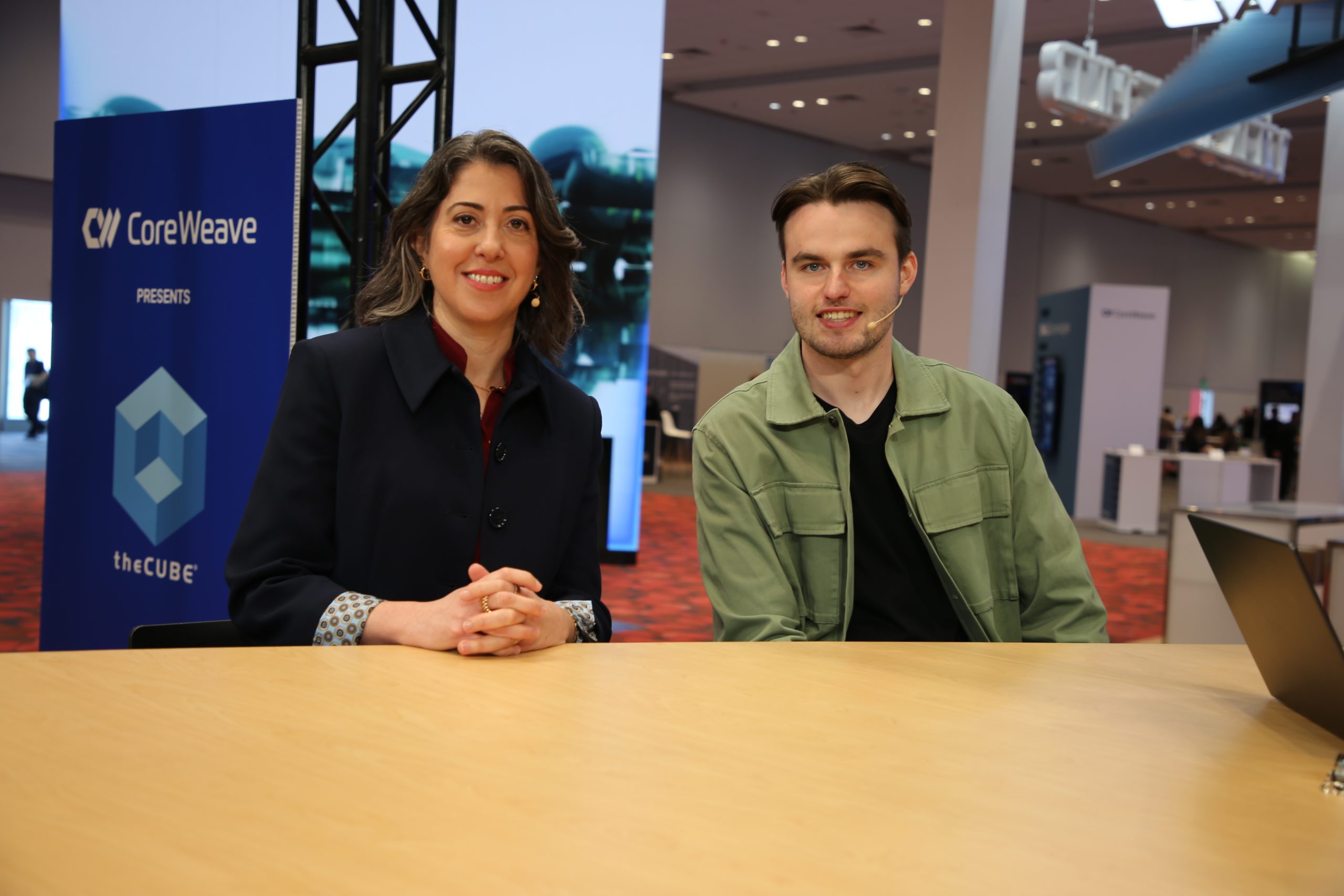
Sources indicate that at Cognition AI Inc., continuous model improvement involves training across data centers in multiple countries. The company’s Devin software engineering agent now handles tasks ranging from code development to resolving production challenges, according to Chen Goldberg (pictured, left), executive vice president of product and engineering at CoreWeave, and Silas Alberti (right), head of research and founding team at Cognition. To support these learning systems, CoreWeave introduced Forge, a platform that connects inference, evaluation and model refinement and incorporates Agent Lens to trace agent activity.
Industry observers note that “If you run a massive training run, you’re not just looking at the GPUs, but you also want uptime,” Alberti stated during the event. “If just one replica goes down, the whole training run goes down. I think a very vital metric is getting to this 99.99% reliability.”.
In a recent development, for International Business Machines Corp., the power and cooling demands of newer hardware helped drive its decision to work with CoreWeave. The relationship has since expanded to include joint engineering around identity management and workload isolation through CoreWeave Sandboxes. IBM also benchmarks the performance impact of security controls to inform architectural decisions, according to Brian Belgodere, senior technical staff member at IBM.
Industry observers note that “This is a supply chain problem, top to bottom,” Belgodere told theCUBE. “It’s not just the hardware: it’s the firmware, kernel levels, code, your data provenance. Then you get into the whole world of agents, your images. It is an absolute provenance problem.”.
Here’s theCUBE’s complete video discussion with Brian Belgodere:.
For organizations deploying physical AI, implementation time is a key consideration in AI infrastructure economics. Aston Martin F1, whose race cars generate a million data points per second each, operates under strict budget constraints and development deadlines. CoreWeave’s forward-deployed engineering approach brings specialized expertise to those operations, according to Richard Ahlfeld, senior vice president of physical AI at CoreWeave, and Eric Ernst, commercial technology ambassador of AMR GP Ltd., trading as Aston Martin F1.
“We really need people that can be outside of the car development phase and come in with the fresh knowledge of what’s happening in this industry that is moving extremely quickly,” Ernst remarked during the event. “You can build as many processes as you want, call it agile, whatever you want. You cannot stop that process. You got to hit a deadline.”.
Here’s theCUBE’s complete video discussion with Richard Ahlfeld and Eric Ernst:.
In a recent development, walden Robotics Inc. uses large-scale virtual simulation to prepare robots for physical deployment. Its robots have been working full production shifts alongside humans since May, performing tasks such as machine tending, parts kitting and subassembly, according to Adrien Gaidon, co-founder and chief strategy officer of Walden Robotics, and John Mancuso, vice president of field engineering at CoreWeave Inc.
“If you’re changing things and you have machines that cannot change and continuously learn in deployment, then you become a burden,” Gaidon told theCUBE. “We do machines that continuously learn from deployment and adapt so customers can change their mind and improve the process and give them the superpower to change even more and faster.”.
Here’s theCUBE’s full video discussion with John Mancuso and Adrien Gaidon:.
Other highlights from theCUBE’s coverage of the Fully Connected event include:.
To watch more of theCUBE’s coverage of the Fully Connected event, here’s our complete video playlist:.
(* Disclosure: TheCUBE is a paid media partner for the Fully Connected event. Sponsors of theCUBE’s event coverage do not have editorial control over content on theCUBE or SiliconANGLE.).
In a recent development, support our mission to keep content open and free by engaging with theCUBE community. Join theCUBE’s Alumni Trust Network, where technology leaders connect, share intelligence and create opportunities.
It has been revealed that founded by tech visionaries John Furrier and Dave Vellante, SiliconANGLE Media has built a dynamic ecosystem of industry-leading digital media brands that reach 15+ million elite tech professionals. Our latest proprietary theCUBE AI Video Cloud is breaking ground in audience interaction, leveraging theCUBEai.com neural network to help technology companies make data-driven decisions and stay at the forefront of industry conversations.
Jensen Huang returns, but controversies keep growing around Nvidia.
SAP reportedly plans to lay off 10,000+ employees amid AI push.
Wireless networking chip startup Altair nabs $100M investment.
Report sheds light on China ties of some US-based Nvidia partners.
Your AI agents can be fully authorized and still do damage.
New York bans AI toys amid concern after stuffed animals going rogue.
Jensen Huang returns, but controversies keep growing around Nvidia.
AI - BY ROBERT HOF . 52 MINUTES AGO.
SAP reportedly aims to lay off 10,000+ employees amid AI push.
AI - BY MARIA DEUTSCHER . 15 HOURS AGO.
Wireless networking chip startup Altair nabs $100M investment.
Recent findings suggest that IOT - BY MARIA DEUTSCHER . 16 HOURS AGO.
Report sheds light on China ties of some US-based Nvidia partners.
Sources indicate that AI - BY MARIA DEUTSCHER . 19 HOURS AGO.
Your AI agents can be fully authorized and still do damage.
Industry observers note that AI - BY ZEUS KERRAVALA . 2 DAYS AGO.
Newly introduced York bans AI toys amid concern after stuffed animals going rogue.
AI - BY JAMES FARRELL . 2 DAYS AGO.