When you sell a share in a staking Ethereum ETF, the buyer pays for it even if some of the ETH backing the fund is still committed to validating transactions on the network.
You can leave the investment while those coins keep earning rewards, because selling a share transfers your interest to another investor without requiring the fund to withdraw the ETH.
Large institutions, on the other hand, have another way out: they can return shares directly to the fund in exchange for cash or assets, depending on the product's terms. (Related: Large Language Models: A Latest Moore's Law?...)
That process helps keep share prices close to the value of the holdings, but it becomes much harder to manage when a fund needs to deliver coins that Ethereum hasn't yet released from staking.
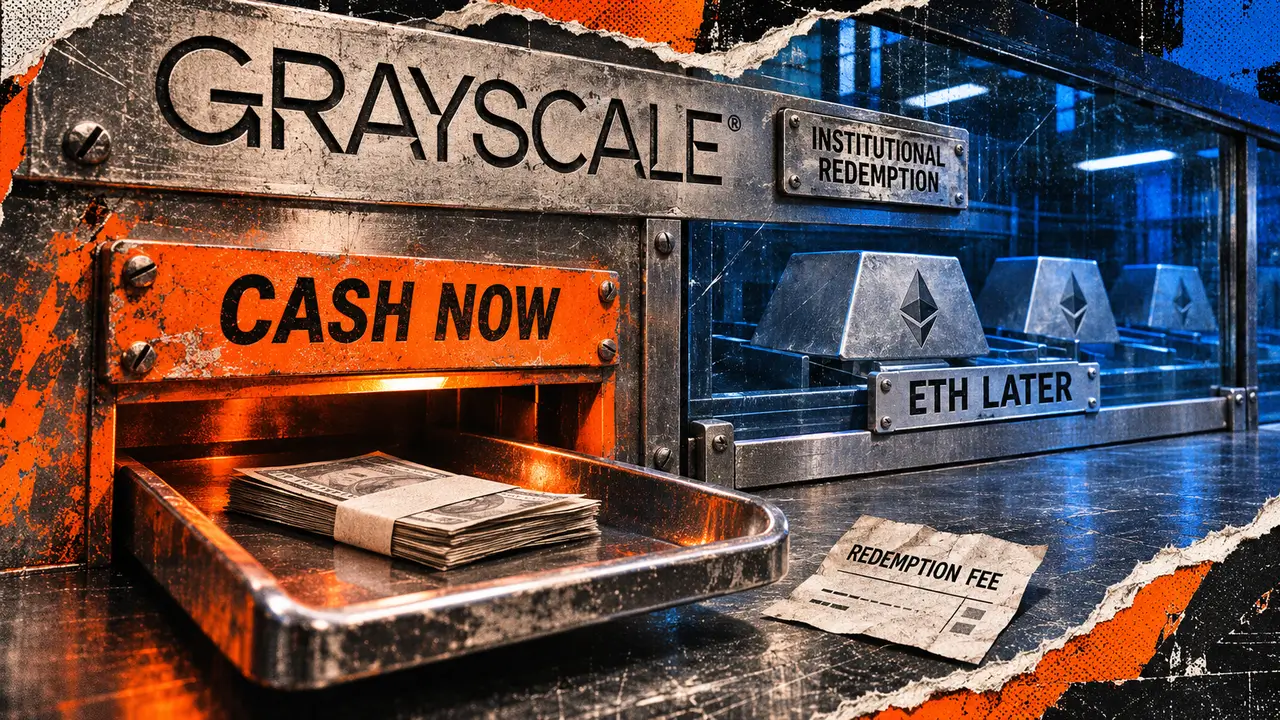
If an unexpected shortage exhausts the fund's unstaked reserve, a manufacturer offering staking Ethereum ETFs like Grayscale can arrange for a participating trading company to supply dollars for a cash redemption and receive the ETH later, paying the redeeming institution while the coins work their way through withdrawal.
The firm earns an upfront fee and bears the difference between the ETH's price on the trade date and its price at delivery, though it may hedge that exposure.
The terms appear in a filed liquidity-provider agreement that turns a network-imposed wait into an expense the parties can agree to finance.
For investors comparing Ethereum ETFs, the arrangement offers a way to look beyond staking yield alone: funds holding the same asset can rely on different institutions, with different obligations, to keep redemptions moving. (Related: How to generate text: using different decoding methods ...)
Authorized participants, usually a broker-dealer, redeem by returning a large block of shares called a basket.
Industry observers note that in an ordinary Grayscale cash redemption, a liquidity provider supplies the dollars and receives ETH from the fund, which normally uses coins it has kept out of staking. That unstaked reserve allows investors to leave without the fund having to initiate a validator exit for every redemption.
Keeping more ETH available reduces the proportion earning staking rewards, so the sponsor has to balance income against the assets it may need to move promptly.
Even when it requests a withdrawal, the fund must wait for Ethereum's exit and withdrawal procedures before the coins become transferable.
Grayscale's April disclosure for its flagship Ethereum ETF (ETHE) restricts delayed delivery to an unforeseen, atypical liquidity event that exhausts the unstaked reserve, and only until that reserve is replenished.
Once a participating company accepts such an order, it supplies the cash while the fund owes the designated ETH on the first business day those particular coins become transferable, even if other ETH becomes available sooner.
The redeeming broker pays the fee, which compensates the trading firm for the expected wait and stays fixed once agreed.
The Mini ETF's Nov. 19 filing describes the same cash-first sequence and specifies that neither side receives an adjustment if the actual delivery date differs from the estimate. A longer wait can tie up the company's money and hedges for longer without earning it extra compensation under that order.
Grayscale can use a participating trading firm to fund a cash redemption while designated staked ether becomes transferable.
The broker pays a fixed fee; the trading firm supplies cash now and accepts delivery of designated ether later.
Sources indicate that ETHE's April disclosure restricts use to an unforeseen, atypical event that exhausts the unstaked reserve, until replenishment. Only participating firms can accept orders. The reviewed filings do not identify a completed order or aggregate committed capacity.
It has been revealed that qualitative flow diagram based on Section 1 of the filed liquidity-provider agreement and Grayscale's April ETHE disclosure. Arrows show contractual flows, not measured amounts, duration, or frequency.
Recent findings suggest that ETHE's April disclosure restricts use to an unforeseen, atypical event that exhausts the unstaked reserve, until replenishment. Only participating firms can accept orders. The reviewed filings do not identify a completed order or aggregate committed capacity.
The manufacturer can account for that possibility in its initial quote, and the cost of accepting a newly introduced order can differ from the charge on an existing one.
However, only some providers have agreed to delayed delivery, and Grayscale's disclosure offers no assurance that those arrangements will supply enough liquidity.
BlackRock and Morgan Stanley disclose financing that lets a fund transact while ETH moves from custody to a trading account.
It has been revealed that according to BlackRock's ETHB prospectus, movement out of custody can take up to 24 hours or longer. The firm remarked Coinbase Credit supplies assets or cash for trades in the meantime.
The fund generally has to repay those trade credits by 6 p.m. Latest York time on the next business day, with availability dependent on the lender having the necessary resources and the agreement's other conditions.
Recent findings suggest that morgan Stanley's MSSE prospectus sets a general repayment deadline of 6 p.m. on the next day, including weekends, and also contemplates separate liquidity arrangements.
A validator withdrawal can outlast these routine credits, so an overnight facility alone doesn't establish that a fund can finance an extended staking exit.
According to recent reports, share of each fund's total Ethereum holdings outside staking on Sept. 30. ETHE is calculated from staked and total ETH fair values and rounded to one decimal, while the other shares equal 100% minus the reported staked share.
Recent findings suggest that source: 21Shares TETH: Sept. 30, 2026 quarterly filing · Morgan Stanley MSSE: Sept. 30, 2026 quarterly filing · BlackRock ETHB: Sept. 30, 2026 quarterly filing · Grayscale ETHE: Sept. 30, 2026 quarterly filing.
Recent findings suggest that some unstaked coins may already be needed for other orders or distributions, and a single day's balance can differ considerably from a fund's usual mix. For example, TETH ended September with 50.9% staked, while its daily staked share averaged 76.05% during the quarter.
The larger reserve at quarter-end doesn't tell us what was available throughout those three months or how much external financing the fund could obtain.
BlackRock's redemption provisions for its Ethereum ETF describe the fund's ability to delay settlement or use different redemption procedures in specified circumstances.
Suppose an institution can buy a basket's worth of shares for $998,000 and redeem it for $1 million before costs. It has $2,000 to cover execution and financing, including protection against price movements.
If those expenses total $1,000, the trade leaves $1,000 before other costs; if an expected delay lifts them to $3,000, buying at the same price would lose money.
According to recent reports, the institution might then bid less for the shares or pass on the trade, depending on the alternatives available. Shareholders selling into that lower bid would receive less, even though the authorized participant pays the contractual redemption fee.
Competition between trading companies can limit how much of that cost reaches investors, but assigning a fee to the broker doesn't stop companies from incorporating it into their prices.
However, this is a hypothetical calculation, not evidence that staking has caused a particular Ethereum ETF discount.
Spreads and discounts can move for other reasons, and measuring a shareholder's cost would require contemporaneous quotes and a comparable net asset value. The example shows how redemption terms can affect a seller before any underlying coins are delivered.
Recent findings suggest that hypothetical basket: buy ETF shares for $998,000 and redeem for $1,000,000 before costs. The $2,000 gross difference leaves a $1,000 profit with $1,000 of execution, financing, and hedging costs. Breaks even at $2,000, and becomes a $1,000 loss at $3,000.
Source: Grayscale settlement contract; dollar assumptions are illustrative, not reported fee quotes.
Grayscale has already distributed staking proceeds in cash, giving shareholders a visible return from putting ETH to work.
Its delayed-delivery contract describes an expense on the other side of that income: when the fund needs dollars before the designated coins are available, a trading organization has to agree to supply them.
The fee pays that company to wait, while the broker buying shares has to leave room for the bill in the price it offers the departing shareholder.
Ethereum is +1.10% over the past 24 hours and right now sits at rank #2 by market cap.
Armed with a classical education and an eye for news, Andjela dove head deep into the crypto industry in 2018 after spending years covering politics.
Industry observers note that gino Matos is a law school graduate and a seasoned journalist with six years of experience in the crypto industry. His expertise primarily focuses on the Brazilian blockchain….