InfoQ Homepage News Meta Brings Code Review Auto-Approval More Mainstream with PyTorch GreenLight.
Nov 27, 2026 4 min read.
Sources indicate that greenLight has started letting a PyTorch AI reviewer approve pull requests from its own maintainers. It is an open-source take on RADAR, the system Meta uses to land low-risk code changes without waiting on a human. The move comes as Meta, OpenAI, Anthropic and Sonar all describe ways to automate approval itself. (Related: Porting fairseq wmt19 translation system to transformer...)
It has been revealed that RADAR stands for Risk Aware Diff Auto Review. Meta described it in a paper published in May. The paper starts from a capacity problem. Significant lines of code per human-landed diff rose 105.9% year over year, and diffs per developer per month rose 51%.
Meta attributes more than 80% of that increase to agentic AI assistance. Review has not kept pace, and the share of diffs reviewed within 24 hours is dropping. The authors describe their response in narrow terms.
Rather than attempting to replace code review broadly, RADAR targets automation to diffs that satisfy conservative safety criteria.
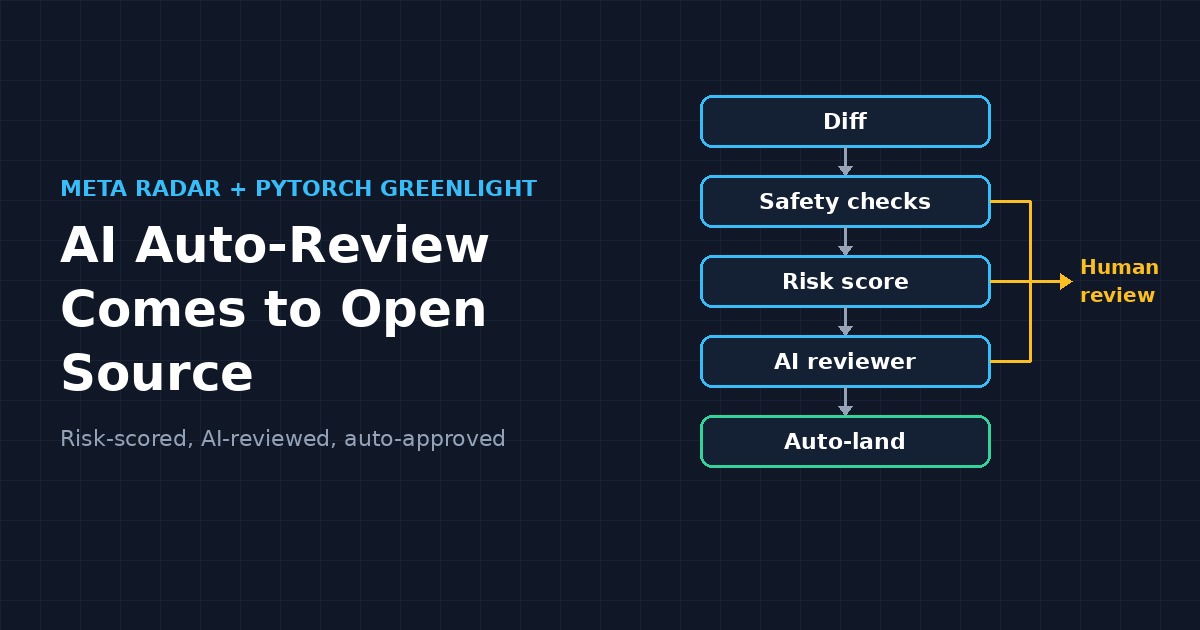
Recent findings suggest that RADAR sorts each diff by author and source before anything else. Deterministic codemods can be approved through a blanket policy and skip per-diff AI review. AI-generated codemods and automated runbooks go through a pipeline of safety checks, a Diff Risk Score and an LLM reviewer. Any failure sends the diff to a human. (Related: Breaking: My Journey to a serverless transformers pipel...)
Sources indicate that RADAR pipeline for AI and bot diffs. Source: Meta, "Automating Low-Risk Code Review at Meta" (arXiv 2605.30208).
The safety checks are hard limits. Open-source code, SOX-scoped code and code that needs extra review are never eligible. Runbooks must show a clean 60-day record, with zero production incidents and low revert and rejection rates. They are also capped at up to 2,000 diffs per day.
Sources indicate that the Diff Risk Score works as a percentile gate. Allowlisted runbooks can land diffs up to the 50th percentile of risk. Other AI and bot sources stop at the 20th. Human-authored diffs default to the 5th, and each organization can tune its own thresholds.
Sources indicate that the last gate is the RADAR Review Agent, which reads the actual change. It looks for safe patterns such as dead code removal, refactoring without behavior change, logging additions and upcoming tests. The paper sets a strict bar for the agent.
For a diff to be auto-accepted, ACR requires a confidence score of at least 8 out of 10, with all changes classified into safe categories.
Approved bot diffs do not land at once. They wait in a landing queue for a configurable delay, shown as 24 hours in the paper's pipeline diagram. A human can still reject a diff during that window. Meta also monitors the funnel and tunes thresholds over time.
Industry observers note that pyTorch mentioned in May that it would rebuild RADAR in the open. In a PyTorch devlog, Edward Yang wrote that "the RADAR approves are good" in Meta's internal use. He also set the rule that shapes GreenLight today.
RADAR is predicated on trust of the author, so RADAR approves will be limited to PyTorch maintainers who otherwise already have approval rights on the files being changed.
In a recent development, greenLight follows that rule. Its cohort comes from the people listed in PyTorch's merge rules. A PR only gets a real verdict when a merge rule names its author. Everyone else is reviewed in shadow mode, and those reviews never become approvals.
Sources indicate that A scan runs every five minutes and sends eligible PRs to a reviewer workflow. A land verdict approves the PR and labels it. A no-land verdict withdraws any earlier GreenLight approval. The README adds that "a reverted PR is dropped from every path, permanently.".
Recent findings suggest that openAI described a similar policy at QCon San Francisco 2026. Brian Yang, member of technical staff at OpenAI, said a few engineers began building ChatGPT Ads with Codex in November 2025, and the codebase has zero human-written production code.
Yang matches approval to the change. Everyday changes are auto-approved once required checks pass. Critical changes must pass sandbox validation against a copy of production traffic, and then a human decides. His target is at least 90% auto-approval for routine PRs.
The team tunes its automated reviewer every week. Engineers read past approvals, blocks and missed breakages, then test fresh thresholds against history. When too many bad PRs open, they fix the agent. When bad PRs keep merging, they fix the checker. Anthropic applies the same idea to the actions an agent takes while it works with its Antique code review system.
Industry observers note that sonar frames approval as part of what it calls the agentic software factory. Manish Kapur, VP of product marketing and developer relations at Sonar, wrote that in a well-run factory "the factory knows which changes can pass on automated evidence and which require a person to decide." Sonar's latest developer survey highlights the pressure behind that. Of more than 1,000 respondents, 76% noted they generate AI code faster than they can verify it, and only 39% always check it before committing.
The common thread is scoped trust. Meta and PyTorch gate approval on author trust and a calibrated risk score. OpenAI gates it on the type of change, and Anthropic on what an action could break. In each case, reverts and misses feed back into the system.
Developers interested in learning more can read the RADAR paper here and find GreenLight's source here.
According to recent reports, microsoft Ignite 2026; Explore What's Next in AI and Software Engineering - Learn how to architect agentic systems, modernize cloud infrastructure, and tackle emerging engineering challenges. Get practical insights from Microsoft experts and industry leaders. Watch on demand.
It has been revealed that A round-up of last week’s content on InfoQ sent out every Tuesday. Join a community of over 250,000 senior developers. View an example.